
Class 12 physics
Physics project for class 12: ideas and kits, chapter by chapter
Short answer
A good physics project for class 12 comes from this year's NCERT chapters and gives you something to measure: a Wheatstone bridge's balance, a transformer's turns ratio or a diode rectifier's output. Gurukul Technicals Institute has ready-made projects and DIY kits for most chapters, many with a printed report, to buy on Amazon or Flipkart or order on WhatsApp.
- Chapters in the NCERT book
- 14, in Part I and Part II
- Project in the practical
- 3 of 30 marks; the viva covers it too
- Printed report
- Included with many listed projects
- How to buy
- Amazon, Flipkart or WhatsApp
What is a physics project for class 12 used for?
One project often does two jobs: the investigatory project in your board practical, and the model at a school exhibition. Each asks for something different.
In the CBSE practical for Physics (042), the investigatory project carries 3 of the 30 marks, its report goes into your practical record, and the 5-mark viva can ask about it. The free ebook Writing a Science Project File helps with that report. The class 12 physics investigatory project guide covers the marking and viva, and class 12 investigatory project physics the method; this page covers choosing and getting the project.
| Question | Board practical | School exhibition |
|---|---|---|
| What it is | Your investigatory project and its report | A working model that shows one principle |
| What matters most | Your own readings, a result that follows from them, clear viva answers | An effect people can see, explained in your own words |
| Ready-made allowed? | Ask your teacher; CBSE's guidance to examiners favours effort and originality | Depends on the school; ask the organising teacher |
Class 12 and CBSE's own exhibition
The CBSE Science Exhibition takes two categories only: classes 6 to 8 and classes 9 to 11. Class 12 is not eligible, so your exhibition is usually your school's own; the other routes open to class 12 are on project for science exhibition. Choosing a topic of your own is on best project for science exhibition.
Which physics project fits each class 12 chapter?
The current NCERT book has 14 chapters: Part I runs from electric charges to electromagnetic waves, and Part II from ray optics to semiconductor electronics.

| Chapter | Project ideas | What it shows or measures |
|---|---|---|
| 1 Electric Charges and Fields | A jar electroscope with foil leaves; two charged pith or Styrofoam balls hanging from threads | Like charges repel; charging by induction; each ball's charge from the angle between the threads |
| 2 Electrostatic Potential and Capacitance | Capacitors in series and parallel; a capacitor charging and discharging through a resistor (its time constant goes beyond the NCERT text) | Capacitors combine the opposite way to resistors; a bigger capacitor or resistor slows the change |
| 3 Current Electricity | Ohm's law; Kirchhoff's rules on a two-loop board; a Wheatstone bridge or metre bridge; the internal resistance of a cell | A straight V against I line for a resistor at steady temperature; a bridge balances when P/Q = R/S |
| 4 Moving Charges and Magnetism | Oersted's compass deflection; a home-made tangent galvanometer; the force on a current-carrying strip | A current makes a magnetic field; a larger current turns the needle further |
| 5 Magnetism and Matter | Field lines of a bar magnet plotted with a compass; how the field weakens with distance; an iron core in a coil | The shape of a field; why an iron core makes an electromagnet stronger |
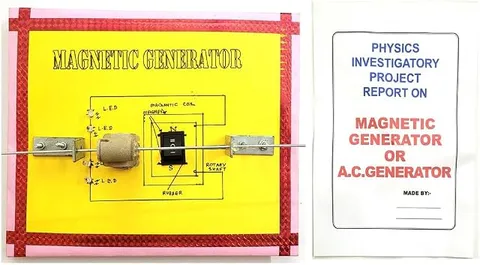
| 6 Electromagnetic Induction | A magnet moved through a coil with a meter; induced emf against magnet speed; a magnet falling through a copper pipe (eddy currents, beyond the syllabus; explain it with Lenz's law); an AC generator | A faster change of flux gives a larger emf (Faraday's law); the induced current opposes the change (Lenz's law) |
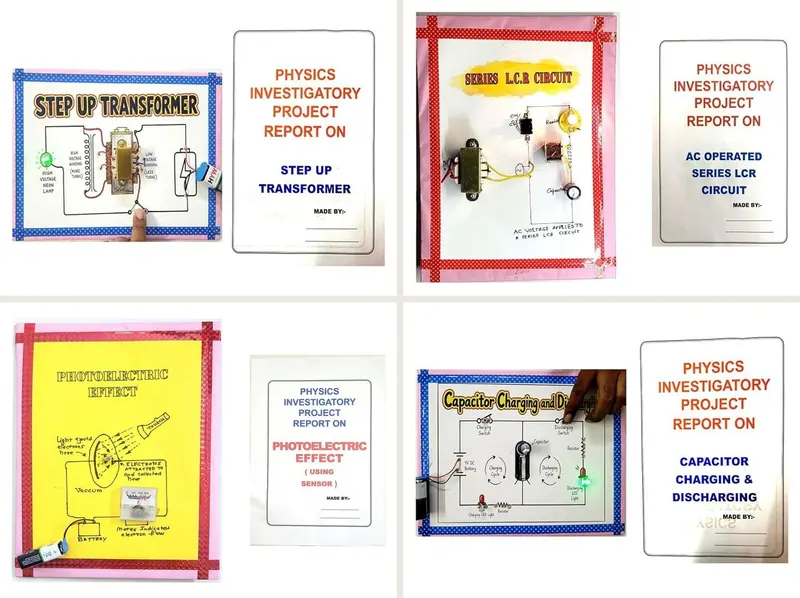
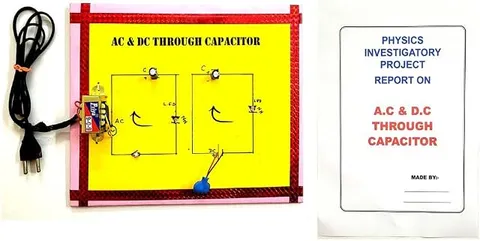
| 7 Alternating Current | A series LCR circuit; AC and DC through a capacitor; a transformer you wind yourself | A capacitor passes AC but blocks steady DC; current peaks at resonance; voltage follows the turns ratio |
| 8 Electromagnetic Waves | A TV remote's infrared LED seen through a phone camera; an infrared beam alarm | Infrared lies beyond red light in the spectrum and is invisible to the eye |
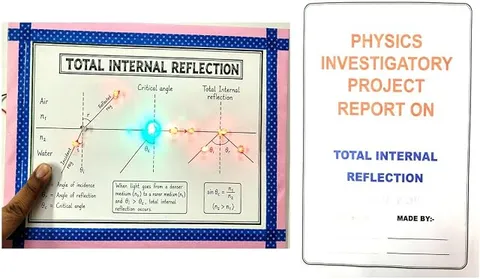
| 9 Ray Optics and Optical Instruments | The critical angle of water with a floating disc; a prism's deviation curve; a two-lens telescope | Total internal reflection beyond the critical angle (sin C = 1/n); minimum deviation; magnifying power |
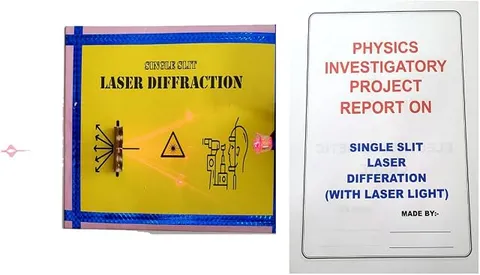
| 10 Wave Optics | A laser through a single narrow slit; fringes from two close slits | Light spreads into bands, so it behaves as a wave; a narrower slit gives a wider central band |
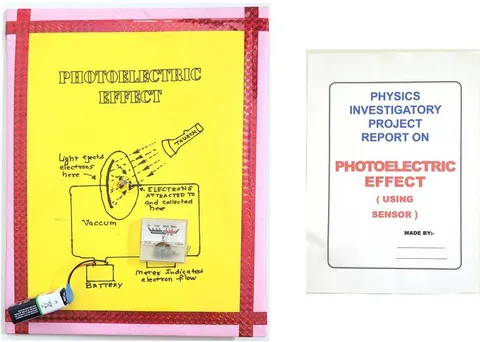
| 11 Dual Nature of Radiation and Matter | A photoelectric effect model with a light sensor and a meter | Brighter light gives more current. It cannot show the threshold frequency, so explain it: whether electrons escape depends on frequency, not brightness |
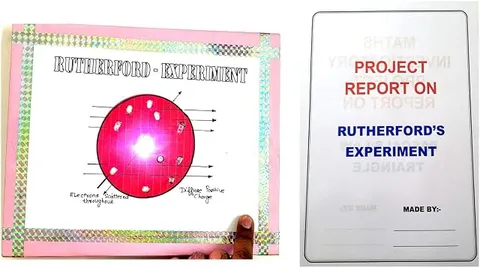
| 12 Atoms | A Rutherford scattering model; a tube light's colours split by a CD | Most alpha particles pass straight through, so the nucleus is tiny; a gas glows only in certain colours |
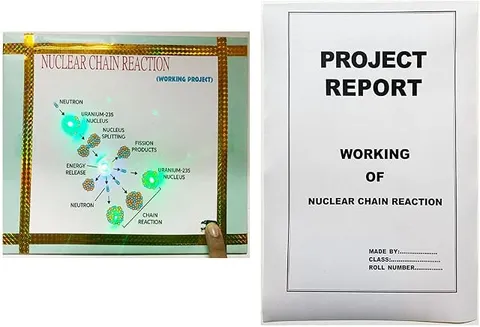
| 13 Nuclei | A model of a fission chain reaction | A neutron splits a heavy nucleus, releasing energy and more neutrons that can split others |
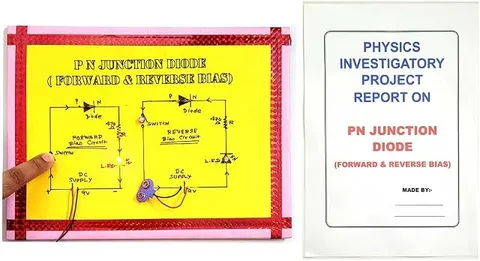
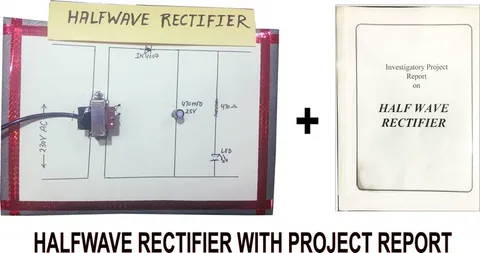
| 14 Semiconductor Electronics | A p-n junction diode in forward and reverse bias; the diode's characteristic with cells; half-wave, full-wave and bridge rectifiers | A diode conducts one way only; a rectifier turns AC into one-way current; a capacitor smooths the output |
The eight projects the CBSE syllabus suggests
The CBSE physics syllabus lists eight suggested investigatory projects. In short:
| Suggested project | Chapter | Where to start |
|---|---|---|
| What the internal resistance or emf of a cell depends on | 3 Current Electricity | The internal resistance idea above, or the lab |
| Current through an LDR as the power or the distance of a lamp lighting it changes | The LDR activity in the practical | The LDR boards on this page |
| Refractive index of water and a clear oil, using a convex lens and a plane mirror | 9 Ray Optics | The school lab |
| Voltage ratio against turns ratio in a transformer you design | 7 Alternating Current | Wind your own; the transformer boards show the principle |
| Angle of deviation against angle of incidence, with a hollow prism filled with different liquids | 9 Ray Optics | The school lab |
| Charge on two identical pith or Styrofoam balls hung side by side, from Coulomb's law | 1 Electric Charges and Fields | The school lab |
| What a coil's self-inductance depends on, using a bulb in series on an AC source of adjustable frequency | 6 and 7, induction and AC | The self inductance board (it varies the core, not the frequency) |
| The earth's magnetic field with a compass needle, a bar magnet and a tangent galvanometer | 4 and 5, magnetism | The school lab |
You need not pick one of the eight (and the NCERT book no longer has its section on the earth's magnetism, though suggestion 8 remains), but they show the kind of project the syllabus has in mind: most change one quantity and measure another. The class 11 and 12 physics list in the project idea finder has many more, with materials, method and viva questions.
A topic worth choosing
- It is from this year's book, or your teacher agreed to one outside it
- You can say in two sentences which principle it shows
- One thing you can change, one thing you can measure
- It runs on a battery, or an adult will handle the mains plug
- You can get it well before your practical date
Ready-made model, DIY kit or parts: which suits your practical?
All three can end in a good project. What differs is the time before it works and how much of it you built yourself.
| Point | Ready-made model | DIY kit | Parts from scratch |
|---|---|---|---|
| What arrives | An assembled board that works when switched on | Loose parts, often with the circuit drawn on card and a soldering iron | Only what you buy, part by part |
| Time before it works | Least: test it, then take readings | More: assembly, soldering, fixing joints | Most: design, shopping, building, fault-finding |
| Skills you need | Reading the circuit and using a meter | Neat soldering, with an adult for any mains part | Choosing component values, soldering and finding faults, with an adult for any mains part |
| What the examiner can ask you | The principle and each part's job | Also why each joint and part is there | Also why you chose each value |
| Printed report | With many listings; look for the Report badge | With several kits | None: you write it all |
| What you must add for the practical | One value changed and your own readings | Readings with and without one part, such as the filter capacitor | Your design, your readings and the reason for every value |

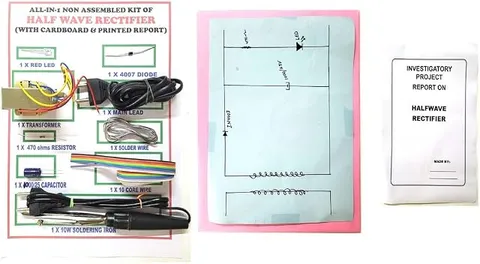
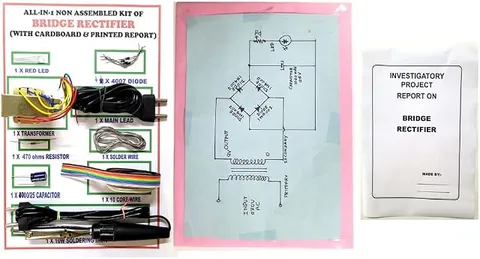
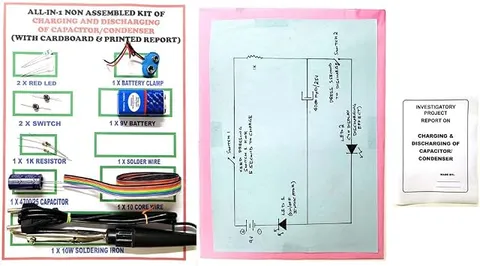
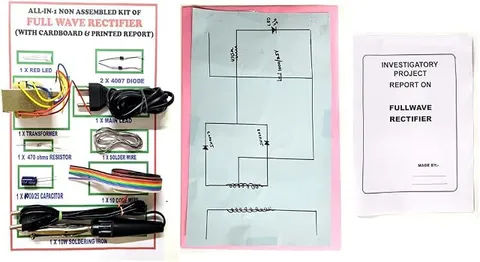
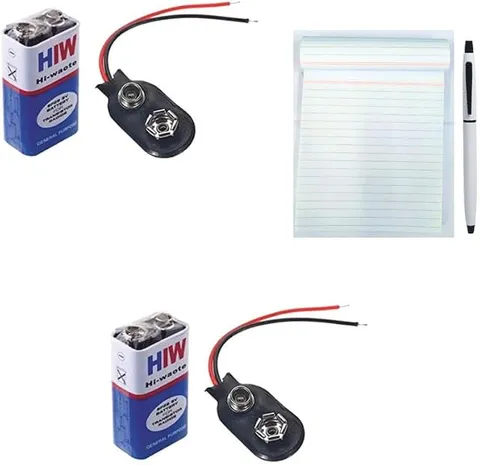
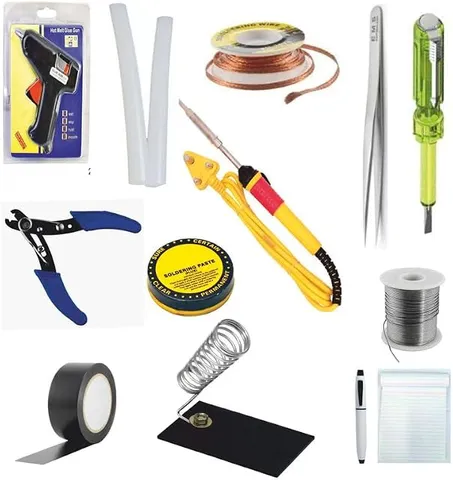
These kits come unassembled, most with a printed report. Those with a transformer have a mains lead: build them with an adult, and plug in only after every joint is checked. New to soldering? The free ebook Soldering for Beginners shows how to make a good joint.
DIY kits: you assemble the circuit
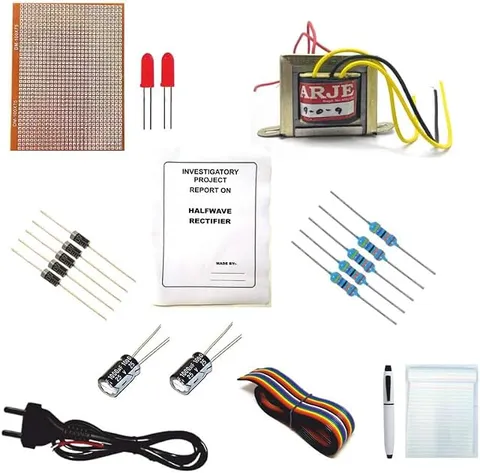
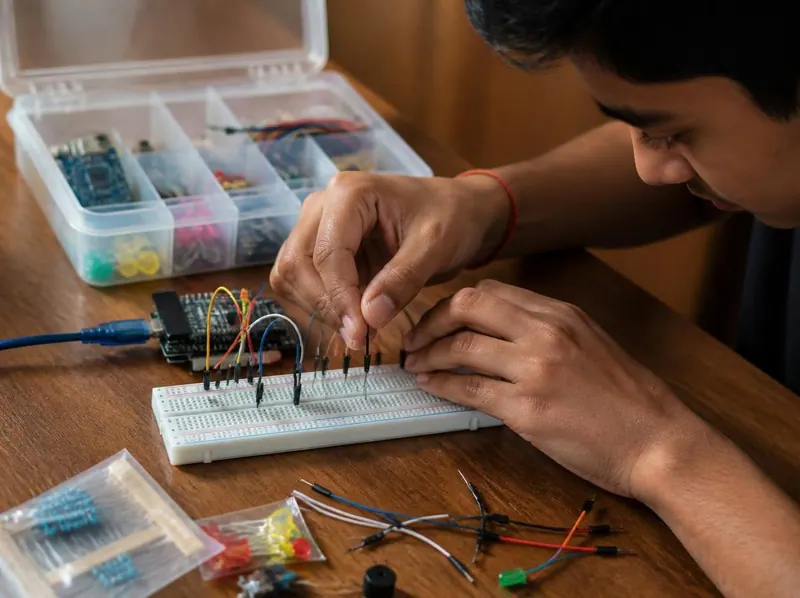
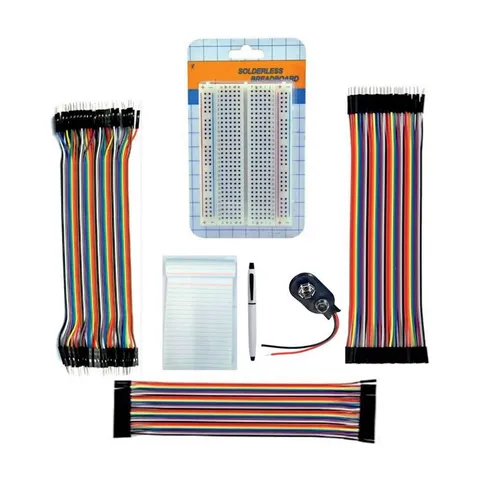
Building from parts starts on a breadboard, so you can test the circuit before soldering anything. Diodes, capacitors and a small step-down transformer for a rectifier come from an electronics shop; the Electronic Components Handbook explains how to read their markings.
A transformer from the shop
A breadboard is for the low-voltage side only. Never wire the transformer's mains side yourself: use the school lab's low-voltage AC supply or a sealed low-voltage AC adapter, or have an adult wire the mains side, sleeve every mains joint and fit the plug. Test the diodes and capacitor from the low-voltage output, never from the socket.
Parts and tools for building it yourself
Which ready-made projects match chapters 1 to 7?
Part I gives the widest choice. In each group, projects with a printed report come first.
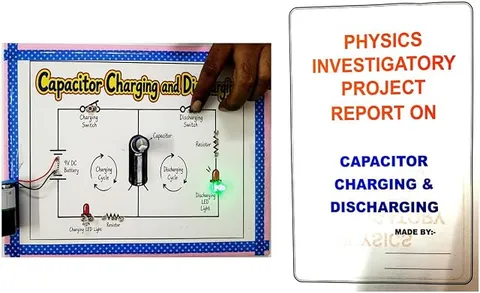
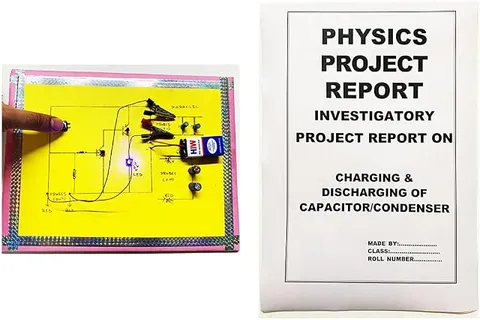
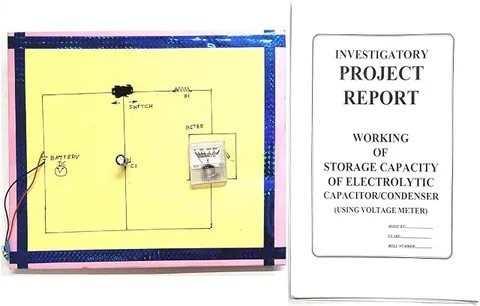
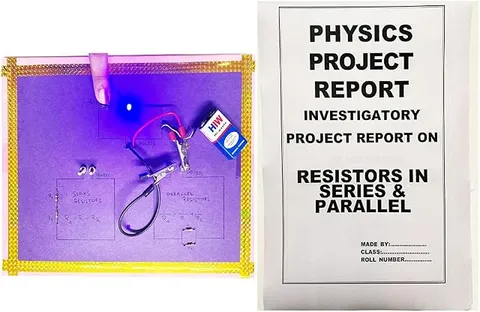
Charges and capacitors. These boards are demonstrations: the charging board empties through an LED in a moment, and on the storage board the meter's needle jumps and falls back. To time the change, discharge a large capacitor through your own resistor (10 kΩ or more) with a multimeter across it, read it at regular times, then repeat with a second resistor. Its time constant goes beyond the NCERT text, so present it as an extension. The electroscope suits chapter 1.
Chapters 1 and 2: charges and capacitors

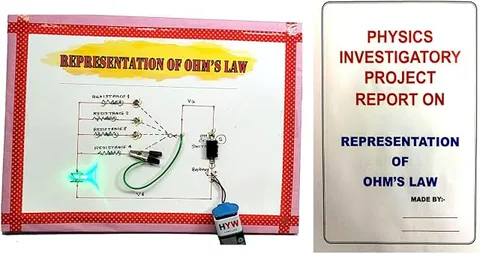
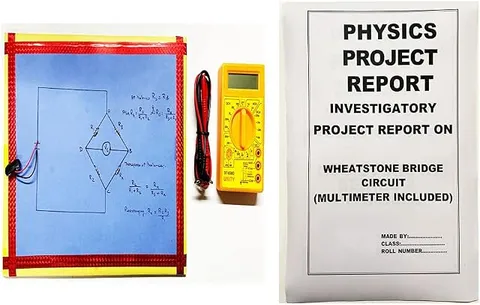
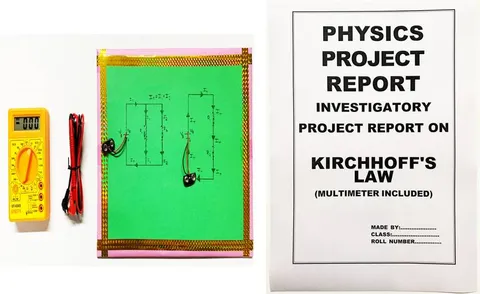
Current electricity. Chapter 3 links straight to the practical list. Most of these boards show the effect with an LED or a bulb; for readings, add your own multimeter (the Wheatstone bridge listing includes one) and change one resistance at a time.
Chapter 3: current electricity
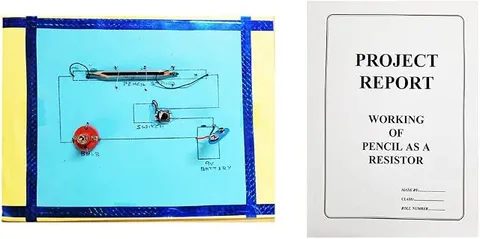
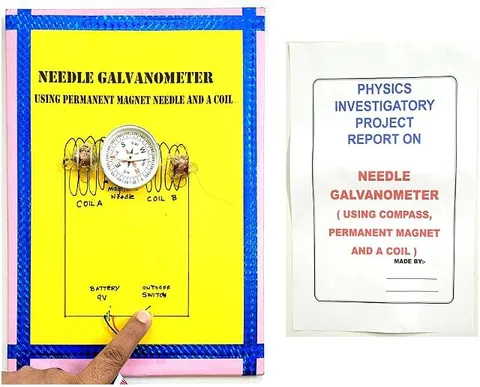
Magnetism. These rest on Oersted's observation that a current turns a compass needle. Line the board up first, so the current's field acts across the earth's north-south field rather than along it; then a larger current gives a larger deflection, and reversing the current reverses it. The current detector also shows a coil behaving like a short bar magnet, which links chapter 4 to chapter 5.
Chapters 4 and 5: magnetic effect of current and magnets
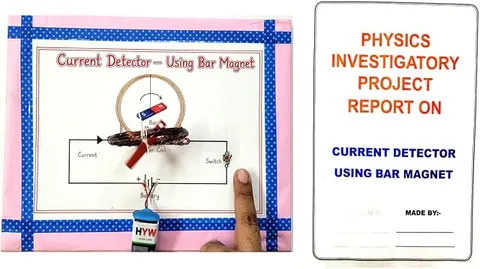
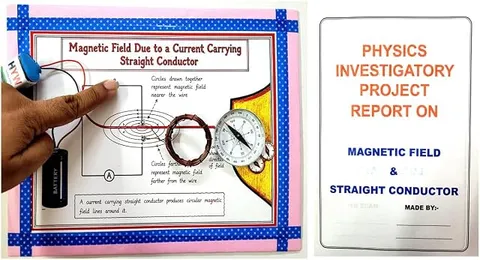
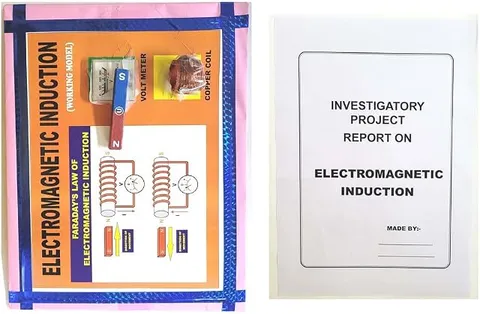
Electromagnetic induction. An induced emf appears only while something changes: the magnet moves, a switch opens, or the current alternates. On a centre-zero galvanometer the needle kicks one way as the magnet enters and the other way as it leaves: Lenz's law you can watch. The electromagnetic induction board's meter reads from zero at one end, so it shows how big the emf is, not that it reverses. The mutual induction board plugs into the mains.
Chapter 6: electromagnetic induction
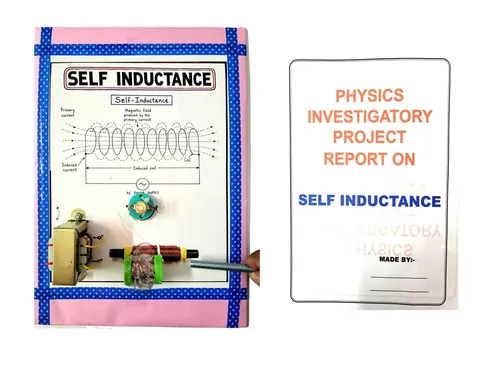
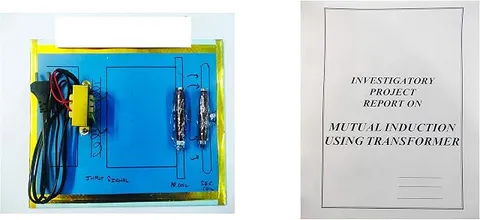
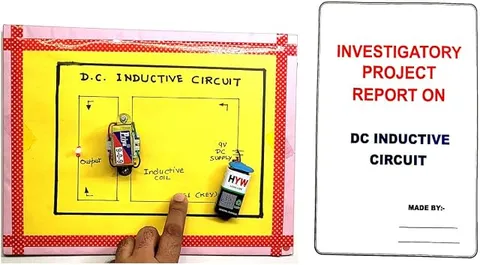
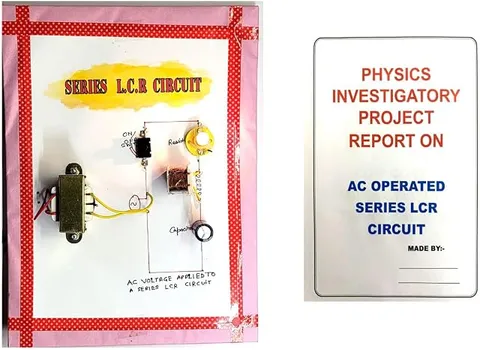
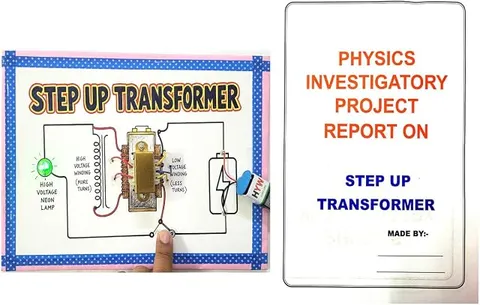
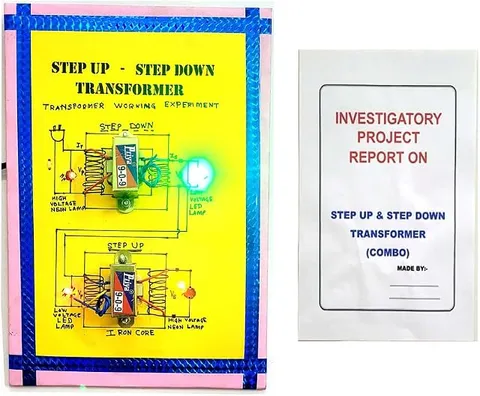
Alternating current. The AC and DC board shows that a capacitor lets AC through but blocks steady DC; the LCR board runs AC through a lamp, a coil and a capacitor in series. A step-up transformer on a 9 V battery works only because its key switches the current on and off: a transformer needs a changing current. Its neon lamp shows a high voltage, so never touch the output. The LCR, AC and DC, and step-up and step-down boards plug into the mains: read the mains safety section first.
Chapter 7: alternating current and transformers
Which ready-made projects match chapters 8 to 14?
Apart from optics and the diode, Part II offers less to measure, so several of these are explanatory models. Where one gives no reading, add your own from the same chapter: the meter's deflection against torch distance on the photoelectric model, the critical angle of water, or a tube light's colours through a CD.
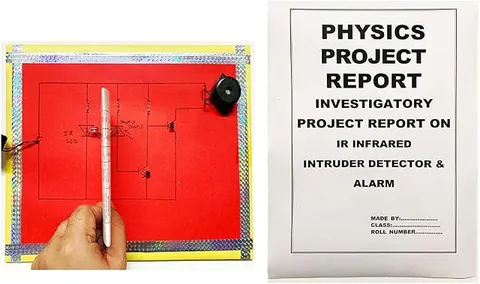
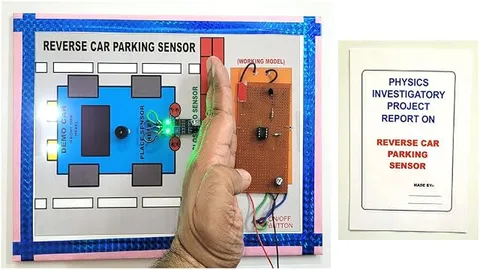
Electromagnetic waves. Chapter 8 is mostly theory, but infrared is easy to show: point a TV remote at a phone camera and press a button, and many cameras show the invisible LED flashing. The projects below use infrared beams with sensor circuits from outside the syllabus; the infrared is your chapter link.
Projects that use infrared, a link to chapter 8
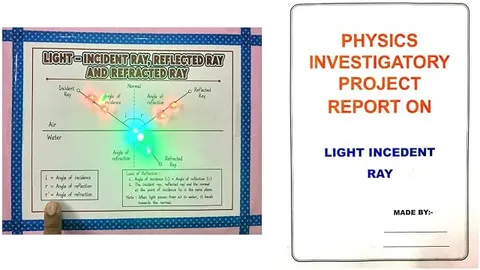
Optics. These are lit charts and a laser board that explain refraction, total internal reflection and single-slit diffraction.
Chapters 9 and 10: ray optics and wave optics
Laser projects
Never look into a laser beam or point it at anyone's face. Let it land on a matt screen or a white wall, never on a mirror or shiny metal that could send it back into someone's eyes.
Photons, atoms and nuclei. The photoelectric model shows that more light means more current. Its light sensor stands in for the vacuum photocell drawn on the chart, and a torch cannot change the light's frequency, so the model cannot show the threshold frequency: say so in your file and explain it from the textbook. The Rutherford board traces alpha particles past a tiny nucleus; the chain reaction model lights up as the neutrons multiply.
Chapters 11 to 13: photons, atoms and nuclei
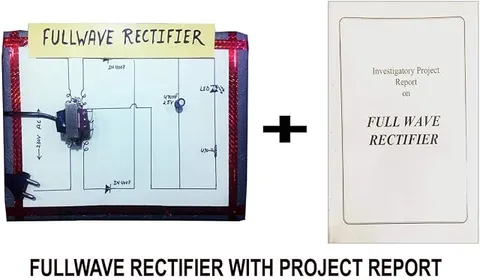
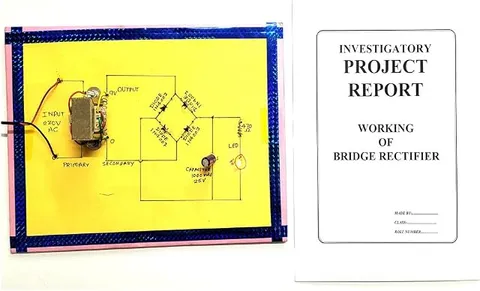
Semiconductors. Chapter 14 now ends at the diode as a rectifier. A half-wave rectifier passes one half of each cycle; full-wave and bridge rectifiers use both halves, so the ripple comes twice as often; a filter capacitor smooths it. The practical list also asks for a diode's characteristic in forward and reverse bias. The rectifier boards plug into the mains (the diode board runs on 9 V batteries); to build one yourself, see the DIY kits above.
Chapter 14: the p-n junction diode and rectifiers
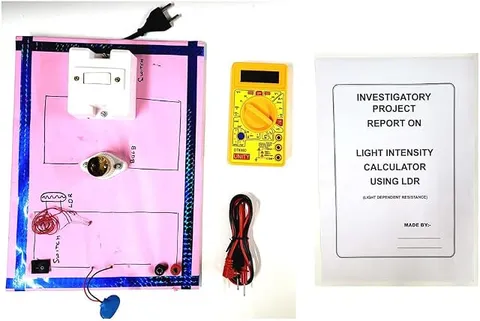
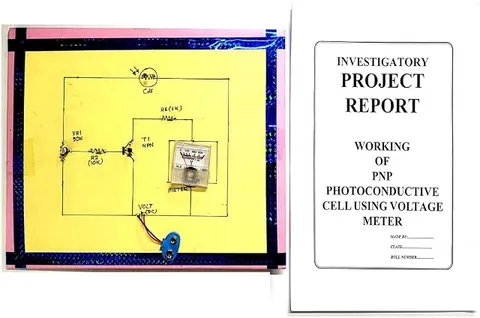
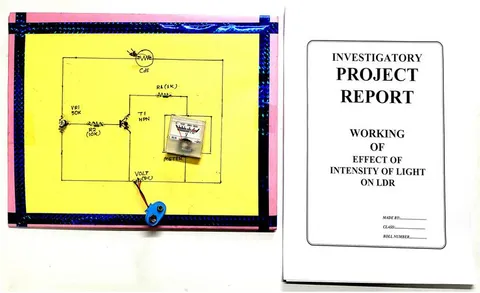
The LDR. A light dependent resistor's resistance falls as more light reaches it. It is a practical activity and suggested project 2. The light meter board reads the LDR's own current on its multimeter, so you can plot current against the lamp's distance; its bulb runs on mains, so an adult plugs it in. The other two boards amplify the LDR's effect with a transistor, which is outside the current syllabus, so their meter shows the transistor's current: say so in your file.
The LDR: suggested project 2 (two boards add a transistor)
Which popular physics projects are outside the current syllabus?
Older project lists, and some listings, still name topics the NCERT book no longer teaches. They make fine exhibition pieces; for the board practical, ask your teacher first.
| Topic | Where it stands now | What you can still do |
|---|---|---|
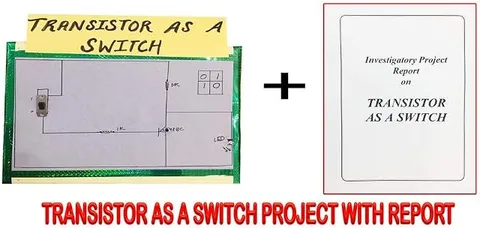
| Transistor as a switch or an amplifier | Not in the current NCERT book or CBSE syllabus | Exhibition model; practical project only if your teacher agrees |
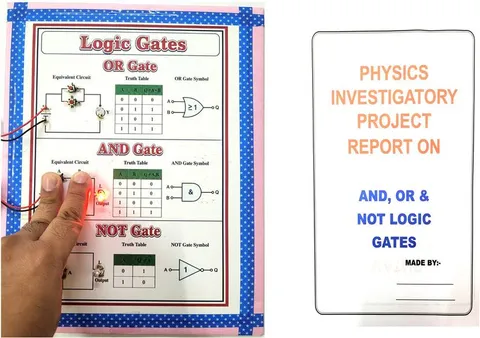
| Logic gates and digital electronics | Dropped from chapter 14 in the rationalised book | Exhibition model; practical project only if your teacher agrees; a good link to computer science |
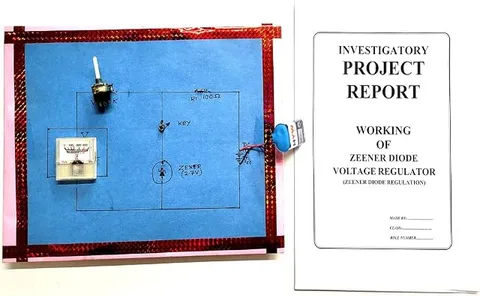
| Zener diode, photodiode, solar cell, LED as topics | Special-purpose diodes were dropped from chapter 14 | Two practical activities still use LEDs: identifying one, and one-way flow on a multimeter |
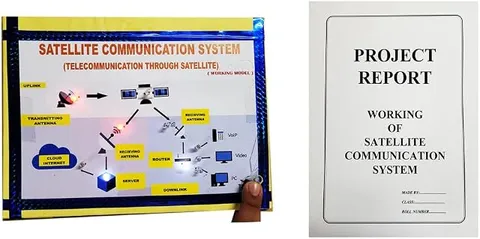
| Communication systems | No longer a chapter | Exhibition model; practical project only if your teacher agrees |
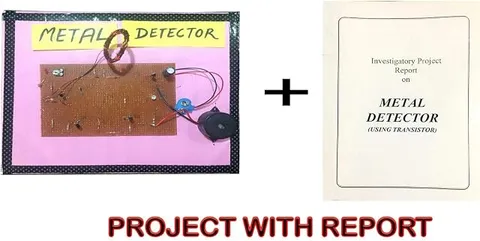
| Eddy currents: magnetic brakes, metal detectors | The section left chapter 6 | Explain them through Lenz's law, which stays |
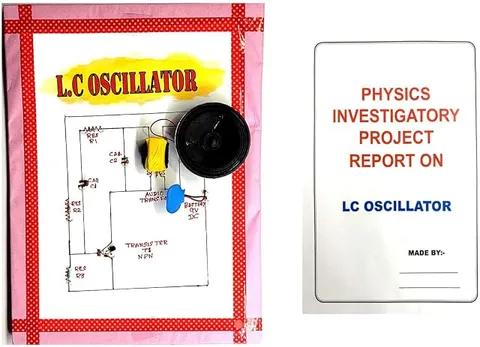
| LC oscillations | Removed from chapter 7 | Series LCR resonance stays in the syllabus |
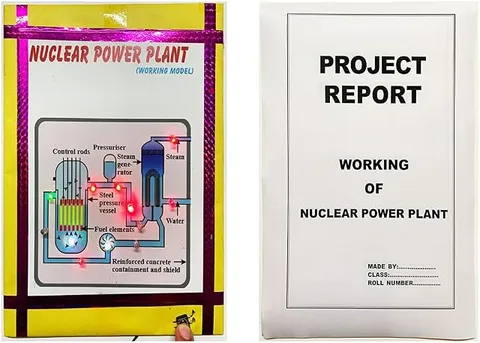
| Nuclear reactor | Removed from chapter 13 | Nuclear fission stays in the syllabus; a chain reaction model builds on it |
| Potentiometer, and the colour code for resistors | Both left chapter 3; the potentiometer is not a listed experiment | The metre bridge is still an experiment, and the activity on potential drop along a wire stays |
If you choose one, say plainly in your file that the topic goes beyond the current syllabus, and be ready for the questions it invites: cut-off and saturation for a transistor switch, or the truth table of a gate.
Beyond the current syllabus: ask your teacher; fine for an exhibition
How do you use a mains-powered project safely?
Several boards on this page plug into the wall: the rectifier boards and kits, the LCR, AC and DC, mutual induction, and step-up and step-down boards, and the LDR light meter, whose bulb runs on mains. A two-pin plug on the lead tells you which ones.
Mains models: an adult plugs in
A two-pin plug on the board means 230 V reaches it. Let an adult check the lead, push the plug in and switch on at the socket.
Unplug before you touch a part or move the board; its own switch is not enough.
Keep it on a dry wooden table, and never leave it plugged in unwatched.
Before every demonstration
- The mains lead has no cuts, tape repairs or bare copper
- The plug fits the socket firmly, with no adapter stacked on another
- The transformer's mains terminals and plug joints are covered; where they are open, as on the LCR and mutual induction boards, nobody touches them while the plug is in
- Your hands and the table are dry
- On battery models, the battery sits in its snap the right way round
Other things that can hurt
Neon lamps: a step-up transformer that lights a neon lamp makes a high voltage, even from a 9 V battery. Do not touch its output.
Capacitors: fit an electrolytic capacitor the right way round; the stripe marks its negative lead. Reversed, it can heat up and burst.
Soldering: rest the iron in its stand, work near an open window, and wash your hands afterwards.
9 V batteries: never carry one loose with coins or keys; its terminals sit close together and can short and get hot.
What should you check the day your project arrives?
Test the project the day it reaches you, not the night before your practical. A fault found on day one is a small problem; in exam week it is a big one.

Arrival test
- Lay every part out and compare it with the listing's photo and title
- Look for a cracked board, a loose wire or a lifted component
- Battery model: fit a fresh 9 V battery the right way round and switch on
- Mains model: an adult checks the lead, plugs it in and switches on
- Watch for the effect the listing describes: an LED lights, a needle moves, a lamp glows
- Run it several times; if anything gets hot or smells, switch off at once
- If a printed report is listed, check it is there and on the same topic
- Record a short video of it working
If something is missing or does not work, take photos the same day and raise it where you ordered: the marketplace order, or WhatsApp if you ordered there. Then start your readings that week.
When should you order, and what if your topic is not listed?
Work back from your practical date. CBSE class 12 practicals are generally held in January and February, before the theory papers, and in November and December in schools that close for winter. Your school's own date is the one that counts.

Agree the topic and the date
Ask your physics teacher to agree the topic, say whether a ready-made model is acceptable, and give you the practical date.
Look for the Report badge
If you need a printed report, choose a card with the Report badge.
Read the delivery date before you pay
The marketplace shows the delivery date for your PIN code before you pay; choose a date that leaves time for a replacement.
Ask on WhatsApp if the topic is not listed
Send the topic, your class, the date and any circuit values; the reply says whether it can be made in time.
Keep the order details
Save the order number and the listing page, so a fault found in the arrival check can be raised the same day.
Showing it at school too?
If the same project will go to a school exhibition, best model for science exhibition covers what makes a model work well on the table; practise a one-minute explanation for visitors too.
Questions about class 12 physics projects
Short answers to what students, parents and teachers ask about projects most often. Tap a question to open its answer.
Which is the easiest physics project for class 12?
One you can get working quickly and explain without help. Ohm's law, the metre bridge (a listed practical experiment), capacitors in series and parallel, and the diode in forward and reverse bias all come from the current syllabus or its practical list. A half-wave rectifier is in the syllabus too, but it plugs into the mains, so an adult handles the plug.
Are transistors and logic gates still in the class 12 physics syllabus?
No. Neither is in the current NCERT book or the CBSE syllabus, which ends Unit IX at the diode as a rectifier; logic gates were dropped when the book was rationalised. Such a project suits an exhibition, and your teacher may accept one for the practical; expect to be asked why you chose a topic outside the syllabus.
Is it all right to buy a ready-made physics project for class 12?
Schools differ, so ask your teacher first. CBSE's guidance to practical examiners says projects showing real effort and originality deserve high marks and routine or stereotyped ones only mediocre marks. So add your own work: fresh readings, one value changed and recorded, and a file in your own words.
How do I know if a physics project comes with a printed report?
Look for the Report badge on the product card, and "Printed report included" on the product page; those projects come first in each group on this page. Some photos show a report cover although the listing does not promise one, so trust the badge and the page, not the picture.
Is the potentiometer still part of the class 12 physics practical?
Not as a listed experiment. The potentiometer has left the NCERT book, and the CBSE practical list keeps only a related activity: how the potential drop varies along a wire carrying a steady current. The metre bridge is still a listed experiment.
My rectifier project gives no DC output: what should I check?
Unplug it first. With the power off, check that each diode's stripe faces the way the circuit shows, that the capacitor's striped (negative) lead goes to the negative side and that the LED is the right way round, then test each joint for continuity. Then an adult plugs it in while you read AC volts across the transformer's low-voltage output only, never the mains side.
How do I get a physics project that is not in the store?
Send the head office in Delhi a WhatsApp message with the topic, your class, the date you need it by and any circuit values your teacher gave you. The reply tells you whether it can be made and by when. Ask early: a project made to order is sent by courier from Delhi.
Do I need a multimeter for a class 12 physics project?
For almost any investigation, yes. It reads voltage, current and resistance, and its continuity range finds broken joints. A few listings on this page include one. Set the range before connecting it, and never use the resistance range on a live circuit. The free ebook Using a Digital Multimeter shows each range.
Which class 12 physics projects run on a 9 V battery?
On this page: the Ohm's law, Kirchhoff's law and pencil resistor boards, the capacitor charging and storage boards, the needle galvanometer, the p-n junction diode board, the photoelectric model and the Effect of Intensity of Light on LDR board. Fit the battery the right way round and keep a spare: a weak one makes readings drift.
Delhi head office
Not sure which project fits your chapter?
Send the head office in Delhi your chapter, the topic your teacher gave and your practical date on WhatsApp. Ask whether a listed project fits, or whether a topic that is not listed can be made in time.