
Guide
Robotics for kids: what age to start and what to learn at each age
A parent guide to starting robotics: what a child can do at KG to Class 2, Class 3 to 8 and Class 8 to 12, what no-code, block coding and Arduino mean, and how to choose a class or a kit.
Overview
Parents ask two questions: is my child too young for robotics, and what will they actually learn? The honest answer is that "robotics" means different things at different ages, from building a circuit that lights up to programming a robot that follows a line. This guide sets out what fits each age, based on what we teach at our institute in Delhi.
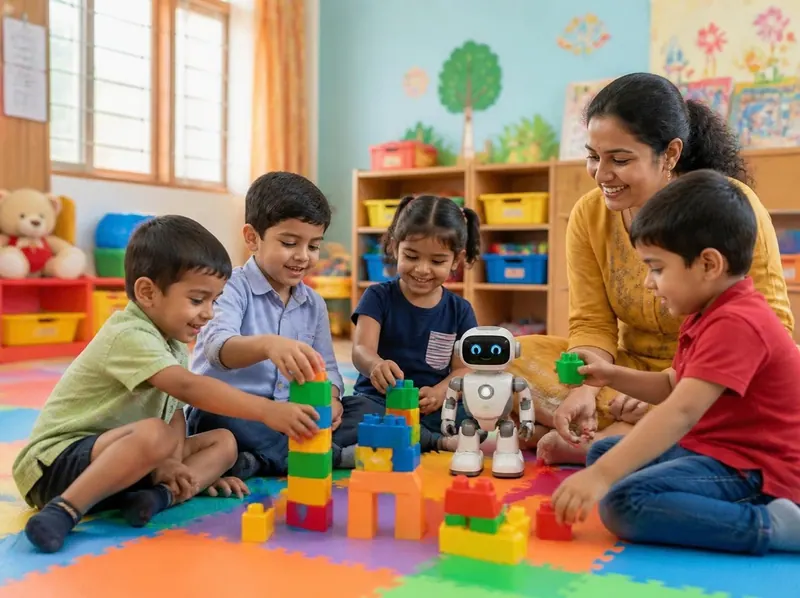
KG to Class 2: hands first, no screens needed
At this age the goal is curiosity and fine motor skills, not code. Children can:
- Connect a battery, a switch and a bulb, and see what happens when the circuit is broken
- Build a simple moving model with a motor, such as a fan or a spinner
- Sort and name parts: motor, wire, switch, battery, LED
- Follow a picture sequence to build something in the right order
Sessions should be short and end with a model the child takes home. No reading or writing is needed. At Gurukul Technicals Institute, batches for KG to Class 2 are formed on request and run as playful, trainer-led sessions.
Class 3 to 8: build real projects and start coding
This is the best age to start regular classes. Children can read a simple diagram, use a screwdriver and a soldering iron with supervision, and reason about cause and effect. In our Class 3 to 8 robotics classes students build a fire alarm, a remote-controlled car, an electromagnetic crane, an automatic room light and a hand-gesture robot, learn to read resistor colour codes, and finish with their first two Arduino projects.
What to expect:
- Basic electronics before coding: how a transistor switches, how a sensor changes a signal
- Block-style coding first, then real Arduino code in short programs
- One finished project per session, kept by the student
Class 8 to 12: Arduino, sensors and autonomous robots
Older students can handle text-based code and multi-part builds. Our Class 8 to 12 classes move through breadboard electronics (LEDs, transistors, the 555 timer, op-amps), motor drivers and speed control, then Arduino programming with sensors, and finally autonomous robots: a line follower, an obstacle detector and an edge avoider. A 30-day robotics and embedded systems module runs as a full course for students who want depth, including DTMF mobile control and an introduction to GSM.
This is also the age for competitions, Atal Tinkering Lab projects and science exhibition entries with an electronics component.
No-code, block coding, Arduino: what the words mean
- No-code:the robot or model is wired, not programmed. Right for KG to Class 4.
- Block coding:programs are built from drag-and-drop blocks (like Scratch). Right for Class 4 to 7.
- Arduino:a small programmable board with text code in C-style syntax. Right from about Class 7 or 8, earlier for a keen child with a trainer.
Does my child need prior coding?
No. Every level starts with hands-on electronics, and the code is introduced when the child can already see what the circuit does. Reading ability helps from Class 3 upward; maths beyond arithmetic is not needed until the Arduino stage.
Class or kit?
- A class gives structure, a trainer to fix mistakes, and other children to build with. Choose it if the child has never built anything and you want weekly progress.
- A kit suits a child who already tinkers, or a family that wants a holiday project. Start with a components pack or a DIY kit and move to an Arduino project when the basics are solid. Our robotics and coding category lists the projects we build to order.
Questions parents ask
- How long is a session? Long enough to finish one project; batches run in the evening on weekdays and weekends, with a summer workshop in the holidays.
- Are the kits included? Yes. All components are provided by the institute, and the model belongs to the student after the class.
- Can my child continue to competitions? Yes, students from the Class 8 to 12 batches take projects to school exhibitions and competitions with the trainer's guidance.
- Do you come to schools? Yes. See robotics classes for schools.
Next step
Message us on WhatsApp with your child's class and the days that suit you, or read about the robotics classes in Delhi first.
Keep reading
More guides
Have a question about this?
The head office answers on WhatsApp and by phone.
Head office
Gurukul Technicals Institute
A-10, Chief Commissioner Colony, opposite Rana Pratap Bagh, Delhi 110007
 GTI Projects & KitsScience projects, project kits and spare partsReady-made working models, project kits and DIY kits, sold on Amazon and Flipkart.Browse projects and kits