Head office, Rana Pratap Bagh, Delhi011 2721 1512+91 97116 99511

Computer & Office Skills

Typing in English, Hindi and regional languages

Touch typing for speed and accuracy, in English and in Hindi and other Indian languages.

Suits: Students, job seekers and office staff

Duration, fees and batch timings are quoted by the head office or your centre.
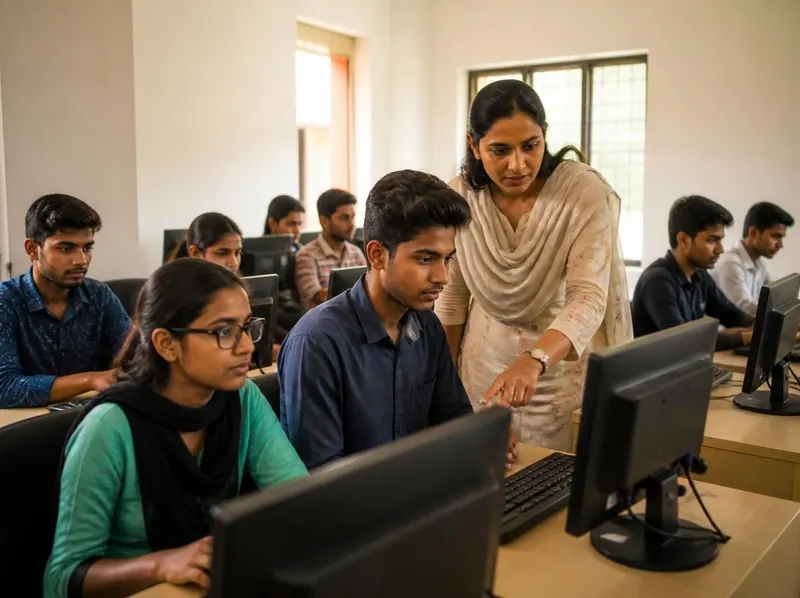
Students at computers in a classroom while a teacher helps one of them

2 study books in this course

  • Typing
  • Computer Fundamentals
Lessons
14
Practice questions
55
Free ebooks
4

About the course

What the typing course is about

Touch typing means typing without looking at the keys, with each finger responsible for its own keys. It is the skill behind data-entry and office work, and it makes every other computer task faster.

The course puts accuracy first and speed second, with a daily practice plan, and covers the basics of Hindi typing as well as English. Computer fundamentals are part of it too, so you understand the machine you are typing on.

What you will practise

Drawn from the lessons of the study books below.

  1. 01

    Sit and place your hands correctly, with your fingers resting on the home row

  2. 02

    Know which finger presses which key, without looking at the keyboard

  3. 03

    Measure your speed in words per minute and your accuracy

  4. 04

    Follow a daily practice plan that builds speed without losing accuracy

  5. 05

    Start typing in Hindi

  6. 06

    Understand the computer you type on, from its parts to saving your files

What you will learn

2 subjects, 14 lessons

Every lesson of the study books that come with this course in the student portal, with the key points of each lesson and exercises to try. Your centre gives you the syllabus, the duration and the fee.

Subject 1 of 2

Typing

Learn touch typing the right way: posture, the home row, which finger presses which key, accuracy before speed, measuring WPM, a daily practice plan and the basics of Hindi typing.

  • 7 lessons
  • About 22 min of reading
  • 20 practice questions
  • 25 key terms
  1. 1Touch Typing and Correct Posture3 min read · 4 key points · 3 exercises

    Key points

    • Touch typing uses all ten fingers without looking at the keyboard.
    • Sit upright with feet flat, elbows at about 90 degrees and wrists straight.
    • Keep the monitor about an arm's length away, top of screen at or below eye level.
    • Press keys lightly and take short breaks to protect your hands and eyes.

    Try this

    1. Check your seat against the seven posture points in this lesson and adjust your chair, monitor and keyboard; then ask a classmate or family member to watch your feet, elbows and wrists while you type for five minutes.
    2. Write down your present typing habits honestly, such as how many fingers you use, how often you look down and whether your neck or wrists ache, so that you can compare them after one month of practice.
    3. During a 30-minute practice session, set a timer to remind you of the 20-20-20 rule every 20 minutes, and finish with one minute of finger, wrist and shoulder stretches.
  2. 2The Home Row3 min read · 4 key points · 3 exercises

    Key points

    • The home row keys are A S D F for the left hand and J K L ; for the right.
    • The bumps on F and J help you find the home row without looking.
    • Every finger reaches, presses and returns to its home key.
    • Use one thumb consistently for the space bar.

    Try this

    1. Close your eyes, place your fingers on the home row by feeling the bumps on F and J, then open your eyes and check that every finger is on the right key; repeat this ten times.
    2. Type each home row drill line from this lesson three times in Notepad without looking at the keyboard, then type each home row word line three times as well and count your mistakes in the last round.
    3. Make up five words or short phrases of your own that use only the letters a, s, d, f, g, h, j, k and l, and type each one five times at a steady rhythm.
  3. 3The Finger-to-Key Map3 min read · 4 key points · 3 exercises

    Key points

    • Each finger covers a slanting column of keys above and below its home key.
    • The index fingers each cover two columns; the little fingers cover the edge keys.
    • Use the Shift key on the opposite side from the letter you are typing.
    • On the numeric keypad, rest on 4, 5 and 6; the 5 key has a bump.

    Try this

    1. Draw the three letter rows of the keyboard in your notebook and colour each key according to the finger that presses it, using one colour per finger, then check your drawing against the table in this lesson.
    2. Type the reach drill lines from this lesson three times each, saying the name of the finger in your mind as it leaves its home key and comes back.
    3. Type the names of ten Indian cities with a capital first letter, using the Shift key on the opposite side every time; then, if your keyboard has a numeric keypad, turn on Num Lock and type a list of ten invoice amounts on it.
  4. 4Accuracy Before Speed3 min read · 4 key points · 3 exercises

    Key points

    • Accuracy comes first; speed grows when correct movements become automatic.
    • Never look at the keys; use the bumps on F and J to find your place.
    • Type to a steady, even rhythm instead of in bursts.
    • Practise your weak keys and letter pairs with short targeted drills.

    Try this

    1. Type a short passage for five minutes at a slow, even pace; count your mistakes and the characters you typed (in Word, the Review tab, then Word Count, shows Characters (with spaces)), and work out your accuracy as correct characters divided by characters typed, times 100, to see whether it is 95 percent or higher.
    2. From your last practice passage, list the keys or letter pairs you got wrong most often, make a two-line drill of them, and type it slowly for ten minutes.
    3. Practise for one week with a light cloth or a cardboard cover over your hands, and note each day how many times you felt like looking down at the keys.
  5. 5Measuring Speed and Accuracy3 min read · 4 key points · 3 exercises

    Key points

    • A standard word is 5 characters, including spaces and punctuation.
    • Gross WPM is total characters divided by 5, divided by the minutes.
    • Net WPM subtracts a penalty for uncorrected errors; accuracy is correct characters as a percentage.
    • Different tests use different rules, so read the official instructions for yours.

    Try this

    1. Work out on paper the gross WPM for 1,500 characters typed in 5 minutes, the net WPM if there were 10 uncorrected errors, and the accuracy if 1,440 of those characters were correct.
    2. Take a 5-minute test on a passage you have not practised, find the number of characters typed from the Characters (with spaces) figure in Word's Word Count box (Review tab, then Word Count), compare your text with the original to count the uncorrected errors, and calculate your gross WPM, net WPM and accuracy.
    3. Start a progress log in a notebook or an Excel sheet with columns for date, passage, gross WPM, net WPM and accuracy, and fill in one row after every practice session for two weeks.
  6. 6Building a Practice Plan3 min read · 4 key points · 3 exercises

    Key points

    • Practise 20 to 30 minutes every day rather than in long, occasional sessions.
    • Each session should include a warm-up, weak keys, word drills, passages and one timed test.
    • Practise with real material that includes capitals, numbers and punctuation.
    • Plateaus are normal; slow down, focus on accuracy and drill weak letter pairs.

    Try this

    1. Follow the 30-minute daily session from this lesson for seven days in a row, ticking off each of its five parts in a notebook every day.
    2. Write your own four-week plan with a fixed daily practice time and one small goal for each week, and keep it beside your computer.
    3. For one week, type one piece of real material each day, such as a leave application, an address with a PIN code or the details of a short invoice, to practise capitals, numbers and punctuation.
  7. 7Hindi Typing Basics4 min read · 5 key points · 3 exercises

    Key points

    • Unicode Hindi works everywhere; legacy-font text needs that exact font installed.
    • Inscript is the standard layout, with vowels mostly on the left and consonants on the right.
    • Remington comes from Hindi typewriters; skill on one layout does not transfer to the other.
    • Windows key + Space switches between English and Hindi keyboards.
    • In Unicode, matras follow the consonant, and the halant joins consonants into conjuncts.

    Try this

    1. Add Hindi and its keyboard in Windows Settings, switch to it with Windows key + Space, and type the words कमल, घर, नमक and सरल in Notepad, finding each letter with an Inscript key chart or the Windows On-Screen Keyboard (Windows key + Ctrl + O), which shows the Hindi letter on every key.
    2. Type the words पानी, किताब, दूध, मेला and गुलाब, remembering that every matra, including the short i matra, is typed after its consonant.
    3. Type the conjuncts क्ष, त्र and ज्ञ using the halant, then copy your Hindi words into an email or chat message to check that the Unicode text appears correctly on another device.
Glossary: 25 key terms of Typing
Accuracy
The share of characters typed correctly, written as a percentage of all the characters typed.
Backspace
The key, pressed with the right little finger, that deletes the character to the left of the cursor.
CPM
Characters per minute, a speed measure in which 5 CPM equals 1 WPM because a standard word is 5 characters.
Devanagari
The script in which Hindi is written, also used for Marathi, Sanskrit and Nepali, with its own letters, matras and conjuncts.
Gross WPM
Typing speed counting every character typed, right or wrong, divided by 5 and then by the number of minutes.
Halant
The Devanagari sign that removes a consonant's built-in vowel so it can join the next consonant, as in क्ष, त्र and ज्ञ.
Home row
The middle row of letter keys, A S D F for the left hand and J K L semicolon for the right, where the fingers rest and return after every key.
Hunt and peck
A slow way of typing in which you look down to find each key and press it with one or two fingers.
Inscript
The standard keyboard layout for Indian scripts, included in Windows, with vowels and matras mostly on the left and consonants mostly on the right.
Key depressions per hour
A speed measure used in some data-entry tests that counts how many keys are pressed in an hour instead of words per minute.
Keyboard layout
The computer setting that decides which character each physical key produces, such as English or Hindi Inscript.
Legacy font
An older Hindi font, such as Kruti Dev, that draws Hindi shapes over the codes of English letters, so the text turns into meaningless characters without that exact font.
Matra
A vowel sign joined to a Devanagari consonant, such as the sign that turns क into का, which in Unicode is typed after the consonant.
Net WPM
Typing speed after a penalty for uncorrected errors has been subtracted from the gross speed.
Numeric keypad
The block of number keys on the right of a full keyboard, with home keys 4, 5 and 6, used for typing figures quickly when Num Lock is on.
Phonetic typing
A way of typing Hindi by writing words in English letters, such as namaste, which the software turns into Devanagari.
Plateau
A stretch of days or weeks during learning when typing speed seems to stop rising, which is a normal stage of practice.
Posture
The way you sit while typing, ideally upright with feet flat on the floor, elbows at about 90 degrees and wrists straight.
Remington
A Hindi keyboard layout that comes from mechanical Hindi typewriters and was long used with legacy fonts such as Kruti Dev.
Shift key
A key held down with the little finger of the opposite hand to type a capital letter or the upper symbol on a key.
Space bar
The long key at the bottom of the keyboard, pressed with the side of a thumb, that types a space.
Standard word
A group of 5 characters, including spaces and punctuation, counted as one word when typing speed is measured.
Touch typing
Typing with all ten fingers without looking at the keyboard, each finger looking after a fixed group of keys.
Unicode
The international standard that gives every character of every major script its own code, so Hindi typed in it shows correctly on any modern device.
WPM
Words per minute, the usual measure of typing speed, in which one word is counted as 5 characters.

Subject 2 of 2

Computer Fundamentals

Learn how a computer works, from its parts and devices to memory units, number systems, software, operating systems and file management.

  • 7 lessons
  • About 21 min of reading
  • 35 practice questions
  • 25 key terms
  1. 1Introduction to Computers3 min read · 4 key points · 3 exercises

    Key points

    • A computer accepts input, processes it, produces output and stores results.
    • Data is raw facts; information is processed data with meaning.
    • GIGO means wrong input gives wrong output.
    • Hardware is the physical machine; software is the set of programs that run on it.

    Try this

    1. List ten machines at home or in your neighbourhood that contain a computer, such as an ATM, a washing machine or a smartphone, and write beside each one its type: desktop, laptop, tablet or smartphone, server, supercomputer or embedded computer.
    2. Take one everyday job, such as preparing a mark sheet for five classmates, and write in your notebook exactly what happens at each of the four stages: input, processing, output and storage.
    3. Make a two-column table headed Hardware and Software and fill it with at least eight items you can see or use on the computer in front of you.
  2. 2Parts of a Computer3 min read · 4 key points · 3 exercises

    Key points

    • The CPU carries out instructions; its parts are the ALU, the Control Unit and registers.
    • The motherboard is the main circuit board that connects every part.
    • The SMPS converts AC mains power into low-voltage DC.
    • Peripherals connect through ports such as USB and HDMI.

    Try this

    1. Look at the back panel of a desktop cabinet or the sides of a laptop, draw a labelled sketch of every port you can find (USB, HDMI, VGA, Ethernet, audio jack), and write one device that plugs into each.
    2. On a Windows computer, open Settings, then System, then About, and note the processor name and the installed RAM; then open Task Manager with Ctrl + Shift + Esc (click More details if it shows only a short list of apps), go to the Performance tab, click CPU and note its base speed in GHz and the number of cores.
    3. Write which part of the computer does each of these jobs: does arithmetic and comparisons, directs the flow of data, holds the programs in use, converts AC mains to DC, creates the picture on the monitor, and carries heat away.
  3. 3Input and Output Devices3 min read · 4 key points · 3 exercises

    Key points

    • Input devices send data in; output devices show, print or play results.
    • OCR reads printed text, OMR reads marked bubbles, and MICR reads cheque characters.
    • Dot matrix printers are impact printers; inkjet and laser printers are not.
    • A touchscreen is both an input and an output device.

    Try this

    1. Go around your computer lab or home and make a table of every device you find, marking each one as input, output or both; for example, a multifunction printer is both.
    2. Use an OCR feature, such as Google Lens on an Android phone or Live Text on an iPhone, to copy the text from a printed page, paste it into a document, and correct any words it read wrongly.
    3. Open Settings, then System, then Display, note the screen resolution of your monitor, and compare it with Full HD (1920 x 1080 pixels).
  4. 4Memory and Storage Devices3 min read · 4 key points · 3 exercises

    Key points

    • RAM is volatile working memory; ROM is non-volatile and holds start-up firmware.
    • Cache sits between the CPU and RAM to speed up access.
    • HDDs store data magnetically; SSDs and pen drives use flash memory.
    • Always keep a backup of important files in more than one place.

    Try this

    1. Open File Explorer with Windows key + E, click This PC, and write down the letter, total size and free space of every drive; then work out roughly what percentage of drive C: is still free.
    2. Open Task Manager with Ctrl + Shift + Esc (click More details if it shows only a short list of apps), go to the Performance tab and click Memory to see how much RAM is installed and how much is in use; open three or four apps and watch the in-use figure rise, then close them and watch it fall.
    3. Plan a 3-2-1 backup for your own important files: write which three copies you would keep, on which two kinds of storage, and where you would keep the copy that stays away from home.
  5. 5Bits, Bytes and Number Systems3 min read · 5 key points · 3 exercises

    Key points

    • 8 bits make a byte and 4 bits make a nibble.
    • In the binary convention, each unit (KB, MB, GB, TB) is 1024 times the one before it.
    • Binary is base 2, octal base 8, decimal base 10 and hexadecimal base 16.
    • 1101 in binary is 13 in decimal; one hex digit equals 4 bits.
    • ASCII codes English characters; Unicode covers scripts such as Devanagari.

    Try this

    1. Convert the decimal numbers 9, 25, 47 and 100 into binary by repeated division by 2, then check each answer by converting it back to decimal using place values.
    2. Open the Windows Calculator, choose Programmer from its menu button (the three lines at the top-left), type a decimal number and read its HEX, OCT and BIN values; use it to check the conversions you did by hand.
    3. Write your first name in capital letters and work out the ASCII code of each letter, remembering that A is 65 and each following letter is one more (B is 66, C is 67 and so on).
  6. 6Software and Operating Systems3 min read · 5 key points · 3 exercises

    Key points

    • System software runs the computer; application software does tasks for the user.
    • A compiler translates the whole program first; an interpreter works one statement at a time.
    • Open-source software shares its source code; proprietary software does not.
    • The OS manages processes, memory, files, devices, security and the user interface.
    • POST is the hardware check the firmware runs at start-up.

    Try this

    1. Open the Start menu, look through the full list of installed apps, and sort ten of them into system software (including utilities) and application software in a two-column table.
    2. Open Settings, then System, then About, and write down the edition and version of Windows installed; then name one open-source program you could use instead of a proprietary office suite and one open-source web browser.
    3. Hold the Shift key while you click Shut down in the Start menu, so that Windows shuts down fully instead of using Fast Startup; switch the computer on again (a cold boot) and note in order what appears until the sign-in screen, such as a maker's or Windows logo, spinning dots and the lock screen, then match each stage as best you can to POST, the boot loader and the operating system loading.
  7. 7File Management Concepts3 min read · 4 key points · 3 exercises

    Key points

    • A file holds data; a folder holds files and other folders.
    • The extension after the last full stop tells the file type.
    • A path is the full address of a file or folder, such as C:\Users\Aman\Documents.
    • Copy keeps the original; move takes it away from the old location.

    Try this

    1. In your Documents folder, create a folder for this course with a subfolder for each subject, such as Fundamentals, Word and Excel; open one subfolder, click an empty part of the address bar to see its full path, and copy that path into your notebook.
    2. Create a text file in Notepad and save it with a date-first name such as 2026-04-15 Practice Notes.txt; then rename it, copy it to a second folder, move that copy to a third folder, delete the moved copy, and restore it from the Recycle Bin.
    3. While renaming a practice file, try to type a question mark or a colon in its name and write down the message Windows shows; then list from memory the nine characters a Windows file name cannot contain.
Glossary: 25 key terms of Computer Fundamentals
ALU
The Arithmetic Logic Unit, the part of the CPU that does arithmetic such as addition and logical comparisons such as checking whether one number is greater than another.
ASCII
American Standard Code for Information Interchange, a character code that gives each English letter, digit and common symbol a number from 0 to 127, such as 65 for capital A and 97 for small a.
Binary
The base-2 number system, which uses only the digits 0 and 1 and is how computers store all data.
BIOS and UEFI
The Basic Input/Output System and its modern replacement, the Unified Extensible Firmware Interface: firmware kept on a chip on the motherboard that checks the hardware and starts loading the operating system when the computer is switched on.
Bit
The smallest unit of data, a single binary digit that is either 0 or 1.
Byte
A group of 8 bits, enough to store one English character in ASCII.
Cache memory
A small, very fast memory between the CPU and RAM that keeps copies of the data the CPU uses most often.
Compiler
A program that translates a whole program written in a high-level language such as C into machine code before it runs.
CPU
The Central Processing Unit, or processor, the chip that carries out the instructions of every program.
File extension
The letters after the last full stop in a file name, such as pdf or docx, which tell the operating system what type of file it is.
GIGO
Short for Garbage In, Garbage Out, the idea that wrong input data or wrong instructions give wrong results.
Hardware
All the physical parts of a computer that you can see and touch, such as the keyboard, monitor and motherboard.
Hexadecimal
The base-16 number system, which uses the digits 0 to 9 and the letters A to F, where one digit stands for exactly 4 bits.
Interpreter
A program that translates and runs a program one statement at a time instead of translating the whole program first.
Motherboard
The main circuit board of a computer, to which the CPU, memory, storage drives and expansion cards all connect.
OCR
Optical Character Recognition, software that reads printed text in a scanned image or photo and turns it into editable text.
Open-source software
Software whose source code is shared so that anyone can study, change and share it, such as Linux, LibreOffice and Mozilla Firefox.
Operating system
The main system software, such as Windows, macOS, Linux or Android, that manages the hardware and gives other programs a platform to run on.
Path
The complete address of a file or folder, listing every folder from the drive down to it, such as C:\Users\Aman\Documents.
POST
The Power-On Self-Test, a quick check of the hardware that the firmware runs every time the computer starts.
RAM
Random Access Memory, the volatile working memory that holds the programs and files in use and loses its contents when the power goes off.
ROM
Read Only Memory, non-volatile memory whose contents stay when the power is off and which holds the start-up firmware.
Software
The programs that tell the hardware what to do, such as Windows, Microsoft Word or a web browser.
SSD
A solid state drive, a storage device that keeps data on flash memory chips with no moving parts and works much faster than a hard disk drive.
Unicode
The international character-coding standard that covers the characters of almost every script in the world, including Devanagari.

Practice and study material

Study books and timed practice tests in the student portal

Students sign in to read the study books lesson by lesson, print them, mark lessons as done and test themselves with timed practice tests, every answer explained.

  • 2study books
  • 14lessons
  • 55practice questions
  • 50glossary terms

How the practice tests work

  • Fresh questions each time

    Up to 20 questions are picked at random from the subject’s question bank.

  • One minute per question

    A timer counts down. When it reaches zero, your answers are sent automatically.

  • Move around freely

    Skip a question, flag it, and come back to change your answer before you submit.

  • Learn from every answer

    At the end you see the right answer and an explanation for each question.

  • Read, print and keep track

    Each study book has its lessons, key points, exercises and a glossary. Print a lesson, or mark it as done.

Try 3 practice questions

Real questions from this course’s question banks. Pick an answer to see the explanation.

  1. Typing · Question 1

    On a computer's numeric keypad, which key has a small bump to help you find the home position?

    Show the answer

    Answer: A. 5

    The 5 key has a bump. The right index, middle and ring fingers rest on 4, 5 and 6.

  2. Computer Fundamentals · Question 2

    What does the SMPS in a desktop computer do?

    Show the answer

    Answer: A. It converts AC mains electricity into the low-voltage DC power the parts need

    The switched-mode power supply (SMPS) changes AC mains power into the steady low-voltage DC power used by the motherboard, drives and other parts.

  3. Typing · Question 3

    Which wrist position is correct while typing?

    Show the answer

    Answer: B. Straight and slightly raised, not bent up or pressed on the desk edge

    Straight, slightly raised wrists reduce strain and let the fingers move freely. Bending them or pressing them on the desk edge can cause pain over time.

Typing speed test

The student portal has a typing test with live highlighting as you type. It works out your net words per minute and your accuracy, and saves each result so you can watch your speed improve.

  • 6 English passages
  • हिन्दी: 4 Hindi passages
  • Results saved to your account
Free typing test

Free ebooks

4 free ebooks for this course

Branded PDF books to read on your phone or print: the study books of this course and more. Free for anyone, no sign-in needed.

Careers

Careers this course leads towards

The kind of work these skills are used for. Each guide explains what the job involves, the skills it asks for and how to get started.

  • Data entry and office assistant

    Typing records, letters and reports, keeping spreadsheets up to date, and handling email, files and printing in an office.

Free calculators

Useful calculators

Free tools that go with this course. They work in your browser, on a phone or a computer.

  • Typing speed test

    Type a passage and see your speed in words per minute and your accuracy.

How admission works

From your first question to your certificate.

The usual steps, at the head office in Delhi or at an authorised member centre.

Who can join
Students above 12 years of age.
Where
The Delhi head office and authorised member centres.
Fees and timings
On WhatsApp at +91 97116 99511, or by phone on 011 2721 1512.
Start with a question
  1. 1

    Ask about the course

    Call or WhatsApp the head office, or visit your nearest member centre. Ask for the duration, the fee and the batch timings in writing.

  2. 2

    Fill the admission form

    Admission forms are supplied by the head office to every centre.

  3. 3

    Learn in class

    Attend your batch at the centre, with the course material and study notes, and sign in to the student portal for the study books and practice tests.

  4. 4

    Take the exam

    The institute prefers written exams, taken in front of a teacher.

  5. 5

    Receive your certificate

    Students who pass get a Gurukul Technicals Institute certificate and marksheet. Employers can verify it with the head office.

Questions

Questions about the typing course

Still have a question?

Chat on WhatsApp
Who can join the typing course?

Students above 12 years of age can take admission, at the Delhi head office or at an authorised member centre. The course suits students, job seekers and office staff. Tell the head office or your centre what you already know, and they will suggest where to start.

Can I practise Hindi typing online?

Yes. The typing test in the student portal has Hindi passages as well as English ones, and it saves your speed and accuracy each time so you can watch them improve.

How long is the course and what is the fee?

Duration, fees and batch timings depend on the course and the centre. Ask the head office or your nearest member centre, and get the details in writing before you pay.

Where are the classes?

At the head office in Delhi (A-10, Chief Commissioner Colony, opposite Rana Pratap Bagh) and at authorised member centres. Call or WhatsApp the head office to find the nearest centre.

What do I need to use the study books and practice tests?

A phone or a computer with an internet connection, and the login your centre gives you at enrolment. The student portal opens in an ordinary web browser, so there is nothing to install. Student login.

How do the practice tests work?

Sign in to the student portal and choose a subject. Each test picks up to 20 questions at random from that subject’s question bank and gives you one minute per question, with a timer that sends your answers automatically when it reaches zero. You can skip a question, flag it and come back before you submit, and at the end you see the right answer and an explanation for every question. This course has 55 practice questions across 2 subjects, and you can take the tests as often as you like.

Is there an exam and a certificate?

Yes. The institute prefers written exams, taken in front of a teacher. Students who pass receive a Gurukul Technicals Institute certificate and marksheet.

How is a Gurukul Technicals Institute certificate verified?

On the verify certificate page, anyone can enter a certificate number and check it against the institute’s online register, which covers certificates issued through the portal. For older certificates, or if there is any doubt, send a copy to the head office by email or WhatsApp; the reply comes within 2 working days.

Are the ebooks on this page really free?

Yes. The 4 ebooks for this course are free PDF downloads for anyone, whether or not you join. The whole library has 100 free ebooks: browse them all.

Ready to start the typing course?

Ask the head office for the duration, the fee, the batch timings and your nearest member centre.

WhatsApp us