Robotics
Robotics and Electronics Basics Study Book
The complete study notes, practice questions and glossary for Robotics and Electronics Basics
 Gurukul Technicals InstituteProjects & kits · Computer education · RoboticsBecome a Franchise PartnerMenu
Head office, Rana Pratap Bagh, Delhi
Robotics & Coding
Basic robotics, from a fire alarm and a robotic car to the first Arduino projects.
Suits: Class 3 to 8
Batch timings and fees are shared on WhatsApp.
2 study books in this course
About the course
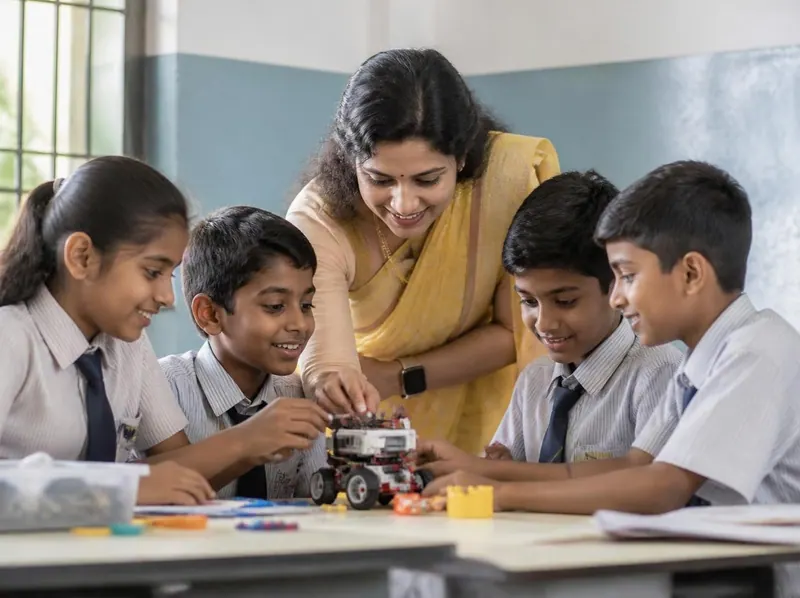
Maximum practical, minimum theory: students learn basic electronics by building a working project in every session, from loose components, with the trainer beside them.
Along the way they read resistor colour codes and capacitor values, learn to solder, find out how transistors, switches, sensors and motors work, and take their first steps in coding with two Arduino projects.
From the robotics class page.
Reading resistor colour codes and capacitor values
Soldering and placing components on a board
How transistors, switches, sensors and motors work
First steps in coding with two Arduino projects
What you will learn
Every lesson of the study books that come with this course in the student portal, with the key points of each lesson and exercises to try. What students build in class is listed further down this page.
Subject 1 of 2
Learn how electricity, circuits and electronic parts work, then use motors, sensors and batteries safely to understand how simple robots such as line followers and obstacle avoiders think and move.
Key points
Try this
Key points
Try this
Key points
Try this
Key points
Try this
Key points
Try this
Key points
Try this
Key points
Try this
Subject 2 of 2
Program an Arduino Uno from your first blinking LED to a working robot: pins, the Arduino IDE, inputs and outputs, the Serial Monitor, variables, decisions, loops and functions, sensors, motor drivers, servos and debugging.
Key points
Try this
Key points
Try this
Key points
Try this
Key points
Try this
Key points
Try this
Key points
Try this
Key points
Try this
In class
Maximum practical, minimum theory. All components and kits are provided by the institute. See the full class page.
A fire alarm that sounds when its sensor senses heat
A remote-controlled robotic car, with a car or truck body
A propeller car that shows how aeroplanes move
An electromagnetic crane that lifts and turns
An automatic room light that switches on when it gets dark
A doorstep alarm that rings when a guest steps on the mat
A dynamo that makes electricity from a spinning magnet
A hand-gesture robot driven by an IR sensor
A condenser mic amplifier and a wall clock of their own design
Practice and study material
Students sign in to read the study books lesson by lesson, print them, mark lessons as done and test themselves with timed practice tests, every answer explained.
Up to 20 questions are picked at random from the subject’s question bank.
A timer counts down. When it reaches zero, your answers are sent automatically.
Skip a question, flag it, and come back to change your answer before you submit.
At the end you see the right answer and an explanation for each question.
Each study book has its lessons, key points, exercises and a glossary. Print a lesson, or mark it as done.
The institute gives each student a login when they enrol.
Real questions from this course’s question banks. Pick an answer to see the explanation.
In a two-sensor line follower, the left sensor sees the black line and the right sensor sees white. What should the robot do?
Answer: A. Turn left
The robot has drifted right, so it turns left until the left sensor is back on white.
Why should beginners leave digital pins 0 and 1 unconnected?
Answer: D. They are the serial lines used for uploads
Pins 0 (RX) and 1 (TX) are the serial lines shared with USB, so anything connected to them can disturb uploads and serial communication.
What power is used by a resistor with 9 V across it and 0.02 A flowing through it?
Answer: C. 0.18 W
Power is P = V × I = 9 × 0.02 = 0.18 W.
Free ebooks
Branded PDF books to read on your phone or print: the study books of this course and more. Free for anyone, no sign-in needed.
Robotics
The complete study notes, practice questions and glossary for Robotics and Electronics Basics
Robotics
The complete study notes, practice questions and glossary for Arduino and Coding for Robots
Robotics
Resistors, capacitors, LEDs, diodes, transistors and more, with how to use each
Robotics
Make things move: DC motors, servos, steppers and how to drive them
Robotics
A complete build guide with two IR sensors, an L298N driver and Arduino
Robotics
An ultrasonic sensor robot that finds its own way, step by step
Careers
Robotics is where many engineers and makers start. Read about the work these fields involve and how people get into them.
Designing and building circuits, sensors and robots, and programming microcontrollers such as the Arduino.
Writing, testing and fixing programs in languages such as C, C++, Java and Python.
Free calculators
Free tools that go with this course. They work in your browser, on a phone or a computer.
Read the value of a resistor from its coloured bands.
Find the voltage, current or resistance of a circuit from the other two (V = I × R).
Find the series resistor an LED needs for your supply voltage.
How admission works
Classes are held at the institute in Delhi, A-10, Chief Commissioner Colony, opposite Rana Pratap Bagh.
Message the institute on WhatsApp for the current batch timings and fees, or to visit the institute before joining.
Weekday and weekend batches run in the evening, so they fit around school and tuition, and a summer workshop runs in the holidays.
Every child builds a working project in each session. All components and kits are provided by the institute.
Every child takes home the project they build. No previous coding or robotics experience is needed.
Children in class 3 to 8. No previous coding or robotics experience is needed. The institute runs separate classes for KG to class 2, class 3 to 8 and class 8 to 12, and robotics workshops inside schools.
No. No previous robotics or coding experience is needed. Students start with electronics and building, and take their first steps in coding with two Arduino projects.
No previous robotics or coding experience is needed. All components and kits are provided by the institute, and every model belongs to the student after the class. Weekday and weekend batches run in the evening so they fit around school and tuition, and a summer workshop runs in the holidays. Message the institute on WhatsApp for the current batch timings and fees.
At Gurukul Technicals Institute, A-10, Chief Commissioner Colony, opposite Rana Pratap Bagh, Delhi 110007. Robotics workshops and weekly programmes are also run inside schools; see robotics for schools.
No. All components and kits are provided by the institute, and the model your child builds is theirs to take home.
A phone or a computer with an internet connection, and the login the institute gives at enrolment. The student portal opens in an ordinary web browser, so there is nothing to install. Student login.
Sign in to the student portal and choose a subject. Each test picks up to 20 questions at random from that subject’s question bank and gives you one minute per question, with a timer that sends your answers automatically when it reaches zero. You can skip a question, flag it and come back before you submit, and at the end you see the right answer and an explanation for every question. This course has 70 practice questions across 2 subjects, and you can take the tests as often as you like.
On the verify certificate page, anyone can enter a certificate number and check it against the institute’s online register, which covers certificates issued through the portal. For older certificates, or if there is any doubt, send a copy to the head office by email or WhatsApp; the reply comes within 2 working days.
Yes. The 10 ebooks for this course are free PDF downloads for anyone, whether or not you join. The whole library has 100 free ebooks: browse them all.
Message the institute on WhatsApp for batch timings and fees, or visit A-10, Chief Commissioner Colony, opposite Rana Pratap Bagh, Delhi.