
School Skills
Science fair skills: planning, building, report and presentation
Taking a science project from an idea to the exhibition table: choosing a question, planning, building, testing, keeping a record, the report and the presentation.
Suits: Students of class 5 to 12
Duration, fees and batch timings are quoted by the head office or your centre.
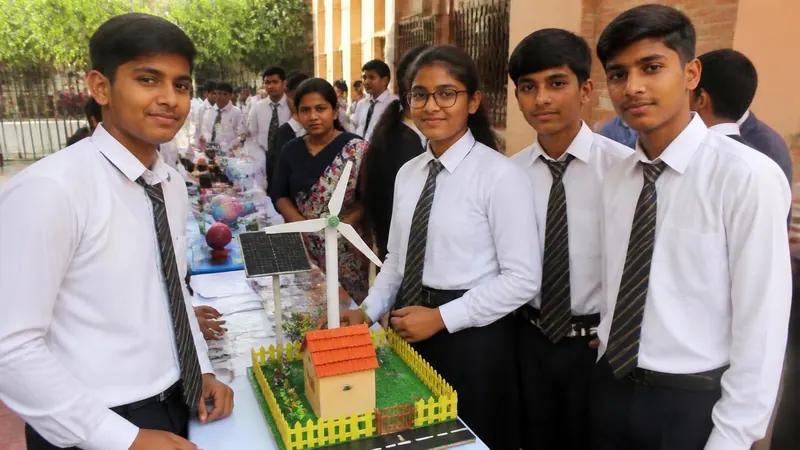
The study book of this course
- Science Fair and Project Skills
- Lessons
- 13
- Practice questions
- 48
- Free ebooks
- 0
About the course
What the science fair skills course is about
A science fair project is judged on the thinking as much as the model: the question, the fair test, the record of what happened, and whether the student can explain it. This course teaches that whole process, from a curious question to the exhibition table.
The study book covers planning and safety, building a sturdy working model, measuring and recording in tables, drawing graphs, writing the project report in the standard order, making the display board, and the two-minute explanation and viva, including what to say when something does not work. It pairs with the free project guides and ebooks on this site.
What you will practise
Drawn from the lessons of the study books below.
- 01
Choose a question that can be tested, and tell a working model from an investigatory project
- 02
State a hypothesis, name the variables and design a fair test
- 03
Plan a timeline, a materials list and safety checks
- 04
Build a sturdy model, take repeat readings, average them and draw a graph
- 05
Write the project report in order: aim, apparatus, procedure, observations, result, conclusion, bibliography
- 06
Make a display board and give a clear two-minute explanation and viva answers
What you will learn
13 lessons, 39 exercises
Every lesson of the study book that comes with this course in the student portal, with the key points of each lesson and exercises to try. Your centre gives you the syllabus, the duration and the fee.
Study book
Science Fair and Project Skills
Plan and present a school science project from start to finish: choosing a testable question, the scientific method, timelines, hypotheses, variables and fair tests, tables and graphs, measurement errors, safety, the report, working models, display boards, talks and viva questions, and honest credit for sources.
1Choosing a good question4 min read · 4 key points · 3 exercises
Key points
- A project question must be testable by measuring something.
- Narrow a broad topic step by step until it can be tested.
- Check that the question is feasible, safe and interesting to you.
- Background reading shows what is already known and helps you predict.
Try this
- Take the topic "plants" and narrow it to a testable question in three steps.
- Rewrite "Which soap is best?" as a question that can be measured.
- List three things that make a question unsafe or too hard for a school project.
2The scientific method4 min read · 4 key points · 3 exercises
Key points
- The steps run from question and research to hypothesis, experiment, data, conclusion and communication.
- A hypothesis is a testable prediction, not a certain fact.
- Results that disagree with the hypothesis are still valid and useful.
- Repeat tests at least three times to be more trustworthy.
Try this
- Write the eight steps of the scientific method in your own words with one line of example for each.
- Plan the steps for the question "Does temperature change how fast sugar dissolves?"
- Explain why changing a result you did not like is wrong.
3Planning and a timeline4 min read · 4 key points · 3 exercises
Key points
- Break the project into stages and put a date on each one.
- Work backwards from the final date and keep spare days.
- Make a complete materials list before you start.
- A logbook records the date, actions, observations and mistakes.
Try this
- Make a 4-week timeline for a plant-growth experiment.
- List the materials for an experiment on how colour affects heat absorption.
- Start a logbook page and record one entry for today.
4Hypothesis, variables and fair tests5 min read · 4 key points · 3 exercises
Key points
- A hypothesis is a testable prediction, often in the form If, then, because.
- Independent variable is changed, dependent is measured, controlled stay the same.
- A fair test changes only one variable at a time.
- A control group gives a baseline for comparison.
Try this
- Identify the three kinds of variable in "Does the height of a ramp change how far a toy car travels?"
- Write a hypothesis in If, then, because form for a seed-germination test.
- List five controlled variables for a test on paper-plane distance.
5Collecting data and making tables4 min read · 4 key points · 3 exercises
Key points
- Data can be quantitative (numbers) or qualitative (descriptions).
- Record at the time of measuring; correct a mistake with one line.
- Tables have a title, units in headings and repeated trials.
- Mean is the sum divided by the number of values; range is largest minus smallest.
Try this
- Draw a data table for testing how three liquids cool in 20 minutes, readings every 5 minutes.
- Find the mean and range of 12, 15, 11, 14, 13.
- Write four observations that could be useful during a plant experiment.
6Graphs and charts4 min read · 4 key points · 3 exercises
Key points
- Choose a bar, line, pie or scatter graph to fit the data.
- Independent variable goes on the x axis, dependent on the y axis.
- Every graph needs a title, labelled axes with units and an even scale.
- Describe the pattern in words below or beside the graph.
Try this
- Which graph type would you use for (a) favourite sports of 30 students (b) temperature over one afternoon? Give reasons.
- Draw a line graph from the table in the data lesson using the averages.
- Write one sentence describing a trend that goes up and then flattens.
7Units and measurement errors5 min read · 4 key points · 3 exercises
Key points
- A measurement needs a number and a unit; use SI units consistently.
- Read each instrument correctly: eye level, zero setting, steady value.
- Accuracy is closeness to the true value; precision is closeness of repeats.
- Repeating reduces random error; checking tools avoids systematic error.
Try this
- Measure the length of your desk three times and give the mean with a unit.
- Explain the difference between a systematic error and a random error with an example of each.
- Convert 2.5 kg to grams and 450 mL to litres.
8Safety rules for projects4 min read · 4 key points · 3 exercises
Key points
- Do a risk assessment and get an adult’s permission first.
- Wear goggles and gloves where needed and keep hair and clothes safe.
- Use only low-voltage battery circuits; never mains electricity or open flames alone.
- Never mix cleaners, never taste chemicals, and report every accident.
Try this
- Write a risk assessment with three hazards and a way to reduce each for an experiment of your choice.
- List the safety items you would wear and keep nearby for a baking-soda and vinegar experiment.
- Explain why you should never test a product by tasting or smelling it closely.
9Writing the report5 min read · 4 key points · 3 exercises
Key points
- A report has aim, hypothesis, apparatus, procedure, observation, result, conclusion and bibliography.
- Procedure is a numbered list that others can repeat.
- Observation is what you saw, result is the pattern, conclusion is the meaning.
- Do not claim more than the data shows; mention errors and limits.
Try this
- Write the aim and hypothesis for your own project in two sentences.
- Rewrite a paragraph of steps as a numbered procedure with variables noted.
- Write a conclusion of three sentences for the salt and ice example.
10Making a working model4 min read · 4 key points · 3 exercises
Key points
- A working model should work and be explainable by you.
- Design on paper first, then build and test one part at a time.
- Use safe, low-voltage and recycled materials where possible.
- Label the model and state the science principle behind it.
Try this
- Sketch and label a design for a model of a hydraulic lift using two syringes.
- List the science principle and materials for a simple working water filter model.
- Describe a back-up plan if your model stops working on the day of display.
11Display board and poster4 min read · 4 key points · 3 exercises
Key points
- The board should show question, method, data and conclusion at a glance.
- Use a large title, short text, few colours and clear labelled visuals.
- Keep the logbook and report beside the board.
- Check spelling and units and carry spare materials.
Try this
- Sketch a tri-fold board layout and write what goes in each panel.
- Rewrite a long paragraph of method as four short bullet points.
- Make a checklist of ten things to bring to the fair.
12Presenting and answering viva questions5 min read · 4 key points · 3 exercises
Key points
- Give a short talk: introduce, question, method, result, conclusion.
- Practise aloud, use cue words and keep eye contact.
- Know your variables, errors, results and the science behind them.
- If you do not know an answer, say so honestly instead of guessing.
Try this
- Write a two-minute talk script for your project using only cue words.
- Prepare spoken answers to three likely viva questions.
- Practise with a family member who asks you five questions, then note which ones were hard.
13Honesty and giving credit4 min read · 4 key points · 3 exercises
Key points
- Report the data you really measured; never invent or change numbers.
- Do your own work; guidance is fine but copying a project is not.
- Give credit with a bibliography and acknowledgement; avoid plagiarism.
- Respect people, animals, plants and the environment in your project.
Try this
- Write a bibliography entry for a book and a website you might use.
- Explain in two sentences why changing a result is worse than a result that surprises you.
- Write an acknowledgement paragraph for your project.
Glossary: 30 key terms of Science Fair and Project Skills
- Hypothesis
- A testable prediction about what will happen in an experiment and why.
- Variable
- Anything in an experiment that can change.
- Independent variable
- The one variable you deliberately change in a test.
- Dependent variable
- The variable you measure to see the effect of the change.
- Controlled variable
- A variable kept the same so that the test stays fair.
- Fair test
- A test in which only one variable is changed at a time.
- Control group
- A sample with nothing changed, used as a baseline for comparison.
- Data
- The facts and measurements collected during a project.
- Quantitative data
- Data given as numbers, such as mass or temperature.
- Qualitative data
- Data given as descriptions, such as colour or texture.
- Mean
- The sum of values divided by how many values there are; the average.
- Range
- The largest value minus the smallest value in a set of data.
- Accuracy
- How close a measurement is to the true value.
- Precision
- How close repeated measurements are to each other.
- Random error
- An unpredictable error that varies from one reading to the next.
- Systematic error
- An error that shifts every result in the same direction, such as an unzeroed balance.
- Unit
- The standard in which a quantity is measured, such as metre or second.
- Observation
- What you see, hear, smell or measure during a project.
- Conclusion
- The answer to the aim, supported by the results.
- Aim
- A sentence that states what the project wants to find out.
- Apparatus
- The equipment and materials used in an experiment.
- Procedure
- The numbered steps followed to carry out an experiment.
- Bibliography
- A list of the books, websites and people used as sources.
- Plagiarism
- Copying someone else’s work or words without giving credit.
- Risk assessment
- A check of hazards in an activity and the ways to reduce them.
- Logbook
- A notebook in which dated notes, data and mistakes are written during a project.
- Working model
- A simple version of a real device that shows how it works.
- Viva
- Spoken questions from a judge or teacher about your project.
- Line of best fit
- A smooth line on a graph that follows the general trend of the points.
- Acknowledgement
- A short note thanking the people who helped with a project.
Practice and study material
Study books and timed practice tests in the student portal
Students sign in to read the study books lesson by lesson, print them, mark lessons as done and test themselves with timed practice tests, every answer explained.
- 1study book
- 13lessons
- 48practice questions
- 30glossary terms
How the practice tests work
- Fresh questions each time
Up to 20 questions are picked at random from the subject’s question bank.
- One minute per question
A timer counts down. When it reaches zero, your answers are sent automatically.
- Move around freely
Skip a question, flag it, and come back to change your answer before you submit.
- Learn from every answer
At the end you see the right answer and an explanation for each question.
- Read, print and keep track
Each study book has its lessons, key points, exercises and a glossary. Print a lesson, or mark it as done.
Your centre gives you your login when you enrol.
Try 3 practice questions
Real questions from this course’s question banks. Pick an answer to see the explanation.
What is a hypothesis?
Show the answer
Answer: B. A testable prediction with a reason
A hypothesis predicts what will happen and why, and can be tested.
Which unit is a metric unit of mass?
Show the answer
Answer: B. Kilogram
The kilogram measures mass.
A good order for a short talk is
Show the answer
Answer: B. introduction, question, method, result, conclusion
The talk follows the story of the project.
Careers
Careers this course leads towards
The kind of work these skills are used for. Each guide explains what the job involves, the skills it asks for and how to get started.
Robotics and electronics
Designing and building circuits, sensors and robots, and programming microcontrollers such as the Arduino.
Software developer
Writing, testing and fixing programs in languages such as C, C++, Java and Python.
Free calculators
Useful calculators
Free tools that go with this course. They work in your browser, on a phone or a computer.
Percentage and marks calculator
Work out the percentage of your marks in a test or across a whole marksheet.
Ohm’s law calculator
Find the voltage, current or resistance of a circuit from the other two (V = I × R).
How admission works
From your first question to your certificate.
The usual steps, at the head office in Delhi or at an authorised member centre.
- Who can join
- Students of class 5 to 12
- Where
- The Delhi head office and authorised member centres.
- Fees and timings
- On WhatsApp at +91 97116 99511, or by phone on 011 2721 1512.
- 1
Ask about the course
Call or WhatsApp the head office, or visit your nearest member centre. Ask for the duration, the fee and the batch timings in writing.
- 2
Fill the admission form
Admission forms are supplied by the head office to every centre.
- 3
Learn in class
Attend your batch at the centre, with the course material and study notes, and sign in to the student portal for the study books and practice tests.
- 4
Take the exam
The institute prefers written exams, taken in front of a teacher.
- 5
Receive your certificate
Students who pass get a Gurukul Technicals Institute certificate and marksheet. Employers can verify it with the head office.
Who can join the science fair skills course?
Students of class 5 to 12. Ask the head office or your nearest member centre which group your child should join, and what they already know will help them start in the right place.
Does the course include a project kit?
The course teaches the skills; the model itself can be any project. The site’s free project guides and ebooks give step-by-step builds, and the institute’s store sells kits and working models that can be used as the project.
How long is the course and what is the fee?
Duration, fees and batch timings depend on the course and the centre. Ask the head office or your nearest member centre, and get the details in writing before you pay.
Where are the classes?
At the head office in Delhi (A-10, Chief Commissioner Colony, opposite Rana Pratap Bagh) and at authorised member centres. Call or WhatsApp the head office to find the nearest centre.
What do I need to use the study books and practice tests?
A phone or a computer with an internet connection, and the login your centre gives you at enrolment. The student portal opens in an ordinary web browser, so there is nothing to install. Student login.
How do the practice tests work?
Sign in to the student portal and choose a subject. Each test picks up to 20 questions at random from that subject’s question bank and gives you one minute per question, with a timer that sends your answers automatically when it reaches zero. You can skip a question, flag it and come back before you submit, and at the end you see the right answer and an explanation for every question. This course has 48 practice questions across 1 subject, and you can take the tests as often as you like.
Is there an exam and a certificate?
Yes. The institute prefers written exams, taken in front of a teacher. Students who pass receive a Gurukul Technicals Institute certificate and marksheet.
How is a Gurukul Technicals Institute certificate verified?
On the verify certificate page, anyone can enter a certificate number and check it against the institute’s online register, which covers certificates issued through the portal. For older certificates, or if there is any doubt, send a copy to the head office by email or WhatsApp; the reply comes within 2 working days.
Ready to start the science fair skills course?
Ask the head office for the duration, the fee, the batch timings and your nearest member centre.