
Guide
How to choose a working model for a science exhibition
What judges score, how to match the model to your class and chapter, working versus static models, and a four-week plan from choosing the topic to the two-minute explanation.
Overview
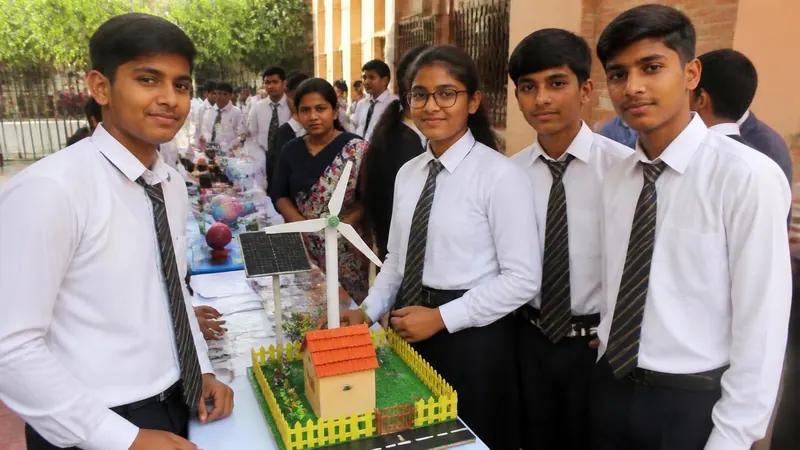
Every year students ask us the same question a week before the exhibition: which working model should I take? The answer depends on three things: what the judges score, what your class has studied, and how much time is left. This guide walks through all three and ends with a plan you can follow.
What judges actually score
CBSE publishes evaluation criteria for its science exhibition. For 2025-26 the weightage was: creativity and imagination 20 percent, originality of the idea 15, scientific thought and principle 15, craftsmanship and workmanship 15, educational value 15, economics and portability 10, and presentation 10. School-level exhibitions use similar lists. Two lessons follow from this.
- Half the marks are about the idea and the science behind it, not the polish. A simple model you can explain beats a complicated one you cannot.
- Presentation is only a tenth of the score, but it is the part you control on the day. Practise the explanation.
Match the model to your class and chapter
Judges ask "why did you choose this?" and "which chapter is it from?" Pick a topic from something you are studying this year, so the answer is natural.
- Class 3 to 5:one idea, one moving or lighting part. A phases of the moon model, a solar house, a simple circuit, a volcano.
- Class 6 to 8:a circuit with a switch or a sensor, or a system model. Human heart or digestive system, an automatic street light, a water level alarm, a hydraulic brake on Pascal's law.
- Class 9 and 10:energy conversion and electricity. A thermoelectric generator or electricity from a speed breaker, a wind turbine, a rainwater harvesting model, a solar cooker.
- Class 11 and 12:an investigatory project with a report, such as a rectifier, transformer or logic gates. See the separate guide on the class 12 physics project.
Working model or static model?
A working model has a part that moves, lights up or measures something when you switch it on. A static model shows a structure, such as a cross-section of a volcano. Judges and visitors spend more time at a model that does something, and a working part gives you a natural demonstration to open your explanation with. If your topic is a structure, add one working part: an LED that lights the chamber, a small pump that moves the water, a buzzer that sounds the alarm. Our components and spares packs are made for exactly this.
Ready-made, kit, or build it yourself?
- Build it yourself when you have three or more weeks and want the full learning. Start from a DIY kit or a components pack so the electrical part works first time.
- Buy a ready-made working model when the exhibition is close or the circuit is beyond your class level. You still need to understand it: read the printed report and run it several times.
- Whatever you choose, never present a model you cannot explain. That is the fastest way to lose the scientific-principle marks.
Size, power and safety
- Check the rules for board size; most schools allow a board of about 2 by 2 feet. Ask before you build large.
- Use a 9V battery or AA cells, not mains power, unless a teacher supervises. Keep spare batteries in your bag.
- Tape down loose wires and label the switch. A model that fails during the demonstration loses craftsmanship marks even if the science is right.
A four-week plan
- Week 1:choose the topic from a chapter, write the aim in one sentence, and list the materials. Order anything you need to buy now; delivery takes a few days.
- Week 2:build the working part and test it. If it does not work, this is the week to fix it or change the design.
- Week 3:finish the board, the chart and the labels. Write the explanation from the report: what it shows, how it works, where it is used.
- Week 4:rehearse the two-minute explanation three times, once for someone who knows nothing about the topic. Pack spare batteries, tape and the report.
Common mistakes
- Choosing a topic from the internet that has nothing to do with your syllabus.
- Testing the model for the first time on the morning of the exhibition.
- A chart full of text copied from a book; judges want your words.
- Forgetting the economics point: say what the model cost and what waste material you reused.
Where to start
Browse the store by class and subject, or send the topic, class and exhibition date on WhatsApp and we will tell you what can be built and by when.
Keep reading
More guides
Have a question about this?
The head office answers on WhatsApp and by phone.
Head office
Gurukul Technicals Institute
A-10, Chief Commissioner Colony, opposite Rana Pratap Bagh, Delhi 110007
 GTI Projects & KitsScience projects, project kits and spare partsReady-made working models, project kits and DIY kits, sold on Amazon and Flipkart.Browse projects and kits