
Programming & Web Development
Python programming
A first programming language with plain, readable code: variables, decisions, loops, lists, functions and small projects.
Suits: School students from class 8 and adults
Duration, fees and batch timings are quoted by the head office or your centre.
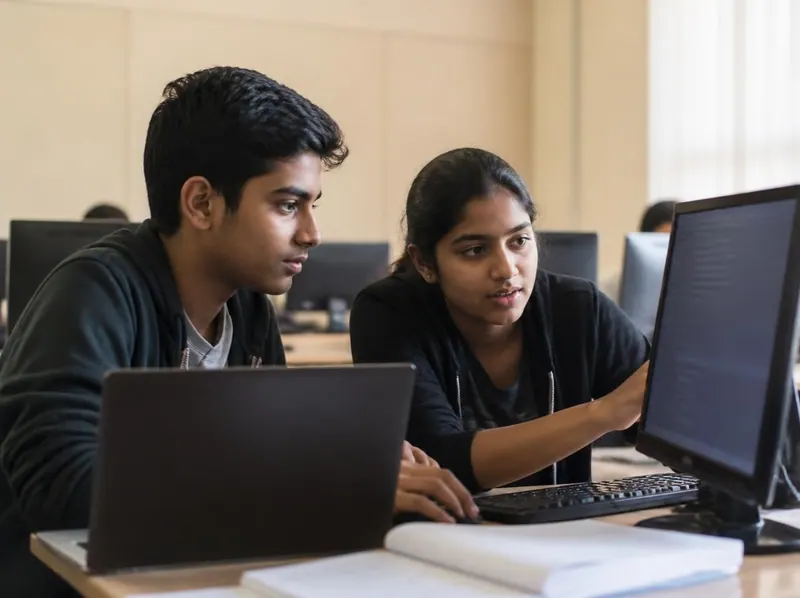
The study book of this course
- Python Programming for Beginners
- Lessons
- 11
- Practice questions
- 40
- Free ebooks
- 0
About the course
What the Python course is about
Python is a general-purpose language known for code that reads almost like English, which makes it a common first language. The course builds from printing and reading input up to decisions, loops, collections and functions.
Each lesson ends with short programs to type and run, and the course closes with files, error handling and a small project, so the student has written real programs, not only read about them.
What you will practise
Drawn from the lessons of the study books below.
- 01
Write programs that take input, calculate and print results
- 02
Choose between paths with if, elif and else
- 03
Repeat work with for and while loops
- 04
Store data in lists, tuples, dictionaries and strings
- 05
Break a problem into functions
- 06
Read and write files, handle errors and debug a program step by step
What you will learn
11 lessons, 33 exercises
Every lesson of the study book that comes with this course in the student portal, with the key points of each lesson and exercises to try. Your centre gives you the syllabus, the duration and the fee.
Study book
Python Programming for Beginners
Learn Python 3 from the first print statement to a small finished project: variables and types, input, operators, decisions, loops, lists, tuples, dictionaries, strings, functions, files and debugging.
1Your first Python program3 min read · 4 key points · 3 exercises
Key points
- print() shows text and numbers on the screen.
- Text in quotes is a string; a line starting with # is a comment.
- Python is case-sensitive, so print is not the same as Print.
- Error messages give a line number and a clue; read them calmly.
Try this
- Write a program that prints your name, your school and your city on three separate lines.
- Print the result of 25 * 4 and of 100 - 37 using print().
- Remove one closing bracket from a print line on purpose, run it and note the error message.
2Variables and data types4 min read · 4 key points · 3 exercises
Key points
- A variable stores a value under a name chosen by you.
- The main types are int, float, str and bool.
- type() reveals a value's type; int(), float() and str() convert.
- Variable names are case-sensitive and cannot start with a digit or contain spaces.
Try this
- Create variables for your name, age and favourite number, then print all three with one print().
- Predict the output of print(type(7.0)) and print(type("7")), then run to check.
- Swap the values of two variables without using a third one, as shown in the lesson.
3Input, operators and f-strings4 min read · 4 key points · 3 exercises
Key points
- input() always returns a string, so convert with int() or float() before calculating.
- // gives the whole-number part of a division and % gives the remainder.
- = stores a value while == compares two values.
- f-strings put variables inside text with curly brackets.
Try this
- Ask for two numbers and print their sum, difference, product and the result of the first divided by the second.
- Ask for a number and print whether it is even or odd using the % operator (print True or False for n % 2 == 0).
- Ask for a name and an age and print one sentence using an f-string.
4Making decisions with if, elif and else4 min read · 4 key points · 3 exercises
Key points
- if, elif and else let a program choose between actions.
- The condition ends with a colon and the block is indented.
- Python runs only the first block whose condition is true.
- Use == to compare and lower() to compare text without worrying about capitals.
Try this
- Write a program that asks for age and prints "Adult" for 18 and above, "Teenager" for 13 to 17 and "Child" otherwise.
- Write a grade program with four bands and test it with marks 95, 80, 40 and 10.
- Ask for a number and print whether it is positive, negative or zero.
5Repeating work with for and while loops4 min read · 4 key points · 3 exercises
Key points
- for repeats over a range or a collection; while repeats as long as a condition is true.
- range(n) starts at 0 and stops before n.
- Forgetting to change the condition variable causes an infinite loop.
- break exits a loop and continue skips to the next round.
Try this
- Print the multiplication table of any number typed by the user.
- Use a loop to add the numbers 1 to 100 and print the total (it should be 5050).
- Write a while loop that keeps asking for a number until the user types 0, then prints how many numbers were entered.
6Lists and tuples4 min read · 4 key points · 3 exercises
Key points
- A list holds ordered, changeable items and counts positions from 0.
- Negative indexes count from the end and slices stop before the end index.
- append, insert, remove, pop and sort change a list.
- A tuple is like a list that cannot be changed.
Try this
- Make a list of five marks, then print the highest, the lowest and the average.
- Ask the user to enter 5 names, store them in a list with a loop and print them sorted.
- Create a tuple of the seven days of the week and print the third day.
7Strings and dictionaries4 min read · 4 key points · 3 exercises
Key points
- Strings can be indexed and sliced, and string methods return new strings.
- split(), strip(), upper(), lower() and replace() are everyday tools.
- A dictionary stores key: value pairs and finds values by key.
- get() avoids a KeyError when a key may be missing.
Try this
- Ask for a sentence and print it in capitals, its length and the number of words (use split and len).
- Create a dictionary of five friends and their favourite sports, then print each pair with a loop.
- Write a program that counts how many vowels are in a word typed by the user.
8Functions: reusable blocks of code4 min read · 4 key points · 3 exercises
Key points
- def creates a function and the function runs only when it is called.
- Parameters are names in the definition; arguments are the values passed in.
- return gives a value back; without it a function returns None.
- Variables created inside a function are local to it.
Try this
- Write a function square(n) that returns n multiplied by itself, and print square(9).
- Write a function is_even(n) that returns True or False, and test it with 4 and 7.
- Write a function that takes a list of marks and returns the highest mark without using max().
9Reading and writing files3 min read · 4 key points · 3 exercises
Key points
- open() with mode "r", "w" or "a" reads, writes or appends.
- Mode "w" erases existing contents, so use "a" to add safely.
- with open(...) closes the file automatically.
- Everything read from a text file is a string until you convert it.
Try this
- Write a program that saves three lines you type into a file called diary.txt, then run it again with mode "a" to add one more line.
- Read diary.txt back and print each line with its line number.
- Write a program that opens a file that does not exist and prints a friendly message instead of crashing.
10Errors and debugging4 min read · 4 key points · 3 exercises
Key points
- Syntax errors stop the program from starting; runtime errors crash it; logic errors give wrong answers.
- Read a traceback from the bottom and go to the named line.
- try and except handle expected problems such as bad input.
- Print statements and small tests are the simplest debugging tools.
Try this
- Write a program that asks for two numbers and divides them, using try and except for ZeroDivisionError and ValueError.
- Take this broken line and fix it: print("Total is" total).
- Add debugging print lines to a loop that sums 1 to 5 and check each step by hand.
11A small project: marks report4 min read · 4 key points · 3 exercises
Key points
- Plan the steps first, then turn each step into code or a function.
- Functions, loops, conditions, dictionaries and files combine into a real program.
- Validate user input with try and except and a while loop.
- Test with simple numbers whose answers you know.
Try this
- Type the project from the lesson, run it with marks 80, 70, 90, 60 and 100 and check the total and grade by hand.
- Extend it to print the subject with the highest marks.
- Change it to ask for the number of subjects first instead of a fixed list of five.
Glossary: 26 key terms of Python Programming for Beginners
- Program
- A list of instructions that a computer follows to do a task.
- Python
- A popular, readable programming language used for many kinds of work.
- Syntax
- The grammar rules of a language; breaking them causes a SyntaxError.
- Variable
- A name that stores a value which can change.
- String
- Text inside quotes, such as "Delhi".
- Integer (int)
- A whole number without a decimal point.
- Float
- A number with a decimal point.
- Boolean
- A value that is either True or False.
- Operator
- A symbol such as +, *, == or and that works on values.
- Comment
- A note starting with # that Python ignores.
- Indentation
- Spaces at the start of a line that show which block the line belongs to.
- Condition
- An expression that is True or False, used by if and while.
- Loop
- Code that repeats, such as for or while.
- Iteration
- One round of a loop.
- List
- An ordered, changeable collection written in square brackets.
- Tuple
- An ordered collection that cannot be changed, written in round brackets.
- Dictionary
- A collection of key: value pairs written in curly brackets.
- Index
- The position of an item, starting from 0.
- Function
- A named, reusable block of code created with def.
- Parameter
- A name in a function definition that receives a value.
- Argument
- The actual value passed to a function when it is called.
- Return value
- The result a function sends back to its caller.
- Exception
- An error that happens while the program is running.
- Debugging
- Finding and fixing mistakes in a program.
- Traceback
- The report Python prints when an error stops the program.
- Module
- A file of ready-made code that you can bring into your program with import.
Practice and study material
Study books and timed practice tests in the student portal
Students sign in to read the study books lesson by lesson, print them, mark lessons as done and test themselves with timed practice tests, every answer explained.
- 1study book
- 11lessons
- 40practice questions
- 26glossary terms
How the practice tests work
- Fresh questions each time
Up to 20 questions are picked at random from the subject’s question bank.
- One minute per question
A timer counts down. When it reaches zero, your answers are sent automatically.
- Move around freely
Skip a question, flag it, and come back to change your answer before you submit.
- Learn from every answer
At the end you see the right answer and an explanation for each question.
- Read, print and keep track
Each study book has its lessons, key points, exercises and a glossary. Print a lesson, or mark it as done.
Your centre gives you your login when you enrol.
Try 3 practice questions
Real questions from this course’s question banks. Pick an answer to see the explanation.
What is "Python"[0:3]?
Show the answer
Answer: B. Pyt
A slice from 0 to 3 gives indexes 0, 1 and 2, which are P, y and t.
Which error does a missing colon after an if line cause?
Show the answer
Answer: C. SyntaxError
A missing colon breaks Python grammar, so the program cannot start.
With marks = 80, what does this print? if marks >= 90: print("A") elif marks >= 75: print("B") else: print("C")
Show the answer
Answer: D. B
80 is not 90 or more, but it is 75 or more, so the elif block runs and prints B.
Careers
Careers this course leads towards
The kind of work these skills are used for. Each guide explains what the job involves, the skills it asks for and how to get started.
Software developer
Writing, testing and fixing programs in languages such as C, C++, Java and Python.
How admission works
From your first question to your certificate.
The usual steps, at the head office in Delhi or at an authorised member centre.
- Who can join
- Students above 12 years of age.
- Where
- The Delhi head office and authorised member centres.
- Fees and timings
- On WhatsApp at +91 97116 99511, or by phone on 011 2721 1512.
- 1
Ask about the course
Call or WhatsApp the head office, or visit your nearest member centre. Ask for the duration, the fee and the batch timings in writing.
- 2
Fill the admission form
Admission forms are supplied by the head office to every centre.
- 3
Learn in class
Attend your batch at the centre, with the course material and study notes, and sign in to the student portal for the study books and practice tests.
- 4
Take the exam
The institute prefers written exams, taken in front of a teacher.
- 5
Receive your certificate
Students who pass get a Gurukul Technicals Institute certificate and marksheet. Employers can verify it with the head office.
Who can join the Python course?
Students above 12 years of age can take admission, at the Delhi head office or at an authorised member centre. The course suits school students from class 8 and adults. Tell the head office or your centre what you already know, and they will suggest where to start.
How long is the course and what is the fee?
Duration, fees and batch timings depend on the course and the centre. Ask the head office or your nearest member centre, and get the details in writing before you pay.
Where are the classes?
At the head office in Delhi (A-10, Chief Commissioner Colony, opposite Rana Pratap Bagh) and at authorised member centres. Call or WhatsApp the head office to find the nearest centre.
What do I need to use the study books and practice tests?
A phone or a computer with an internet connection, and the login your centre gives you at enrolment. The student portal opens in an ordinary web browser, so there is nothing to install. Student login.
How do the practice tests work?
Sign in to the student portal and choose a subject. Each test picks up to 20 questions at random from that subject’s question bank and gives you one minute per question, with a timer that sends your answers automatically when it reaches zero. You can skip a question, flag it and come back before you submit, and at the end you see the right answer and an explanation for every question. This course has 40 practice questions across 1 subject, and you can take the tests as often as you like.
Is there an exam and a certificate?
Yes. The institute prefers written exams, taken in front of a teacher. Students who pass receive a Gurukul Technicals Institute certificate and marksheet.
How is a Gurukul Technicals Institute certificate verified?
On the verify certificate page, anyone can enter a certificate number and check it against the institute’s online register, which covers certificates issued through the portal. For older certificates, or if there is any doubt, send a copy to the head office by email or WhatsApp; the reply comes within 2 working days.
Ready to start the Python course?
Ask the head office for the duration, the fee, the batch timings and your nearest member centre.