
Guide
Best out of waste project ideas for school, class 1 to 10
Twenty-four best-out-of-waste ideas grouped by class, with the materials, what each one teaches, and the one working part that turns a craft project into a science model.
Overview
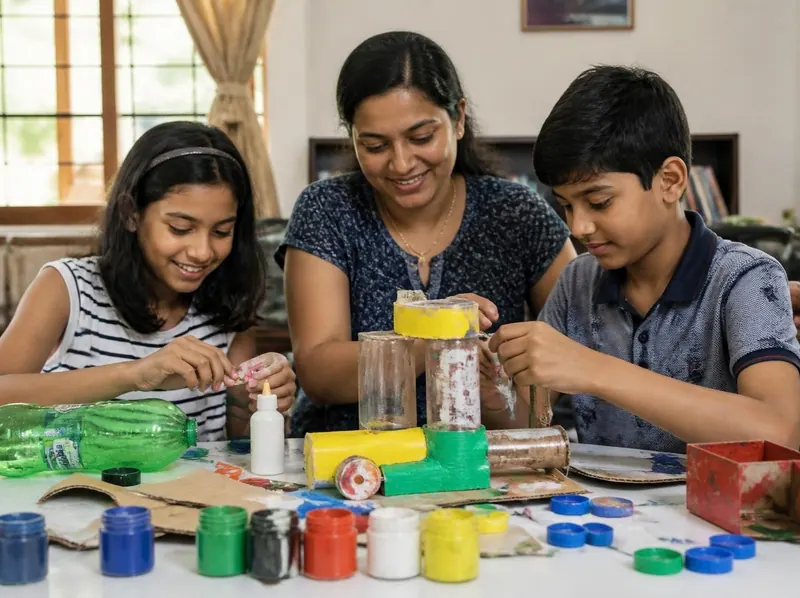
Best out of waste is set as a competition topic in most schools, and it is also a science exhibition brief: CBSE's 2025-26 sub-themes include waste management and alternatives to plastics, and the economics-and-portability criterion rewards low-cost material. The trick is to make the project show a science idea, not only reuse a bottle. Here are ideas by class, each with the material, the concept and the working part that lifts it.
Class 1 to 3
- Bird feeder from a milk jug or a bottle: cut, hang, fill. Teaches care for animals; the working part is a tilt lid that stops rain.
- Pen stand from a detergent bottle: cut, sand, paint. Teaches reuse; add a small LED reading light with a switch.
- Paper-roll binoculars: two rolls, string, paint. Teaches how we see far; no electricity needed.
- Bottle-cap wind spinner: caps on a straw. Teaches wind energy; mount it on a stand so it turns in a fan's breeze.
Class 4 and 5
- Water filter from a cut bottle: layers of cloth, sand, charcoal and gravel. Teaches filtration; show dirty water going in and clearer water coming out.
- Plastic-bottle vertical garden: bottles on a rope with drip holes. Teaches soil and water; a small pump makes the drip work on stage.
- Bottle rocket with a bicycle pump: air pressure launches it outdoors. Teaches pressure and force; demonstrate with a video if the venue is indoors.
- Cardboard periscope with two mirrors at 45 degrees. Teaches reflection; a torch through it shows the path of light.
Class 6 to 8
- Wind turbine from bottle blades and a small DC motor: the motor works as a generator and lights an LED. Teaches energy conversion. The motor and LED come from a components pack.
- Hydraulic lift from syringes, tubing and cardboard: press one syringe, the platform rises. Teaches Pascal's law.
- Drip irrigation from a bottle and a tube with pin holes: teaches water conservation; add a second bottle to compare with flood irrigation.
- Solar cooker from a pizza box and foil: teaches reflection and heat; record the temperature inside with a thermometer.
- Rainwater harvesting model from bottles and pipes: teaches water management; a tiny pump can recirculate the water.
- Automatic street light with an old LED, a bottle post and an LDR: teaches sensors; the light turns on when you cover the LDR.
Class 9 and 10
- Earthquake alarm from a spring, a can and a buzzer: the pendulum closes a contact when shaken. Teaches vibration sensing.
- Water pump from a bottle, a DC motor and a bottle-cap impeller: teaches centrifugal force and pumps.
- Solar water heater from black-painted waste pipes and a foil box: teaches absorption of heat; measure inlet and outlet temperature.
- Cardboard hydraulic robotic arm with syringes: teaches pressure and levers; pick up a small object in the demonstration.
- Plastic-bottle solar water purifier (solar still): teaches evaporation and condensation.
- Simple microscope from a lens and a cardboard tube: teaches magnification; show a leaf or a printed dot.
- Buzzer wire game from a hanger and a battery: teaches open and closed circuits, and it draws a crowd.
- Newspaper or cardboard bridge tested with weights: teaches load and structure; record the weight it holds.
What makes it score
- One clear concept the model shows, named on the card.
- Clean, dry waste with labels removed, so the model looks deliberate rather than found.
- One working part: a motor, a pump, a light or a sensor.
- A short card: the waste used, what the model shows, and what the idea saves or prevents.
- The cost written down. Judges like to see that the whole model cost less than a hundred rupees plus one motor.
Where the non-waste parts come from
The motor, LED, buzzer, switch, wires and battery are the only parts you usually cannot find at home. Our components and spares packs have them, and the best out of waste category has models we build to order if you want a ready one to learn from. For a topic that is not listed, message us on WhatsApp.
Keep reading
More guides
Have a question about this?
The head office answers on WhatsApp and by phone.
Head office
Gurukul Technicals Institute
A-10, Chief Commissioner Colony, opposite Rana Pratap Bagh, Delhi 110007
 GTI Projects & KitsScience projects, project kits and spare partsReady-made working models, project kits and DIY kits, sold on Amazon and Flipkart.Browse projects and kits