Head office, Rana Pratap Bagh, Delhi011 2721 1512+91 97116 99511

Hardware & Networking

PC maintenance

Keeping computers running: finding faults, cleaning, upgrades and installing software.

Suits: Learners who want hands-on technical work

Duration, fees and batch timings are quoted by the head office or your centre.
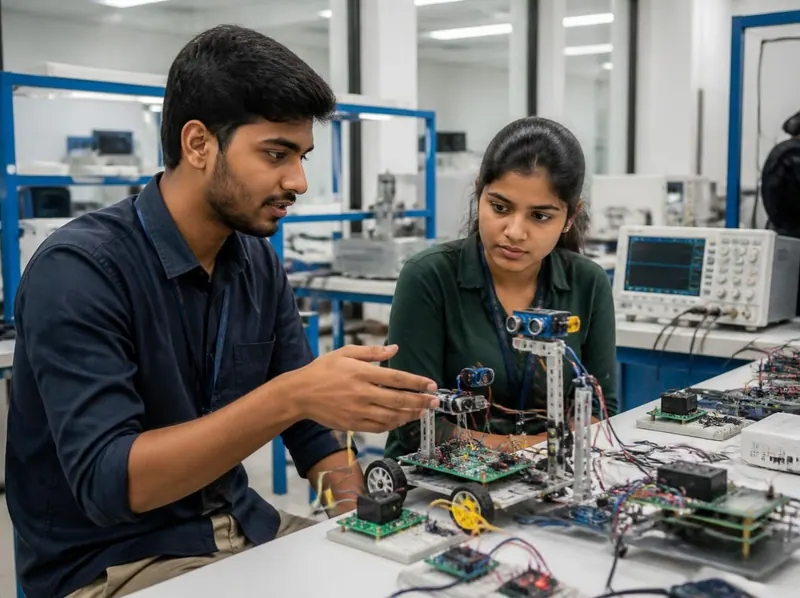
Two engineering students discussing a robotics prototype with sensors in an electronics lab

2 study books in this course

  • Computer Hardware and Maintenance
  • Cyber Security Basics
Lessons
14
Practice questions
70
Free ebooks
6

About the course

What the PC maintenance course is about

A practical course in looking after computers. It goes inside the PC, from the motherboard and CPU to RAM, storage and the power supply, then covers assembly, BIOS and UEFI, installing Windows and drivers, troubleshooting and preventive maintenance.

Cyber security basics are part of the course, because a well-kept computer is also a protected one: updates, antivirus, safe browsing, backups and strong passwords.

What you will practise

Drawn from the lessons of the study books below.

  1. 01

    Know the motherboard, CPU, RAM types, HDD, SSD and NVMe storage

  2. 02

    Assemble a PC safely and set up BIOS/UEFI and the boot order

  3. 03

    Install Windows and drivers

  4. 04

    Troubleshoot step by step and prevent faults with cleaning, airflow, a UPS and backups

  5. 05

    Keep Windows updated and protected with antivirus and safe browsing

  6. 06

    Use strong passwords and two-factor authentication, and keep backups

What you will learn

2 subjects, 14 lessons

Every lesson of the study books that come with this course in the student portal, with the key points of each lesson and exercises to try. Your centre gives you the syllabus, the duration and the fee.

Subject 1 of 2

Computer Hardware and Maintenance

Know every part inside a PC, assemble one safely, set up BIOS/UEFI, install Windows and drivers, and diagnose and prevent common hardware faults.

  • 7 lessons
  • About 21 min of reading
  • 35 practice questions
  • 25 key terms
  1. 1Inside the PC: Motherboard and CPU3 min read · 5 key points · 3 exercises

    Key points

    • The motherboard connects every component and carries power and data.
    • Form factors such as ATX, Micro-ATX and Mini-ITX must suit the cabinet.
    • CPU specifications include cores, threads, clock speed (GHz) and cache.
    • A CPU must match the socket and appear on the motherboard support list.
    • Thermal paste and a cooler stop the CPU from overheating.

    Try this

    1. With your instructor's permission, open the side panel of a switched-off and unplugged desktop and draw a labelled sketch showing the CPU socket and cooler, RAM slots, PCIe slots, M.2 slot (older boards may have none), SATA ports, 24-pin power connector, CMOS battery and front-panel header.
    2. Open the Performance tab of Task Manager on a Windows computer, select CPU, and note the processor's name, base speed, number of cores, logical processors and cache sizes; repeat on a second computer and compare the two.
    3. Choose two motherboards from a shop brochure or a manufacturer's specification sheet and make a comparison table of their form factor, CPU socket, chipset, number of RAM slots, M.2 slots and SATA ports.
  2. 2Memory: RAM Types3 min read · 5 key points · 3 exercises

    Key points

    • RAM is fast, volatile working memory; its contents vanish without power.
    • DDR3, DDR4 and DDR5 are not interchangeable because the notch position differs.
    • Desktops use DIMMs, laptops use SO-DIMMs, and some laptops have soldered RAM.
    • Matching modules in the correct slots run in faster dual-channel mode.
    • A loose RAM module is a common cause of no display.

    Try this

    1. Check how much RAM a Windows computer has under Settings > System > About, then open Task Manager > Performance > Memory and note the speed, the number of slots used and the form factor shown there.
    2. With the PC unplugged and an antistatic wrist strap on, remove one RAM module, look at the position of its notch and read its label for the generation, capacity and speed, then reinstall it and confirm the full amount of RAM is detected.
    3. Make a chart comparing DDR3, DDR4 and DDR5 with their standard voltages, and draw a desktop DIMM beside a laptop SO-DIMM showing the difference in length and notch position.
  3. 3Storage: HDD, SSD and NVMe3 min read · 5 key points · 3 exercises

    Key points

    • HDDs use spinning platters; SSDs use flash memory with no moving parts.
    • SATA SSDs are limited by the SATA interface; NVMe SSDs use faster PCIe lanes.
    • M.2 is a form factor, and an M.2 drive can be SATA or NVMe.
    • Defragment HDDs but never SSDs; Windows uses TRIM for SSDs.
    • A clicking hard disk means back up the data immediately.

    Try this

    1. Open the Defragment and Optimize Drives tool on a Windows computer and note the media type of each drive, then write down whether Windows will defragment it (hard disk drive) or send it TRIM (solid state drive).
    2. Work out how many GB Windows will show for drives sold as 256 GB, 512 GB, 1 TB and 2 TB by dividing the decimal number of bytes by 1,073,741,824 (Windows shows the 2 TB result, about 1,863 GB, as 1.81 TB after dividing by 1,024 once more), then compare one answer with a real drive in File Explorer, where the C: drive may be a little smaller because Windows keeps small hidden system partitions.
    3. Compare a 3.5-inch HDD, a 2.5-inch SATA SSD and an M.2 SSD at the centre, or pictures of them, writing for each its connection, typical use and one advantage and one disadvantage; measure the M.2 SSD with a ruler, if you have the real drive, to work out its size code, such as 2280 for 22 mm wide and 80 mm long.
  4. 4The SMPS and Computer Ports3 min read · 5 key points · 3 exercises

    Key points

    • The SMPS converts 230 V AC mains into low DC voltages: +12 V, +5 V and +3.3 V.
    • Main connectors are the 24-pin ATX, 8-pin CPU, PCIe and SATA power.
    • Choose adequate wattage from a reliable brand and protect it with a UPS.
    • Never open an SMPS: its capacitors can stay charged.
    • USB-C is a connector shape; speed depends on the USB version.

    Try this

    1. On an unplugged SMPS that is kept for practice, identify the 24-pin ATX, 8-pin CPU, PCIe, SATA power and Molex connectors without opening the unit (a basic office SMPS may have no PCIe connector), and make a chart of the ATX wire colours with the voltage or signal each one carries.
    2. Read the label on an SMPS and write down its wattage, its 80 PLUS rating if it has one, and the maximum current of its +12 V output.
    3. Go round the front and back of a desktop PC and the sides of a laptop and list every port you find, writing its name, what it is used for and, for USB ports, whether it is Type-A or Type-C and whether it looks like USB 2.0 or USB 3.x.
  5. 5Assembling a PC Safely3 min read · 5 key points · 3 exercises

    Key points

    • Unplug the PC and drain leftover charge before working inside.
    • ESD can damage parts invisibly: use a wrist strap, an antistatic mat and antistatic bags.
    • Handle components by their edges and never force a CPU or RAM module.
    • A pea-sized dot of thermal paste is enough; connect the fan to CPU_FAN.
    • If a new build will not start, check the front-panel and CPU power cables first.

    Try this

    1. Practise the full safety routine under supervision: shut down and unplug the PC, hold the power button for a few seconds, take off your watch and rings, clip on an antistatic wrist strap to bare metal on the case, and pick up a RAM module and an expansion card correctly by their edges.
    2. Under supervision and after the full safety routine (unplugged, power button held, wrist strap on), take apart a training PC step by step, putting the screws for each part into a labelled tray and photographing every stage, then reassemble it in reverse order, cleaning off the old thermal paste and applying a fresh pea-sized dot if you removed the CPU cooler, and confirm it reaches the BIOS/UEFI screen.
    3. Using the motherboard manual, copy the front-panel header diagram into your notebook, then, with the PC unplugged, connect the power switch, reset switch and LED wires to the correct pins on a training board, plug it back in and check that the power button works.
  6. 6BIOS/UEFI, Boot Order, Windows and Drivers3 min read · 5 key points · 3 exercises

    Key points

    • Firmware runs POST, then starts the OS from the first bootable device.
    • UEFI replaces legacy BIOS and supports GPT drives and Secure Boot.
    • Setup and boot-menu keys vary by maker; Delete, F2, F12 and Esc are common.
    • Windows 11 requires Secure Boot capable UEFI firmware and TPM 2.0.
    • Get drivers from official sites; Device Manager shows problems and can roll back a driver.

    Try this

    1. Restart a PC, find the setup key and the one-time boot menu key from the start-up screen or the manual, enter setup and note the detected CPU, RAM and drives, the boot order and whether Secure Boot and the TPM are enabled, then exit without saving any changes.
    2. After copying any files off a USB drive of at least 8 GB, use the Media Creation Tool on a working PC to make a Windows 11 bootable USB drive, then check that a test PC lists it in its one-time boot menu without starting an installation.
    3. Open Device Manager, expand each category and note any device with a yellow warning icon; for one device, open Properties > Driver and write down the driver provider, date and version, and whether Roll Back Driver is available.
  7. 7Troubleshooting and Preventive Maintenance3 min read · 5 key points · 3 exercises

    Key points

    • Troubleshoot methodically: ask, reproduce, check simple things, change one thing at a time.
    • Fans without a display often means RAM seating or the wrong monitor port.
    • A clock that resets at every start points to a weak CMOS battery.
    • Beep codes differ by manufacturer, so check the motherboard manual.
    • Regular cleaning, good airflow, a UPS and backups prevent many faults.

    Try this

    1. Make a job card with fields for the customer, the symptom, questions asked, tests done, parts swapped, the fix and the date, and fill it in while solving a practice fault set by your instructor, such as a loosened RAM module or an unplugged front-panel cable.
    2. Open Task Manager with Ctrl + Shift + Esc, sort the processes by CPU and then by memory, disable one unnecessary program on the Startup apps page (the Startup tab on Windows 10), and schedule Windows Memory Diagnostic to run at the next restart, noting its result.
    3. Carry out preventive maintenance on a training PC: with it shut down and unplugged, blow out the dust while holding the fans still, then power it on with the side panel off and check that every fan spins, wipe the keyboard and the screen the correct way, and record the date and the work done in a maintenance log.
Glossary: 25 key terms of Computer Hardware and Maintenance
BIOS and UEFI
Firmware on a motherboard chip that tests the hardware and starts the operating system; UEFI is the modern replacement for the older BIOS and adds GPT drive support and Secure Boot.
Boot order
The sequence of devices the firmware tries, one after another, when looking for an operating system to start.
Chipset
The chips on the motherboard that manage communication between the CPU and devices such as USB ports and SATA drives.
CMOS battery
A coin cell on the motherboard, commonly a CR2032, that keeps the clock and firmware settings when the PC is unplugged.
CPU
The Central Processing Unit, or processor, the chip that carries out the instructions of programs.
DDR
Double Data Rate SDRAM, the type of RAM in current PCs and laptops, made in generations such as DDR4 and DDR5 that do not fit each other's slots.
DIMM
Dual Inline Memory Module, the long memory module used in desktop computers; most upgradeable laptops and mini PCs use the shorter SO-DIMM instead.
Driver
Software that lets the operating system communicate with a particular piece of hardware, such as a graphics card, Wi-Fi adapter or printer.
ESD
Electrostatic discharge, a sudden flow of static electricity that can damage chips even when it is too small for you to feel.
Form factor
The standard size and layout of a part, such as ATX, Micro-ATX or Mini-ITX for motherboards and M.2 2280 for SSDs.
HDD
A hard disk drive, which stores data magnetically on spinning platters read by a head on a moving arm.
M.2
A small card-shaped form factor and slot used mainly for SSDs; an M.2 SSD is either a SATA drive or an NVMe drive, and the slot must support that type.
Motherboard
The main circuit board of a computer, which connects every component and carries power and data between them.
NVMe
Non-Volatile Memory Express, a way for SSDs to communicate over fast PCIe lanes, making them several times faster than SATA SSDs.
PCIe
PCI Express, the high-speed connection used by graphics cards, NVMe SSDs and other expansion cards, in slots of different widths such as x1 and x16.
POST
The Power-On Self-Test, the check the firmware runs at switch-on to confirm that the CPU, RAM and graphics are working before the operating system starts.
RAM
Random Access Memory, the fast working memory that holds open programs and files and loses its contents when the power goes off.
SATA
Serial ATA, the interface and cables used to connect hard disks, SATA SSDs and optical drives; SATA III is limited to 6 Gb/s.
Secure Boot
A UEFI feature that lets only boot software signed with a trusted key start, which blocks malicious boot programs.
SMPS
The Switched-Mode Power Supply, which converts AC mains electricity into the low DC voltages, such as +12 V, +5 V and +3.3 V, that computer parts use.
SSD
A solid state drive, which stores data in flash memory chips and has no moving parts, so it is faster and tougher than a hard disk.
Thermal paste
A paste spread thinly between the CPU and its cooler to fill tiny air gaps so that heat flows into the heatsink.
TPM
The Trusted Platform Module, a security chip or firmware feature that stores encryption keys safely; Windows 11 requires TPM version 2.0.
TRIM
A command the operating system, such as Windows, sends to an SSD to say which blocks of data are no longer in use, helping the drive manage its free space and stay fast.
UPS
An Uninterruptible Power Supply, a battery-backed unit that keeps a computer running for a short time during a power cut so work can be saved and the PC shut down safely.

Subject 2 of 2

Cyber Security Basics

Protect your accounts, money and data: strong passwords, two-factor authentication, spotting phishing and UPI fraud, malware, safe browsing, backups and social media privacy.

  • 7 lessons
  • About 21 min of reading
  • 35 practice questions
  • 25 key terms
  1. 1Strong Passwords and Password Managers3 min read · 5 key points · 3 exercises

    Key points

    • Length matters most: use a passphrase of at least 12 characters.
    • Use a different password for every account.
    • A password manager keeps passwords in an encrypted vault behind one master password.
    • Never share a password, even with someone claiming to be from your bank.
    • Passkeys sign you in with your device screen lock and resist phishing.

    Try this

    1. Write three practice passphrases (not ones you will really use) of at least four unrelated words each, count the characters in each one, and check that none of them contains your name, date of birth, mobile number or any other personal detail.
    2. Open the password manager built into your browser, such as Google Password Manager in Chrome or the Passwords page in Edge, count how many passwords are saved, and run its password check to list any that are reused, weak or leaked.
    3. List your five most important accounts, such as email, banking app and social media; change any password that is short or reused to a unique passphrase, and set up a passkey on any of those accounts that offers one.
  2. 2Two-Factor Authentication3 min read · 5 key points · 3 exercises

    Key points

    • 2FA adds a second proof of identity, so a stolen password alone is not enough.
    • The factors are something you know, something you have and something you are.
    • Authenticator apps are safer than SMS OTPs; security keys and passkeys are strongest.
    • Deny any sign-in approval request you did not start.
    • Keep backup codes offline in case you lose your phone.

    Try this

    1. Open the security settings of your main email account, turn on two-step verification, and write down every kind of second factor it offers, such as SMS code, authenticator app, sign-in prompt on your phone or passkey.
    2. Install an authenticator app such as Google Authenticator or Microsoft Authenticator, link it to one of your accounts by scanning the QR code shown by the website, then sign out and sign in again to confirm the six-digit code works.
    3. Generate the backup codes for that account, print them or copy them onto paper and keep them somewhere safe away from your phone; then turn on two-step verification with a six-digit PIN in WhatsApp under Settings > Account.
  3. 3Phishing, Smishing and Vishing3 min read · 5 key points · 3 exercises

    Key points

    • Phishing impersonates a trusted source to steal secrets or install malware.
    • Smishing uses SMS or chat apps; vishing uses voice calls.
    • Urgency, prizes and requests for OTPs or PINs are red flags.
    • Verify by calling the official number on your card or the official website.
    • If you clicked, change passwords, enable 2FA and tell your bank quickly.

    Try this

    1. Collect five suspicious SMS, email or WhatsApp messages from your own phone, or a family member's phone with their permission, without clicking any link or replying, and for each one write down the warning signs it shows: urgency, a prize, a request for an OTP or PIN, an odd sender or a look-alike address.
    2. Write ten short example messages of your own, five genuine and five phishing, mix them up, and ask a classmate to sort them into the two groups and name the warning sign in each phishing message.
    3. Write a short script of what you would say to a vishing caller who claims to be from your bank's KYC department, ending with hanging up and calling the number printed on your card, and role-play it with a friend taking the caller's part.
  4. 4UPI and OTP Fraud3 min read · 5 key points · 3 exercises

    Key points

    • You never need a UPI PIN or a QR scan to receive money.
    • Never share an OTP; read what the OTP message says it is for.
    • Do not install screen-sharing apps at a stranger's request.
    • Take helpline numbers only from official apps, websites or your card.
    • Report fraud at once to your bank and on 1930 or cybercrime.gov.in.

    Try this

    1. Open your UPI app, or a family member's with their permission, and find where it shows the receiver's name before a payment (stop at that screen without entering your UPI PIN, so no money is sent), where the transaction history is kept and whether you can set a transaction limit; write down the menu path to each.
    2. Read five OTP messages already on your phone and copy down, for each one, what the OTP was sent for and the warning the message gives about not sharing it.
    3. Make a one-page poster for a shop counter or your home titled "PIN only to pay, never to receive", listing the six frauds described in this lesson and the national cyber crime helpline number 1930 for reporting fraud.
  5. 5Malware: Types and How It Spreads3 min read · 4 key points · 3 exercises

    Key points

    • Malware is any software designed to harm, spy on or control a device.
    • A virus needs a host file, a worm spreads by itself, a trojan disguises itself.
    • Ransomware encrypts files and demands payment; an offline backup is the best defence.
    • Pirated software, unknown apps, attachments and pen drives are common routes in.

    Try this

    1. Make a table of the eight malware types in this lesson with three columns: what it does, how it usually gets onto a device, and one sign that a device may have it.
    2. Open the Windows Security app on a computer, go to Virus & threat protection, run a Quick scan, and note how many files were scanned and when the protection updates were last installed.
    3. Plug a pen drive into a Windows computer, right-click it in File Explorer (choose Show more options first on Windows 11 if needed), select Scan with Microsoft Defender before opening any file, and record the result.
  6. 6Updates, Antivirus and Safe Browsing3 min read · 5 key points · 3 exercises

    Key points

    • Updates patch vulnerabilities, so install them promptly.
    • Windows 10 and 11 include Microsoft Defender Antivirus; run only one real-time antivirus.
    • HTTPS encrypts the connection but does not prove a site is genuine.
    • Check the real domain name before entering a password.
    • Avoid banking on public Wi-Fi and sign out on shared computers.

    Try this

    1. Open Windows Update in Settings on a computer, check for updates, and note the date of the most recent update in the update history and whether a restart is pending; then check your phone for a system update and update all its apps from the Play Store or App Store.
    2. In the Windows Security app, confirm that Real-time protection is on under Virus & threat protection > Virus & threat protection settings > Manage settings, and that the firewall is on for every network type under Firewall & network protection, and write down anything that shows a warning.
    3. Write ten made-up website addresses that use the name of a bank or shop, some genuine-looking and some tricks with the name at the start, then for each one underline the real domain by finding the first single slash and reading leftwards from it.
  7. 7Backups and Privacy on Social Media3 min read · 5 key points · 3 exercises

    Key points

    • Follow 3-2-1: three copies, two kinds of storage, one copy off-site.
    • Keep an unplugged backup to survive ransomware, and test restoring files.
    • Syncing alone is not a backup.
    • Never post Aadhaar, PAN, tickets or your live location publicly.
    • Confirm unexpected money requests from friends by phone.

    Try this

    1. Plan a 3-2-1 backup for your own phone and computer in a table that lists your important data, the two kinds of storage you will use and where the off-site copy will be kept, then make one backup copy to a pen drive or external disk.
    2. Copy a practice file into your backup, delete the original from the computer, and then restore it from the backup, noting how long the restore took and whether the file opens correctly.
    3. Open the privacy settings of one social media account you use, make the profile private or limit who can see your posts, turn off finding you by phone number, and remove any connected third-party apps you no longer use.
Glossary: 25 key terms of Cyber Security Basics
Authenticator app
A phone app, such as Google Authenticator or Microsoft Authenticator, that generates a new short sign-in code every 30 seconds or so as a second factor.
Backup
An extra copy of your data kept on a separate device or in the cloud, so it can be restored if the original is lost, damaged or locked.
Credential stuffing
An attack in which criminals try email and password pairs leaked from one website on many other websites, hoping people have reused them.
Encryption
Scrambling data with a key so that only someone who has the correct key can read it.
Firewall
A security feature that controls which network connections are allowed into and out of a device or network.
HTTPS
HyperText Transfer Protocol Secure, the secure form of the web protocol HTTP, which encrypts the connection between your browser and a website; it keeps data private but does not prove the website is honest.
Malware
Any software written to harm a device, steal data or take control of it, including viruses, worms, trojans, ransomware and spyware.
OTP
A one-time password: a short code sent by SMS or email, or generated by an app, that works only once and expires after a short time.
Passkey
A sign-in method that uses your device's fingerprint, face unlock or screen lock instead of a password and works only on the genuine website it was created for.
Passphrase
A long password made of several unrelated words, which is easier to remember and much harder to guess than a short jumble of characters.
Password manager
An app or browser feature that stores your passwords in an encrypted vault behind one master password and fills them in for you on the correct websites.
Patch
A software fix, delivered in an update, that corrects a bug or closes a security vulnerability.
Phishing
A trick in which a criminal pretends to be a trusted person or organisation to make you click a link, open an attachment or reveal secrets such as passwords or OTPs.
Ransomware
Malware that encrypts the files on a device and demands payment to unlock them.
SIM swap
A fraud in which a criminal gets a duplicate SIM card issued in your name, so your calls and OTP messages reach them instead of you.
Smishing
Phishing carried out through SMS or chat-app messages, such as a fake parcel or electricity bill alert.
Spear phishing
A phishing message aimed at one particular person or group that uses details such as their name, college or workplace to look genuine.
Spyware
Malware that secretly watches what you do on a device and sends the information to an attacker.
Trojan
Malware disguised as useful software, such as a free game or a crack, that tricks you into installing it and does not copy itself.
Two-factor authentication (2FA)
Signing in with a second, different kind of proof of identity, such as a code from your phone, in addition to your password; it is the most common form of multi-factor authentication.
UPI PIN
The secret number that approves payments out of your bank account in a UPI app; it is never needed to receive money.
Virus
Malware that attaches itself to a file or program and spreads when that file is run or shared.
Vishing
Phishing carried out over a voice call, where the caller pretends to be from a bank, company, government office or the police.
Vulnerability
A mistake in software that an attacker can use to break into a device or gain access it should not have.
Worm
Malware that copies itself across networks automatically, without needing a host file or anyone to open it.

Practice and study material

Study books and timed practice tests in the student portal

Students sign in to read the study books lesson by lesson, print them, mark lessons as done and test themselves with timed practice tests, every answer explained.

  • 2study books
  • 14lessons
  • 70practice questions
  • 50glossary terms

How the practice tests work

  • Fresh questions each time

    Up to 20 questions are picked at random from the subject’s question bank.

  • One minute per question

    A timer counts down. When it reaches zero, your answers are sent automatically.

  • Move around freely

    Skip a question, flag it, and come back to change your answer before you submit.

  • Learn from every answer

    At the end you see the right answer and an explanation for each question.

  • Read, print and keep track

    Each study book has its lessons, key points, exercises and a glossary. Print a lesson, or mark it as done.

Try 3 practice questions

Real questions from this course’s question banks. Pick an answer to see the explanation.

  1. Computer Hardware and Maintenance · Question 1

    You want to install Windows from a USB drive. What should you do?

    Show the answer

    Answer: A. Select the USB drive in the boot menu

    The firmware must start from the USB drive for the Windows installer to run.

  2. Cyber Security Basics · Question 2

    You suspect an office computer is infected. What should you do first?

    Show the answer

    Answer: D. Disconnect it from the network, then run a full scan

    Disconnecting stops the malware spreading or sending data out while you scan and clean the computer.

  3. Computer Hardware and Maintenance · Question 3

    A desktop PC powers on and its fans spin, but the monitor shows nothing. What is a sensible first step?

    Show the answer

    Answer: C. Reseat the RAM and check the monitor cable and port

    Loose RAM and a monitor cable in the wrong port are common, quick-to-check causes of no display.

Free ebooks

6 free ebooks for this course

Branded PDF books to read on your phone or print: the study books of this course and more. Free for anyone, no sign-in needed.

Careers

Careers this course leads towards

The kind of work these skills are used for. Each guide explains what the job involves, the skills it asks for and how to get started.

  • Hardware and networking technician

    Assembling and repairing computers, installing Windows and drivers, and setting up and fixing office networks.

  • Cyber security

    Keeping accounts, devices and networks safe: passwords, updates, backups, and spotting fraud and malware.

Free calculators

Useful calculators

Free tools that go with this course. They work in your browser, on a phone or a computer.

How admission works

From your first question to your certificate.

The usual steps, at the head office in Delhi or at an authorised member centre.

Who can join
Students above 12 years of age.
Where
The Delhi head office and authorised member centres.
Fees and timings
On WhatsApp at +91 97116 99511, or by phone on 011 2721 1512.
Start with a question
  1. 1

    Ask about the course

    Call or WhatsApp the head office, or visit your nearest member centre. Ask for the duration, the fee and the batch timings in writing.

  2. 2

    Fill the admission form

    Admission forms are supplied by the head office to every centre.

  3. 3

    Learn in class

    Attend your batch at the centre, with the course material and study notes, and sign in to the student portal for the study books and practice tests.

  4. 4

    Take the exam

    The institute prefers written exams, taken in front of a teacher.

  5. 5

    Receive your certificate

    Students who pass get a Gurukul Technicals Institute certificate and marksheet. Employers can verify it with the head office.

Questions

Questions about the PC maintenance course

Still have a question?

Chat on WhatsApp
Who can join the PC maintenance course?

Students above 12 years of age can take admission, at the Delhi head office or at an authorised member centre. The course suits learners who want hands-on technical work. Tell the head office or your centre what you already know, and they will suggest where to start.

How long is the course and what is the fee?

Duration, fees and batch timings depend on the course and the centre. Ask the head office or your nearest member centre, and get the details in writing before you pay.

Where are the classes?

At the head office in Delhi (A-10, Chief Commissioner Colony, opposite Rana Pratap Bagh) and at authorised member centres. Call or WhatsApp the head office to find the nearest centre.

What do I need to use the study books and practice tests?

A phone or a computer with an internet connection, and the login your centre gives you at enrolment. The student portal opens in an ordinary web browser, so there is nothing to install. Student login.

How do the practice tests work?

Sign in to the student portal and choose a subject. Each test picks up to 20 questions at random from that subject’s question bank and gives you one minute per question, with a timer that sends your answers automatically when it reaches zero. You can skip a question, flag it and come back before you submit, and at the end you see the right answer and an explanation for every question. This course has 70 practice questions across 2 subjects, and you can take the tests as often as you like.

Is there an exam and a certificate?

Yes. The institute prefers written exams, taken in front of a teacher. Students who pass receive a Gurukul Technicals Institute certificate and marksheet.

How is a Gurukul Technicals Institute certificate verified?

On the verify certificate page, anyone can enter a certificate number and check it against the institute’s online register, which covers certificates issued through the portal. For older certificates, or if there is any doubt, send a copy to the head office by email or WhatsApp; the reply comes within 2 working days.

Are the ebooks on this page really free?

Yes. The 6 ebooks for this course are free PDF downloads for anyone, whether or not you join. The whole library has 100 free ebooks: browse them all.

Ready to start the PC maintenance course?

Ask the head office for the duration, the fee, the batch timings and your nearest member centre.

WhatsApp us