- Chemistry
- Ready-made model
- Printed report included
Nuclear Chain Reaction Readymade Science Working Project & Model in Chemistry with Multicolor Running Lights (with Printed Report)
Code B099R282BH
- Paid for and delivered by Amazon. The current price and the delivery date for your PIN code are shown there.
- Sold by Gurukul Technicals Institute, Delhi.
- Need a different topic, a custom version or a school order? Ask on WhatsApp.
In this project guide
Ready-made model
About this model
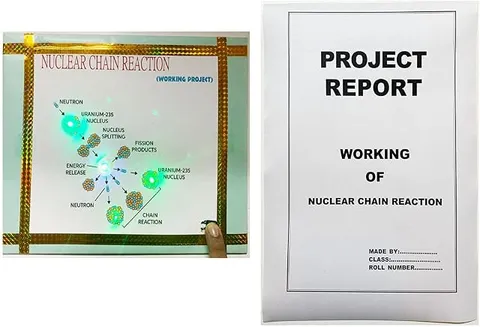
This model explains a nuclear chain reaction, in which splitting one heavy nucleus releases neutrons that go on to split more nuclei. The listing says it uses multicolour running lights and includes a printed report, so the spreading reaction can be shown step by step.
How it works
The science behind it
The idea the model demonstrates, in words you can use in your report and when you explain it.
In nuclear fission, a uranium-235 nucleus captures a slow neutron, becomes unstable and breaks into two medium-sized nuclei, giving out energy and two or three fresh neutrons. One common example is uranium-235 + neutron → barium-141 + krypton-92 + 3 neutrons + energy, and the mass numbers balance: 235 + 1 = 141 + 92 + 3. Each fission releases about 200 MeV, because the products have slightly less mass than the starting particles, and the missing mass appears as energy, E = mc². If at least one new neutron from each fission causes another fission, the reaction keeps itself going; this is a chain reaction. In a nuclear reactor it is controlled: heavy water can act as a moderator that slows the neutrons, and control rods of materials like cadmium or boron absorb extra neutrons. In an atomic bomb the chain reaction is uncontrolled. India produces electricity this way at nuclear power stations such as Tarapur, Rawatbhata and Kudankulam.
Make it yourself
Make a nuclear chain reaction model with running lights yourself
Build your own version from scratch, or use the steps to understand how the ready-made model is put together before you present it.
What you need 9
Step by step 8 steps
Draw the chain on the board: one neutron striking a uranium-235 nucleus, three neutrons flying out to strike three more nuclei, and nine neutrons coming from those.
Fix the clay or bead nuclei and neutrons along the paths, and make a hole beside each neutron for an LED.
Push in the LEDs, 1, 3 and 9 for the three generations, and wire each LED in series with its own 1 kΩ resistor so every LED in a group gets the same current.
Connect each group between the positive rail and the collector of its own transistor, with the emitters to negative, so one transistor switches a whole group.
Wire the 555 as a slow astable giving about one pulse a second to clock the CD4017, connect outputs Q1, Q2 and Q3 through the 10 kΩ resistors to the three bases, and join Q4 to the reset pin so the sequence repeats.
Put the control rod switch in the line to the third group's transistor, and label it.
- Switch on
The reaction spreads 1, 3, 9 and starts again. Slide the control rod in and show that the third generation no longer lights, as control rods in a reactor absorb neutrons.
Add labels for fission, chain reaction, control rods and moderator, and a card checking the mass numbers of one fission reaction from your textbook.
Read this first
Safety first
Go through these points before you build or switch anything on. Younger students should do this with an adult.
- This is a model only: never use radioactive material, smoke detector parts or old luminous dials in it.
- Use only the 9 V battery and do not short its terminals.
- Use the glue gun and soldering iron only with an adult.
- Switch the model off when it is not being shown, to save the battery.
Troubleshooting
If something does not work
The usual problems with this model and how to fix them. Open a problem to see the fix.
One whole group never lights
Check that group's transistor (pin order and base resistor), its line from the CD4017, and the control rod switch if it is the third group.
Only some LEDs in a group light
Those LEDs are reversed or have loose joints. Turn them so the longer leg faces the positive rail and re-solder the joints.
The groups change too fast or too slowly
Change the 555's timing resistor or capacitor; larger values give slower steps.
The lights stop on one group
The 555 is not clocking the counter. Check the 555's wiring, and that the CD4017's enable pin is tied to negative.
Exhibition day
How to present it
A running order for the exhibition table or the practical, step by step.
Run the lights and explain how one neutron leads to two or three fissions, and then many more.
Write the fission equation on a chart and show that the mass numbers balance on both sides.
Contrast the controlled reaction in a reactor with the uncontrolled one in a bomb.
Name an Indian nuclear power station to connect the model with real life.
Practice
Viva questions
Practice questions on this model, with short answers. Try each one aloud before you open the answer.
What is nuclear fission?
The splitting of a heavy nucleus, such as uranium-235, into two lighter nuclei with the release of energy and neutrons.
What is the job of control rods in a reactor?
They absorb extra neutrons so that the chain reaction stays steady and does not run out of control.
Why is a moderator used in a reactor?
It slows down fast neutrons, because slow neutrons are far more likely to cause fission in uranium-235.
Where does the energy released in fission come from?
From a small loss of mass, which is converted into energy according to E = mc².
Project file
Project file outline
The headings of the project file, in order. Give each heading its own section and write it in your own words.
The listing includes a printed project report: use this outline to check that your own file covers every part.
Free ebook: Writing a Science Project FileContents
- Aim: to show how one fission can start a chain reaction, and how it is controlled
- The nucleus, isotopes and uranium-235
- Nuclear fission and the energy released, with E = mc²
- The chain reaction and critical mass
- Controlled and uncontrolled chain reactions: reactors and bombs
- Control rods, moderators and coolant in a nuclear reactor
- How the model's running lights show the spreading reaction
- Benefits and risks of nuclear energy, including waste and safety
- Conclusion and sources used
Buying checklist
Before you buy
What to check before you order the model, and what to do when it arrives.
1Before you order
- Check that a nuclear chain reaction model suits your class and the chapter on sources of energy or nuclear physics.
- The listing says a printed report is included; check its facts against your textbook and add your own diagrams.
- Read the listing for the battery the lights need; do not assume one is in the box.
- Keep the box so the lights and labels survive the trip to school.
- Check the delivery date for your PIN code on the marketplace, and order well before the exhibition or practical.
- Practise explaining it. Judges ask what the model shows and why; knowing the science matters as much as the model. The viva questions above are a good place to start.
2When it arrives
- When it arrives, switch it on and watch the whole light sequence a few days before the exhibition.
Next steps
Take it further
Ways to turn this model into a bigger investigation or a stronger exhibition entry.
Set up dominoes in a branching pattern, where one knocks over two and two knock over four, and remove some to show how control rods stop the spread.
Use E = mc² to work out the energy from a tiny mass, and compare it with burning the same mass of coal using figures from a reliable source.
Add a panel comparing nuclear fission on Earth with nuclear fusion in the Sun.
Audience
Who it suits
Class 10 to 12 students preparing an exhibition model on nuclear energy or sources of energy.
- SubjectChemistry
- TypeReady-made model
- Project reportPrinted report included
Free to read
Free ebooks for this topic
Free PDF ebooks from Gurukul Technicals Institute on the science, the making and the presenting of projects like this one.
- Free PDF ebook
Safe Chemistry Projects for School
Experiments and models with kitchen materials and proper safety
- Free PDF ebook
Your Science Exhibition Guide
Choose a project, build it, present it and answer the judges with confidence
- Free PDF ebook
Writing a Science Project File
How to write the report, from the cover page to the bibliography
- Free PDF ebook
Viva Questions for Science Projects
How to answer examiner questions, with sample questions for popular projects