- Biology
- Ready-made model
- Class 1 to 9
- Printed report included
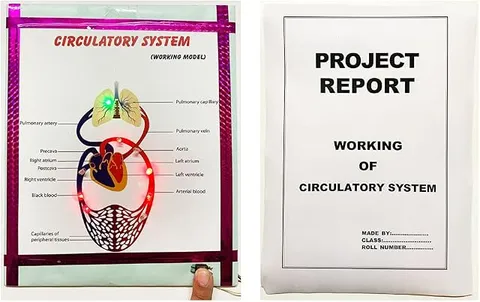
Human Heart Readymade Science Working Project & Model in Biology with Multicolor Running Lights(with Printed Report)
Code B099QZTRDR
- Paid for and delivered by Amazon. The current price and the delivery date for your PIN code are shown there.
- Sold by Gurukul Technicals Institute, Delhi.
- Need a different topic, a custom version or a school order? Ask on WhatsApp.
In this project guide
Ready-made model
About this model
This biology working model is about the human heart and helps a student explain its four chambers, its valves and the main blood vessels joined to it. The listing says it comes with multicolour running lights and a printed report.
How it works
The science behind it
The idea the model demonstrates, in words you can use in your report and when you explain it.
The human heart is a muscular pump about the size of a fist, made of cardiac muscle that keeps contracting throughout life. It has four chambers: two upper atria that receive blood and two lower ventricles that pump it out. A wall called the septum keeps oxygen-rich blood on the left separate from oxygen-poor blood on the right. Valves make blood flow one way: the tricuspid valve on the right and the bicuspid (mitral) valve on the left sit between the atria and ventricles, and semilunar valves guard the pulmonary artery and the aorta. The left ventricle has the thickest wall because it pumps blood to the whole body. Each beat has a contraction phase (systole) and a relaxation phase (diastole), started by a natural pacemaker called the SA node. The lub-dub a doctor hears through a stethoscope is the sound of the valves closing. At rest, an adult heart beats about 72 times a minute.
Make it yourself
Make a human heart model with beating lights yourself
Build your own version from scratch, or use the steps to understand how the ready-made model is put together before you present it.
What you need 9
Step by step 8 steps
Shape the heart from clay, or carve it from thermocol with an adult, then cut it in half from top to bottom so the inside can be shown.
- Carve or mould four chambers
Two smaller atria at the top and two ventricles below, with the left ventricle's wall clearly thicker. Leave a wall, the septum, between left and right.
Paint the right side blue for deoxygenated blood and the left side red for oxygenated blood.
- Fix the straws in place
The venae cavae into the right atrium, the pulmonary artery from the right ventricle, the pulmonary veins into the left atrium, and the aorta arching up from the left ventricle.
Mark the valves with small white card flaps: the tricuspid valve on the right, the bicuspid (mitral) valve on the left, and the semilunar valves at the openings of the pulmonary artery and aorta.
Build a 555 flasher on the circuit board with the variable resistor, so the LEDs blink at about the rate of a resting heartbeat (around 72 times a minute). Drive the LEDs in parallel from its output, each with its own resistor.
Push the red LEDs into the left chambers and the blue LEDs into the right chambers, and fix the board and battery behind the model.
Label every part with toothpick flags and add arrows showing the direction of blood flow.
Read this first
Safety first
Go through these points before you build or switch anything on. Younger students should do this with an adult.
- Carving thermocol with a hot-wire cutter or knife must be done by an adult.
- Solder only with an adult, keep the iron on its stand and work in a ventilated room.
- Keep a resistor with every LED, and fit the 555 chip the right way round.
- Let paint and glue dry fully before wiring the LEDs in.
Troubleshooting
If something does not work
The usual problems with this model and how to fix them. Open a problem to see the fix.
The LEDs stay on and do not blink
The 555 is not oscillating. Check that the timing capacitor is in place and the right way round, that pins 2 and 6 are joined, and that pin 4 (reset) is connected to positive.
The blink rate is nothing like a heartbeat
Count the blinks for one minute with a stopwatch and turn the variable resistor until you get about 72.
The clay cracks as it dries
It dried too fast or was too thick. Cover it with a damp cloth while working, let it dry slowly in the shade, or put a thin clay coat over a thermocol core.
The straws keep falling out
Push them deeper and seal round each one with a little clay or glue, holding it until set.
Exhibition day
How to present it
A running order for the exhibition table or the practical, step by step.
Name the four chambers and the four valves, pointing to each on the model or on a labelled chart beside it.
Explain why the wall of the left ventricle is thicker than that of the right.
Let visitors listen to a heartbeat through a paper tube, or a stethoscope if one is available.
Link the heart to lifestyle: regular exercise, less fried food and no smoking keep it healthy.
Practice
Viva questions
Practice questions on this model, with short answers. Try each one aloud before you open the answer.
How many chambers does the human heart have?
Four: the right and left atria above and the right and left ventricles below.
Why is the wall of the left ventricle thicker?
It has to pump blood with greater force to every part of the body, while the right ventricle pumps only to the nearby lungs.
What causes the lub-dub sound of the heart?
Lub is the closing of the valves between the atria and ventricles, and dub is the closing of the semilunar valves.
What is the pacemaker of the heart?
The SA (sinoatrial) node in the wall of the right atrium, which starts each heartbeat.
Project file
Project file outline
The headings of the project file, in order. Give each heading its own section and write it in your own words.
The listing includes a printed project report: use this outline to check that your own file covers every part.
Free ebook: Writing a Science Project FileContents
- Aim: to show the structure of the human heart and the path of blood through it
- Introduction: the heart as a muscular pump
- The four chambers and the septum
- Valves and why blood flows only one way
- Blood vessels joined to the heart
- Path of blood through the heart in one heartbeat
- Construction of the model and the heartbeat light circuit
- Heart rate, pulse and keeping the heart healthy
- Conclusion
Buying checklist
Before you buy
What to check before you order the model, and what to do when it arrives.
1Before you order
- Check that the structure of the heart is in your class syllabus and suits your teacher's brief.
- Read the listing to see what is mentioned with the model, such as the lights and printed report, and whether a battery is needed.
- Practise naming each chamber, valve and vessel while pointing to it, in the order blood flows.
- Keep the box and carry the model upright.
- Check the delivery date for your PIN code on the marketplace, and order well before the exhibition or practical.
- The project report is a learning aid. Read it, understand how the model works, and write your own observations; schools expect your own work.
2When it arrives
- Switch the lights on when it arrives and again a few days before the exhibition.
Next steps
Take it further
Ways to turn this model into a bigger investigation or a stronger exhibition entry.
Make a simple stethoscope from a funnel and plastic tube to hear the 'lub-dub' sounds, and explain that they come from valves closing.
Measure the pulse of several classmates at rest and after exercise and plot the results.
Compare the human heart with the two-chambered heart of a fish and the three-chambered heart of a frog.
Audience
Who it suits
Suits Class 7 to 10 biology exhibitions and lessons on the human heart, and Class 11 revision of circulation.
- ClassClass 1 to 9
- SubjectBiology
- TypeReady-made model
- Project reportPrinted report included
Free to read
Free ebooks for this topic
Free PDF ebooks from Gurukul Technicals Institute on the science, the making and the presenting of projects like this one.
- Free PDF ebook
Biology Models Guide
Make the heart, lungs, kidney, eye, cell and more, and explain them well
- Free PDF ebook
Your Science Exhibition Guide
Choose a project, build it, present it and answer the judges with confidence
- Free PDF ebook
Writing a Science Project File
How to write the report, from the cover page to the bibliography
- Free PDF ebook
Viva Questions for Science Projects
How to answer examiner questions, with sample questions for popular projects