- Biology
- Ready-made model
- Printed report included
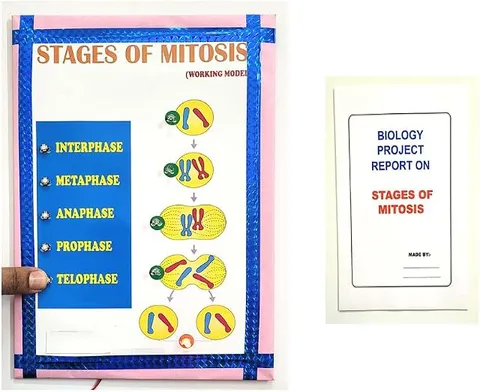
Stages of Mitosis and Meiosis Cell Division Educational Biology Science Working Project Model with Printed Report
Code B0DK22Y4DB
- Paid for and delivered by Amazon. The current price and the delivery date for your PIN code are shown there.
- Sold by Gurukul Technicals Institute, Delhi.
- Need a different topic, a custom version or a school order? Ask on WhatsApp.
In this project guide
Ready-made model
About this model
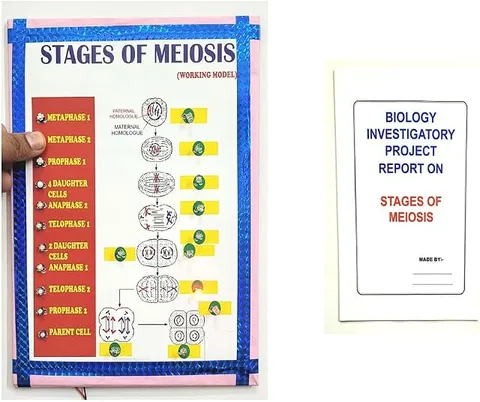
This biology project model covers the stages of mitosis and meiosis, the two kinds of cell division, and gives a student a way to explain how meiosis halves the chromosome number and creates variation. The listing says a printed report is included, which supports the written part of a school project.
How it works
The science behind it
The idea the model demonstrates, in words you can use in your report and when you explain it.
Mitosis gives two daughter cells that are genetically identical to the parent and is used for growth and repair. Meiosis takes place in reproductive organs and has two divisions. Meiosis I is the reductional division: in prophase I, homologous chromosomes pair up and exchange segments by crossing over at points called chiasmata; in metaphase I the pairs line up at the equator; in anaphase I the homologous chromosomes, not the chromatids, move to opposite poles. Meiosis II is like mitosis: sister chromatids separate, giving four haploid cells in all. Halving the chromosome number (2n to n) means that when two gametes fuse at fertilisation, the normal diploid number is restored. Crossing over and the random way chromosome pairs line up create new combinations of genes, which is why brothers and sisters do not look exactly alike. In the school lab, onion root tips are used to observe mitosis and flower buds to observe meiosis.
Make it yourself
Make a magnetic mitosis and meiosis model yourself
Build your own version from scratch, or use the steps to understand how the ready-made model is put together before you present it.
What you need 8
Step by step 8 steps
Cut one long and one short chromosome in each colour, so the cell has 2n = 4: a long pair and a short pair. For the stages after copying, make a second set and join each copy to its partner at a bead, forming sister chromatids.
Stick a small piece of magnet behind every chromosome and chromatid so it holds on the steel base and can be moved from stage to stage.
Draw a row of mitosis cells on the base: interphase, prophase, metaphase, anaphase, telophase, and cytokinesis ending in two daughter cells.
Move the chromosomes along the row as you explain: they condense in prophase, line up singly on the equator in metaphase, the sister chromatids are pulled apart in anaphase, and each daughter cell ends with four chromosomes.
Draw a second row for meiosis. In prophase I, place each blue chromosome beside its pink partner and swap a small tip between one chromatid of each to show crossing over.
In metaphase I, line up the pairs on the equator; in anaphase I, move whole chromosomes, not chromatids, to opposite poles, so each of the two cells now has n = 2.
Continue with meiosis II, where the sister chromatids separate as in mitosis, to finish with four cells, each with two chromosomes, some carrying segments of the other colour.
- Make the cell-cycle wheel
Draw the stages around the disc, fix it behind the window card with the paper fastener, and turn it to show them in order.
Read this first
Safety first
Go through these points before you build or switch anything on. Younger students should do this with an adult.
- Use scissors carefully, and ask an adult to cut the steel sheet or any thick magnetic sheet, whose edges can be sharp.
- Keep magnets and beads away from young children; swallowed magnets are very dangerous.
- Keep magnets away from mobile phones, bank cards and computer screens.
- Wash your hands after using clay and paints.
Troubleshooting
If something does not work
The usual problems with this model and how to fix them. Open a problem to see the fix.
The chromosomes slide down the board
The magnets are too weak for their weight. Use thin craft foam instead of clay, or a larger piece of magnet behind each one.
Visitors cannot tell mitosis from meiosis
Keep the two rows the same width and add a summary card at the end of each: two identical cells with 2n for mitosis, four varied cells with n for meiosis.
The crossing-over swap looks confusing
Use strongly contrasting colours and swap only a small tip of one chromatid from each chromosome, then point out that the other two chromatids keep their original colour.
Clay chromosomes crack or break
Roll them thicker and let them dry slowly, or switch to craft foam, which bends without breaking.
Exhibition day
How to present it
A running order for the exhibition table or the practical, step by step.
Show meiosis I and meiosis II separately and explain why the first is called reductional and the second equational.
Colour the chromosomes from each parent differently on your chart so that crossing over is easy to see.
Finish with a comparison chart of mitosis and meiosis and point out where each happens in the body.
Explain the link with heredity: meiosis is why children resemble their parents but are not exact copies.
Practice
Viva questions
Practice questions on this model, with short answers. Try each one aloud before you open the answer.
What is crossing over and when does it happen?
Crossing over is the exchange of segments between non-sister chromatids of homologous chromosomes, and it happens during prophase I of meiosis.
Why is meiosis I called reductional division?
Because homologous chromosomes separate in it, so each daughter cell gets half the chromosome number of the parent cell.
Where does meiosis take place in flowering plants?
In the anthers, where pollen grains form, and in the ovules inside the ovary.
Why are onion root tips used to study mitosis?
The root tip has a growing region where cells divide rapidly, so many cells can be seen in different stages of mitosis.
Project file
Project file outline
The headings of the project file, in order. Give each heading its own section and write it in your own words.
The listing includes a printed project report: use this outline to check that your own file covers every part.
Free ebook: Writing a Science Project FileContents
- Aim: to compare mitosis and meiosis using a model with movable chromosomes
- Introduction: the cell cycle, chromosomes and why cells divide
- Stages of mitosis, with diagrams
- Stages of meiosis I and meiosis II, with diagrams
- Crossing over and how it creates variation
- Comparison table: mitosis and meiosis
- Construction of the magnetic model and the cell-cycle wheel
- Why meiosis keeps the chromosome number constant from one generation to the next
- Conclusion and bibliography
Buying checklist
Before you buy
What to check before you order the model, and what to do when it arrives.
1Before you order
- Check how much of cell division your syllabus covers; it is introduced in the middle classes and the stages are studied in detail in Class 11.
- The listing says a printed report is included; read it alongside your textbook and add your own labelled diagrams.
- Practise explaining the difference between anaphase I and anaphase II, which examiners often ask about.
- Keep the box and some padding for transport.
- Check the delivery date for your PIN code on the marketplace, and order well before the exhibition or practical.
2When it arrives
- On arrival, check that every stage is clearly labelled and no part has come loose.
Next steps
Take it further
Ways to turn this model into a bigger investigation or a stronger exhibition entry.
With a teacher, look at a stained onion root tip slide under the microscope and sketch the mitosis stages you can find.
Work out how many different combinations of chromosomes a gamete can receive (2 to the power n) for n = 2 and n = 23, and explain why brothers and sisters differ.
Add a card on what happens when chromosomes fail to separate properly, with Down syndrome as an example.
Audience
Who it suits
Suits Class 10 to 12 biology students for exhibitions, practical files and revision of cell division and heredity.
- SubjectBiology
- TypeReady-made model
- Project reportPrinted report included
Free to read
Free ebooks for this topic
Free PDF ebooks from Gurukul Technicals Institute on the science, the making and the presenting of projects like this one.
- Free PDF ebook
Biology Models Guide
Make the heart, lungs, kidney, eye, cell and more, and explain them well
- Free PDF ebook
Your Science Exhibition Guide
Choose a project, build it, present it and answer the judges with confidence
- Free PDF ebook
Writing a Science Project File
How to write the report, from the cover page to the bibliography
- Free PDF ebook
Viva Questions for Science Projects
How to answer examiner questions, with sample questions for popular projects