- Biology
- DIY kit
- Class 1 to 9
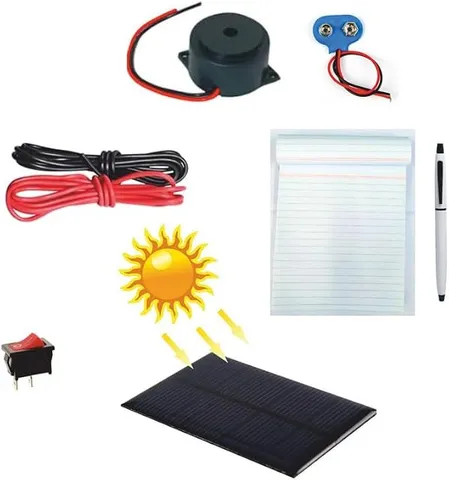
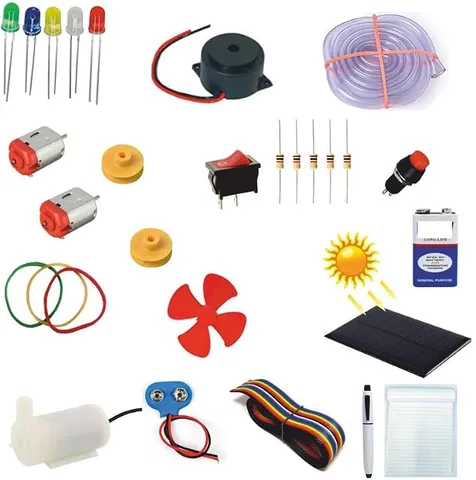
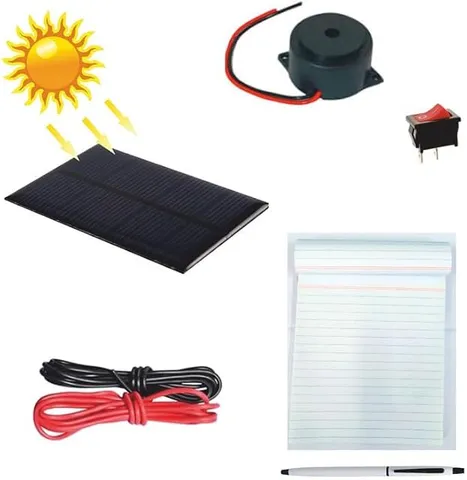
Solar Panel Cell 5V Starter DIY KIT Long Durable Life with Rough PAD and Pen
Code B0FGV4MWLS
- Paid for and delivered by Amazon. The current price and the delivery date for your PIN code are shown there.
- Sold by Gurukul Technicals Institute, Delhi.
- Need a different topic, a custom version or a school order? Ask on WhatsApp.
DIY kit
About this kit
This is a starter kit built around a 5V solar panel for school renewable energy projects; the listing says it comes with a rough pad and a pen. A panel like this can be used in models such as a solar fan, a solar car or an LED lamp, and makes a good first step into solar electronics.
How it works
The science behind it
The idea the kit demonstrates, in words you can use in your report and when you explain it.
A solar cell is a large, thin PN junction, usually made of silicon. When sunlight falls on it, photons with enough energy create electron-hole pairs near the junction. The electric field in the depletion region pushes electrons to the n-side and holes to the p-side, building up a voltage; this is the photovoltaic effect. When a circuit is connected, current flows, so light energy is converted directly into electrical energy, as DC. A single silicon cell gives only about 0.5 to 0.6 V, so a 5 V panel has many cells joined in series, where voltages add. The output depends on the intensity of light and the angle of the panel: it is highest when sunlight falls straight onto the surface and drops in shade or cloudy weather. Electrical power is P = V × I. Rooftop solar panels in India usually face south, because the country lies north of the equator.
Using it in your projects
Using the 5 V solar panel in your projects
What this kit is good for, what else you need with it and how to connect it.
Projects you can build with it 7
- A solar fan that spins faster as the sunlight gets brighter
- A solar car on a light card chassis
- A solar LED lamp that charges rechargeable cells by day
- A solar water pump for an irrigation model
- An investigation of panel angle against output voltage
- A comparison of output in sun, cloud and shade through the day
- A solar-powered turntable for another exhibition model
What else you need 8
How to connect it 8 steps
Find the panel's positive and negative leads from their colours or markings, and confirm them with the multimeter in sunlight.
Measure the voltage with nothing connected in full sun, then in shade and under a room light, and note how much it falls.
Connect the LED with its resistor to the panel, long leg to positive, and watch it light in sunlight.
Connect the motor with the fan blade; if it does not start in weak light, give the blade a gentle push.
Set the panel on the stand at different angles to the sun and measure the voltage at each angle with the motor connected.
Cover one corner of the panel with card and see how much the output drops, because the cells inside are joined in series.
To store energy, connect the panel to the rechargeable cells through the diode, banded end towards the cells' positive, so they cannot discharge back through the panel.
Fix the panel firmly to your model with tape or a stand, keeping its face clean and unshaded.
Read this first
Safety first
Go through these points before you build or switch anything on. Younger students should do this with an adult.
- Never look at the sun while aiming the panel; judge the angle from the stand's shadow instead.
- The panel can get hot in strong sun, so handle it by the edges and let it cool.
- Do not connect the panel straight to a mobile phone or to a lithium cell, because its voltage is not regulated.
- Solder only with an adult present.
Troubleshooting
If something does not work
The usual problems with this kit and how to fix them. Open a problem to see the fix.
The panel shows almost no voltage indoors
Room lights are far too weak. Test it outside in direct sunlight.
The voltage is fine but the motor will not start
The panel cannot give enough current to start a stiff motor. Use a light, free-spinning motor and blade, or give it a push.
The output drops sharply when a small part is shaded
The cells are in series, so one shaded cell limits the whole panel. Keep the entire face in sunlight.
The LED does not light
It is probably the wrong way round. Turn it so its long leg goes to the panel's positive lead.
Exhibition day
How to present it
A running order for the exhibition table or the practical, step by step.
Measure the panel's voltage with a multimeter in direct sun, in shade and under a tube light, and show the readings on a chart.
Tilt the panel at different angles to show that the output is highest when sunlight falls straight on it.
Explain the photovoltaic effect with a simple drawing of a PN junction.
If you plan to charge anything, mention that the panel's voltage changes with light, so devices like phones need a proper regulator circuit.
Practice
Viva questions
Practice questions on this kit, with short answers. Try each one aloud before you open the answer.
On which principle does a solar cell work?
It works on the photovoltaic effect, in which light falling on a PN junction produces a voltage and a current.
Roughly how much voltage does one silicon cell produce, and how does a panel reach 5 V?
About 0.5 to 0.6 V, so a 5 V panel joins many cells in series so that their voltages add up.
Does a solar panel give AC or DC?
A solar panel gives direct current (DC); an inverter is needed to change it to AC for home appliances.
Which direction should a fixed solar panel face in India for the best yearly output, and why?
South, because India lies north of the equator, so for most of the year the Sun is in the southern part of the sky.
Buying checklist
Before you buy
What to check before you order the kit, and what to do when it arrives.
1Before you order
- Check the listing for the panel's voltage, current and size, and choose a motor or LED that suits it.
- Check in the listing whether wires are attached to the panel; if not, you will need to solder them with an adult.
- Keep it in its box or wrapped in cloth so the face is not scratched.
- Check the delivery date for your PIN code on the marketplace, and order well before the exhibition or practical.
2When it arrives
- Test the panel outdoors in sunlight as soon as it arrives.
Next steps
Take it further
Ways to turn this kit into a bigger investigation or a stronger exhibition entry.
Measure the panel's current with resistors of different values and plot a current-voltage curve to find where it gives the most power.
Join two panels in series and then in parallel, and compare the voltage and current.
Record the panel's output every hour through a sunny day and plot it against time.
Audience
Who it suits
Suits Class 6 to 12 students making solar energy projects and beginners learning basic electronics.
- ClassClass 1 to 9
- SubjectBiology
- TypeDIY kit
Free to read
Free ebooks for this topic
Free PDF ebooks from Gurukul Technicals Institute on the science, the making and the presenting of projects like this one.
- Free PDF ebook
Electronic Components Handbook
Resistors, capacitors, LEDs, diodes, transistors and more, with how to use each
- Free PDF ebook
Tools, Materials and Safety for Model Making
Everything you need to build neat, strong and safe science models
- Free PDF ebook
Your Science Exhibition Guide
Choose a project, build it, present it and answer the judges with confidence