- Biology
- Ready-made model
- Class 1 to 9
Plant Cell Biology Working Model Educational Science Project
Code B0BN2GG6CW
- Paid for and delivered by Amazon. The current price and the delivery date for your PIN code are shown there.
- Sold by Gurukul Technicals Institute, Delhi.
- Need a different topic, a custom version or a school order? Ask on WhatsApp.
In this project guide
Ready-made model
About this model
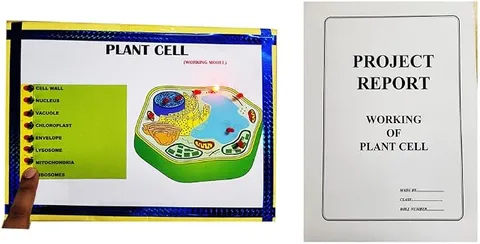
This biology working model shows the structure of a plant cell and its main parts, from the rigid cell wall to the chloroplasts and the large central vacuole. It helps a student explain what each organelle does and how a plant cell differs from an animal cell.
How it works
The science behind it
The idea the model demonstrates, in words you can use in your report and when you explain it.
The cell is the basic structural and functional unit of life; Robert Hooke first saw and named cells in 1665 while looking at a thin slice of cork. A plant cell is surrounded by a rigid cell wall made of cellulose, which gives it shape and support. Inside it, the cell membrane is selectively permeable and controls what enters and leaves. The nucleus contains chromosomes made of DNA and controls the cell's activities. Chloroplasts contain chlorophyll and carry out photosynthesis, while mitochondria release energy from food during respiration. A large central vacuole stores cell sap and keeps the cell firm through turgor pressure. Ribosomes make proteins, and the endoplasmic reticulum and Golgi apparatus help make and transport materials. Animal cells have no cell wall or chloroplasts, and their vacuoles, if present, are small. Wilted spinach leaves become crisp again in water because their vacuoles fill up and the cells become turgid.
Make it yourself
Make a plant cell model with moving chloroplasts yourself
Build your own version from scratch, or use the steps to understand how the ready-made model is put together before you present it.
What you need 9
Step by step 8 steps
Line the edge of the tray with the thick green strip as the cell wall and the thin yellow strip just inside it as the cell membrane, with a small gap so both can be seen.
Mount the motor under the tray with its shaft coming up through a hole near the middle, and fix the clear disc flat on the shaft.
Glue the blue vacuole in the middle of the disc so it takes up most of the cell, and glue the green chloroplasts around the disc's edge.
Model the nucleus with a nucleolus and a double outline for the nuclear membrane, and fix it near one side of the cell, where the large vacuole pushes it in a mature plant cell.
Add mitochondria as small capsule shapes with folded inner lines, the Golgi apparatus as a stack of curved flat sacs, rough ER dotted with tiny ribosome beads, and smooth ER without them, keeping all of them clear of the turning disc.
Wire the motor to the cells through the switch and check that the disc turns slowly: the chloroplasts circle the vacuole, showing cytoplasmic streaming, which can be seen in Hydrilla leaf cells under a microscope.
Label every part with toothpick flags, and add a card listing the parts found only in plant cells: cell wall, chloroplasts and a large central vacuole.
Add a small side panel with an animal cell outline for comparison, showing its small vacuoles and the lack of a cell wall.
Read this first
Safety first
Go through these points before you build or switch anything on. Younger students should do this with an adult.
- Use the glue gun and any cutter only with an adult, and let glue cool before touching.
- Keep fingers away from the turning disc and the motor shaft.
- Keep small beads away from young children at the exhibition.
- If you look at onion peel or Hydrilla under a microscope, handle glass slides and any stain only with a teacher.
Troubleshooting
If something does not work
The usual problems with this model and how to fix them. Open a problem to see the fix.
The disc turns too fast
The motor needs more gear reduction. Run it on fewer cells or use a slower-rated motor; streaming in real cells is slow and steady.
The disc wobbles or scrapes the tray
The shaft is off-centre or the disc is warped. Re-centre it and add a thin washer so the disc clears the tray floor.
Visitors ask why the nucleus is at the side
In mature plant cells the large central vacuole pushes the cytoplasm and nucleus towards the wall, so the side position is correct.
Clay organelles fall off
Press them onto small dots of glue rather than relying on the clay to stick, and keep the model level.
Exhibition day
How to present it
A running order for the exhibition table or the practical, step by step.
Point to each organelle and give its job in a few words, starting from the outside and moving inward.
Make a comparison chart of plant and animal cells, highlighting the cell wall, chloroplasts and vacuole.
If you can, show an onion peel slide or a photo of one to connect the model with a real cell.
Use the spinach example to explain turgor pressure in a way visitors remember.
Practice
Viva questions
Practice questions on this model, with short answers. Try each one aloud before you open the answer.
Which organelle is called the powerhouse of the cell?
The mitochondrion, because it releases energy from food during respiration.
Name three structures found in a plant cell but not in an animal cell.
A cell wall, chloroplasts (plastids) and a large central vacuole.
What is the cell wall of a plant cell made of?
It is made mainly of cellulose, which makes it strong and rigid.
What is the function of the vacuole in a plant cell?
It stores cell sap and keeps the cell firm by maintaining turgor pressure.
Project file
Project file outline
The headings of the project file, in order. Give each heading its own section and write it in your own words.
Free ebook: Writing a Science Project FileContents
- Aim: to show the structure of a plant cell and the function of each part
- Introduction: the cell as the basic unit of life, and Robert Hooke's discovery
- Cell wall, cell membrane and cytoplasm
- Nucleus, mitochondria, plastids, ER, Golgi apparatus, ribosomes and vacuole
- Cytoplasmic streaming and how the model shows it
- Table of differences between plant and animal cells
- Construction of the model
- Observation of onion peel cells under a microscope
- Conclusion and bibliography
Buying checklist
Before you buy
What to check before you order the model, and what to do when it arrives.
1Before you order
- Check which cell parts your syllabus names (Class 8 and Class 9 differ), and compare them with the parts shown in the listing photos.
- Plan to add labels or a comparison card yourself if your textbook names parts the model does not show.
- Practise pointing to each part and giving its function in one line.
- Keep the box to carry the model.
- Check the delivery date for your PIN code on the marketplace, and order well before the exhibition or practical.
2When it arrives
- On arrival, check that no part has come loose and that any working part runs smoothly.
Next steps
Take it further
Ways to turn this model into a bigger investigation or a stronger exhibition entry.
With a teacher, prepare an onion peel slide stained with safranin, draw what you see under the microscope, and compare it with your model.
Show osmosis in plant tissue by placing potato strips in plain and salty water and recording how their length changes.
Add a card on centrioles, which the cells of flowering plants do not have, and explain how those cells still divide.
Audience
Who it suits
Suits Class 8 and 9 biology exhibitions and lessons on cell structure.
- ClassClass 1 to 9
- SubjectBiology
- TypeReady-made model
Free to read
Free ebooks for this topic
Free PDF ebooks from Gurukul Technicals Institute on the science, the making and the presenting of projects like this one.
- Free PDF ebook
Biology Models Guide
Make the heart, lungs, kidney, eye, cell and more, and explain them well
- Free PDF ebook
Your Science Exhibition Guide
Choose a project, build it, present it and answer the judges with confidence
- Free PDF ebook
Writing a Science Project File
How to write the report, from the cover page to the bibliography
- Free PDF ebook
Viva Questions for Science Projects
How to answer examiner questions, with sample questions for popular projects