- Biology
- Ready-made model
- Class 1 to 9
Biogas Plant Biology Working Model Educational Science Project
Code B0BN2GKZ32
- Paid for and delivered by Amazon. The current price and the delivery date for your PIN code are shown there.
- Sold by Gurukul Technicals Institute, Delhi.
- Need a different topic, a custom version or a school order? Ask on WhatsApp.
In this project guide
Ready-made model
About this model
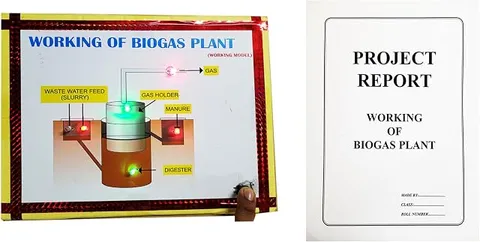
A working model of a biogas plant, the kind of digester used in Indian villages to turn cow dung and kitchen waste into cooking gas and manure. It helps students explain how waste becomes a clean fuel through the work of bacteria living without oxygen.
How it works
The science behind it
The idea the model demonstrates, in words you can use in your report and when you explain it.
A biogas plant works by anaerobic digestion, the breakdown of organic matter by microorganisms in the absence of oxygen. A slurry of cow dung and water is fed into a sealed digester. First, bacteria break large molecules such as carbohydrates, fats and proteins into simpler compounds; next, acid-forming bacteria turn these into simple acids; finally, methane-producing bacteria convert them into biogas. Biogas is mainly methane, with carbon dioxide and small amounts of hydrogen and hydrogen sulphide. Methane burns with a clean blue flame and leaves no smoke or ash, unlike dung cakes. The gas collects in a dome or floating drum and is piped to the kitchen, while the spent slurry left behind is rich in nitrogen and phosphorus and makes good manure. Gobar gas plants in rural India are the everyday example, saving firewood and cutting indoor smoke.
Make it yourself
Make a floating-drum biogas plant model yourself
Build your own version from scratch, or use the steps to understand how the ready-made model is put together before you present it.
What you need 9
Step by step 8 steps
Stand the digester in the middle of the base, with the inlet tank on the left and the outlet tank on the right, slightly lower, and join both to the bottom of the digester with pipes sealed by glue.
Fill the digester with brown-coloured water to stand for slurry, and set the cut bottle upside down in it so it floats with its open end under the water.
Fit the gas tube and its clip to the top of the gas holder and run it to the model stove.
Push air through the gas tube with the syringe: the gas holder rises, showing how the drum lifts as biogas collects. Open the clip and it sinks as the gas is used.
- Label the parts
Inlet for dung and water, digester, floating gas holder, gas outlet, and outlet for the digested slurry that is used as manure.
For the real test, wear gloves and, with an adult, mix fresh cow dung and water about half and half into a smooth slurry, and fill the 1-litre bottle about two-thirds full through the funnel.
Stretch the balloon over the bottle's neck, seal it with tape, and keep the bottle somewhere warm but out of direct sun. Check it daily; the balloon slowly fills over one to three weeks, faster in warm weather.
Photograph the balloon every few days and display the dated photos beside the model.
Read this first
Safety first
Go through these points before you build or switch anything on. Younger students should do this with an adult.
- Never try to light the gas from the balloon or the model; methane is flammable, and burning it is a job for trained people with proper equipment.
- Wear gloves when handling cow dung, wash your hands with soap afterwards, and do not touch your face while working.
- Release the balloon's gas only outdoors and away from flames, and with an adult, bury or compost the slurry when the test is over.
- Use the glue gun and any cutter only with an adult.
Troubleshooting
If something does not work
The usual problems with this model and how to fix them. Open a problem to see the fix.
The balloon does not fill
The weather may be cold, the slurry too thin or too dry, or the neck may leak. Seal the neck well, keep the bottle warm, and give it more time; fresh dung works best.
The gas holder tips over
It is too tall for its width or not deep enough in the water. Use a wider, shorter bottle and add a little weight around its rim.
Water leaks from the pipe joints
Seal every joint with glue on the outside, let it set for a day before filling, and wrap the joints with sealing tape too.
The bottle smells strongly
A rotten-egg smell from hydrogen sulphide is normal. Keep the bottle outdoors or in a well-ventilated place and do not open it indoors.
Exhibition day
How to present it
A running order for the exhibition table or the practical, step by step.
Label the inlet, digester, gas holder, gas outlet and outlet tank, and point to each in the order the slurry moves.
Explain why the digester must be airtight, because this is the question judges ask most often.
Compare biogas with dung cakes and firewood on a small chart covering smoke, ash, heat and manure.
Mention both products of the plant, fuel and manure, to show that one plant solves two problems.
Practice
Viva questions
Practice questions on this model, with short answers. Try each one aloud before you open the answer.
What is anaerobic digestion?
It is the breakdown of organic matter by microorganisms in the absence of oxygen, which produces biogas and slurry.
What is the main component of biogas?
Methane is the main component; most of the rest is carbon dioxide, with traces of hydrogen and hydrogen sulphide.
Why must the digester be airtight?
The methane-producing bacteria are anaerobic and work only without oxygen, and an airtight tank also stops the gas from escaping.
How is the slurry from a biogas plant used?
The slurry is rich in nitrogen and phosphorus, so it is used as manure in fields.
Project file
Project file outline
The headings of the project file, in order. Give each heading its own section and write it in your own words.
Free ebook: Writing a Science Project FileContents
- Aim: to show how a biogas plant turns cow dung and waste into fuel gas and manure
- Introduction: biomass as a renewable source of energy
- Anaerobic digestion and the three stages carried out by bacteria
- Composition of biogas, and why methane is a clean fuel
- Parts of a floating-drum biogas plant and their functions
- Construction of the model
- Observations: daily record of the balloon test
- Benefits of biogas for Indian villages: fuel, manure and cleaner surroundings
- Conclusion and bibliography
Buying checklist
Before you buy
What to check before you order the model, and what to do when it arrives.
1Before you order
- Check that biogas or sources of energy is in your syllabus (Class 8 to 10 science), and whether a display model is enough or your teacher wants an experiment too.
- Look at the listing photos to see which type of plant is shown, floating drum or fixed dome, and read up on that type.
- Start the balloon test at least three weeks before the exhibition, since gas forms slowly.
- Keep the box for transport.
- Check the delivery date for your PIN code on the marketplace, and order well before the exhibition or practical.
- Practise explaining it. Judges ask what the model shows and why; knowing the science matters as much as the model. The viva questions above are a good place to start.
2When it arrives
- On arrival, check the parts are firmly fixed, and if it holds water, test it on a tray first.
Next steps
Take it further
Ways to turn this model into a bigger investigation or a stronger exhibition entry.
Compare the floating-drum and fixed-dome designs, and explain which keeps the gas pressure steadier and why.
Set up two balloon bottles, one in a warm place and one in a cool place, and compare how quickly gas forms.
Estimate from published figures how much cooking gas the dung of a family's cattle could provide each day.
Audience
Who it suits
Suits Class 7 to 10 science exhibitions on energy, waste management and the environment.
- ClassClass 1 to 9
- SubjectBiology
- TypeReady-made model
Free to read
Free ebooks for this topic
Free PDF ebooks from Gurukul Technicals Institute on the science, the making and the presenting of projects like this one.
- Free PDF ebook
Biology Models Guide
Make the heart, lungs, kidney, eye, cell and more, and explain them well
- Free PDF ebook
Your Science Exhibition Guide
Choose a project, build it, present it and answer the judges with confidence
- Free PDF ebook
Writing a Science Project File
How to write the report, from the cover page to the bibliography