- Biology
- Ready-made model
- Class 1 to 9
Conduction of Water and Food in Plant Biology Handmade Working Model and Educational Science Project
Code B0C3H2RC92
- Paid for and delivered by Amazon. The current price and the delivery date for your PIN code are shown there.
- Sold by Gurukul Technicals Institute, Delhi.
- Need a different topic, a custom version or a school order? Ask on WhatsApp.
In this project guide
Ready-made model
About this model
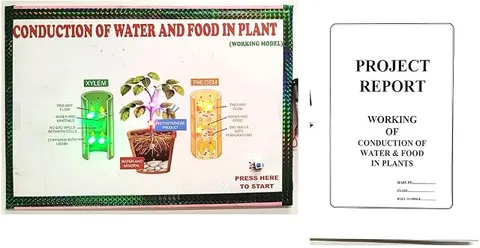
This handmade working model shows how water and food are transported inside a plant through two kinds of tissue, xylem and phloem. It helps students explain an invisible process with a clear visual, which is useful for exhibitions and biology projects. It suits middle and secondary school students.
How it works
The science behind it
The idea the model demonstrates, in words you can use in your report and when you explain it.
Plants have two conducting tissues. Xylem carries water and dissolved minerals from the roots up to the stem and leaves, always upward. Water moves mainly because of transpiration: as water evaporates through the stomata of the leaves, it creates a pull that draws a continuous column of water up the xylem. Root pressure helps too, especially at night. Phloem carries food, mainly sugar made in the leaves by photosynthesis, to every part of the plant that needs it, including roots, fruits and growing tips. This transport, called translocation, can go up or down, and unlike movement in the xylem it uses energy from ATP. Together the two tissues form the vascular bundles that we see as veins in a leaf. A classic Indian school activity shows the xylem at work: keep a balsam plant in water coloured with red ink, and the red colour soon appears in its stem and veins.
Make it yourself
Make a model of water and food transport in a plant yourself
Build your own version from scratch, or use the steps to understand how the ready-made model is put together before you present it.
What you need 7
Step by step 8 steps
Draw the plant on the sunboard with roots at the bottom, a thick stem and leaves at the top, and label root hairs, stem, leaf and fruit.
Fix the bottom container behind the roots, fill it with blue water, and place the pump in it.
Run the wider tube from the pump up through the roots and stem to the top container behind the leaves, so blue water climbs upward only.
Fill the thinner tube with orange water, seal its ends, and fix it from the leaves down to the roots and up to the fruit, with arrows pointing both ways.
Keep the cell holder and switch on a dry shelf at the side and run the pump wires along the board.
Switch on and show the blue water rising, like the water column in the xylem; switch off once the top container is nearly full.
For a live demonstration, stand a white flower or celery stalk in blue ink water a day before, then show the coloured veins and the blue dots in a cut stem.
Add cards explaining the transpiration pull at the leaves and the movement of food through the phloem.
Read this first
Safety first
Go through these points before you build or switch anything on. Younger students should do this with an adult.
- Keep the cells, switch and wires away from water, and dry your hands before switching on.
- Never run the pump without water, and switch it off before the top container overflows.
- Food colour and ink stain, so cover the table and wear old clothes.
- Seal the tubing with the glue gun, and cut it, only with an adult.
Troubleshooting
If something does not work
The usual problems with this model and how to fix them. Open a problem to see the fix.
The pump runs but the water does not reach the top
The tube is too long or the top too high for a small pump. Lower the top container, use a shorter tube, and check for kinks.
Water overflows at the top
Add a return tube from the top container back down to the bottom one, so the water goes round instead of spilling.
The flower does not take up the colour
Cut the stem freshly at an angle just before placing it, use more colour, and leave it in a warm, bright room for longer.
The tube joints leak
Switch off, dry the joint, and seal it with tape or glue once the glue gun has cooled.
Exhibition day
How to present it
A running order for the exhibition table or the practical, step by step.
Use two colours consistently, one for water in xylem and one for food in phloem, and explain the key.
Point out that water moves only upward while food moves in both directions.
Bring a balsam or celery stem kept in coloured water as a live demonstration beside the model.
Explain transpiration pull with the simple example of sipping through a straw.
Practice
Viva questions
Practice questions on this model, with short answers. Try each one aloud before you open the answer.
What is the function of xylem?
Xylem transports water and dissolved minerals from the roots to the leaves and other parts above the ground.
What is translocation?
Translocation is the movement of food made in the leaves to other parts of the plant through the phloem.
What makes water rise in tall trees?
Mainly transpiration pull, created when water evaporates from the leaves, helped by root pressure.
Why does transport in the phloem need energy?
Because sugars are actively loaded into the phloem using energy from ATP, which builds up the pressure that moves the sap.
Project file
Project file outline
The headings of the project file, in order. Give each heading its own section and write it in your own words.
Free ebook: Writing a Science Project FileContents
- Aim: to show how water moves through the xylem and food through the phloem of a plant
- Structure of xylem and phloem
- Transpiration pull and root pressure
- Translocation of food from the leaves to roots, fruits and growing tips
- How the model was built, with a labelled diagram
- Live experiment: coloured water in a flower or celery stalk, with photos
- Transport in xylem and phloem compared
- Conclusion on how a plant moves water and food without a heart, and references
Buying checklist
Before you buy
What to check before you order the model, and what to do when it arrives.
1Before you order
- Check the class level in the listing and that the model covers both xylem and phloem, as your syllabus asks.
- See whether the listing describes it as working (with a pump or lights) and whether it needs batteries.
- Keep the box and carry the model upright.
- Check the delivery date for your PIN code on the marketplace, and order well before the exhibition or practical.
- Practise explaining it. Judges ask what the model shows and why; knowing the science matters as much as the model. The viva questions above are a good place to start.
2When it arrives
- When it arrives, look for loose labels or cracked parts, and test any working part with water early.
Next steps
Take it further
Ways to turn this model into a bigger investigation or a stronger exhibition entry.
Time how fast coloured water rises in celery stalks kept in light and dark, or with and without a fan, to show the effect of transpiration.
Tie a clear plastic bag over some leaves of a potted plant and collect the water given off in a day.
Compare monocot and dicot stems using cross-section diagrams or slides from the school lab.
Audience
Who it suits
Class 7 to 10 biology projects and science exhibitions on transport in plants.
- ClassClass 1 to 9
- SubjectBiology
- TypeReady-made model
Free to read
Free ebooks for this topic
Free PDF ebooks from Gurukul Technicals Institute on the science, the making and the presenting of projects like this one.
- Free PDF ebook
Biology Models Guide
Make the heart, lungs, kidney, eye, cell and more, and explain them well
- Free PDF ebook
Your Science Exhibition Guide
Choose a project, build it, present it and answer the judges with confidence
- Free PDF ebook
Writing a Science Project File
How to write the report, from the cover page to the bibliography
- Free PDF ebook
Viva Questions for Science Projects
How to answer examiner questions, with sample questions for popular projects