- Biology
- Ready-made model
- Class 1 to 9
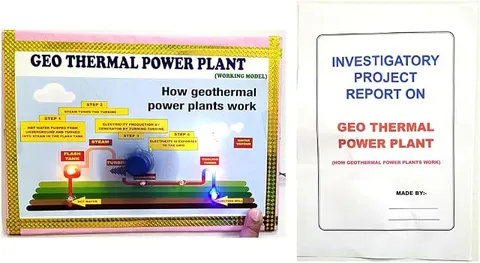
How a Geothermal Power Plant Works Working Model Project and Science Aid Educational Electronic Hobby Kit
Code B0DTYL4MK7
- Paid for and delivered by Amazon. The current price and the delivery date for your PIN code are shown there.
- Sold by Gurukul Technicals Institute, Delhi.
- Need a different topic, a custom version or a school order? Ask on WhatsApp.
In this project guide
Ready-made model
About this model
This working model explains how a geothermal power plant uses heat from inside the Earth to produce steam and generate electricity. It is a good exhibition choice on renewable energy because it shows a source that, unlike solar and wind, can run day and night.
How it works
The science behind it
The idea the model demonstrates, in words you can use in your report and when you explain it.
The Earth's interior is very hot, partly from heat left over from its formation and partly from the slow radioactive decay of elements such as uranium, thorium and potassium in the rocks. In some places, usually near plate boundaries and volcanic regions, hot rocks lie close to the surface and heat underground water into hot water or steam. A geothermal plant drills wells into these zones and brings the steam up. The steam spins a turbine connected to a generator, so heat energy becomes mechanical energy and then electrical energy. The cooled water is pumped back underground to be heated again, which keeps the source going. Some plants use the hot water to boil a second liquid with a lower boiling point. India has hot springs at places like Manikaran in Himachal Pradesh, and the Puga Valley in Ladakh is being explored for geothermal power.
Make it yourself
Make a geothermal power plant model yourself
Build your own version from scratch, or use the steps to understand how the ready-made model is put together before you present it.
What you need 9
Step by step 7 steps
Cut the front off the box and build up layers of clay: surface soil, rock, and a hot rock zone at the bottom.
Push the LEDs through into the hot rock zone and wire each, with its own resistor, to the 9 V battery through the first switch.
Run the red straw from the hot zone up to the power house as the production well, and the blue straw back down as the injection well.
Build the power house on the surface with the turbine fan inside, wired to its own two cells through the second switch. Keep the two circuits separate, so the 9 V battery is never joined to the cells.
Add a cooling tower with cotton wool steam beside it, and a transmission tower carrying wires away.
- Draw arrows along the straws
Hot water and steam rising in the red well, cooled water going down the blue one.
Switch on both circuits so the hot zone glows and the turbine spins, and label each part with its role in the energy change.
Read this first
Safety first
Go through these points before you build or switch anything on. Younger students should do this with an adult.
- Use cotton wool for steam; never boil water or use a kettle in the model.
- Keep fingers away from the turbine fan.
- Ask an adult to use the cutter and the glue gun.
- Switch off both circuits when the model is not on show.
Troubleshooting
If something does not work
The usual problems with this model and how to fix them. Open a problem to see the fix.
Some LEDs are bright and others dim
Each LED needs its own resistor; LEDs sharing one resistor in parallel take uneven current.
The turbine fan runs slowly
Its cells are weak, or the blade rubs on the power house wall. Fit fresh cells and free the blade.
Visitors mix up the two wells
Paint them clearly red and blue, and add arrows and labels showing which way the water flows.
The cotton steam falls off
Fix it on a thin wire pushed into the cooling tower.
Exhibition day
How to present it
A running order for the exhibition table or the practical, step by step.
Explain the energy chain step by step: heat inside the Earth, steam, turbine, generator, electricity.
Explain why the cooled water is pumped back underground, since examiners often ask what keeps a geothermal source going.
Compare geothermal with solar and wind on a small chart: it works all day and night, but only in suitable places.
Show a map of India marking hot spring sites such as Manikaran and the Puga Valley.
Practice
Viva questions
Practice questions on this model, with short answers. Try each one aloud before you open the answer.
Where does the Earth's internal heat come from?
Partly from heat left over from the Earth's formation and partly from the radioactive decay of elements like uranium and thorium in the rocks.
What energy conversions take place in a geothermal power plant?
Heat from the Earth turns water into steam, the steam turns a turbine (mechanical energy), and the generator converts this into electrical energy.
Why is geothermal energy called renewable?
Heat is produced inside the Earth all the time, and the used water is pumped back underground to be heated again.
Why can't geothermal power plants be built everywhere?
They need hot rocks close to the surface, which are found mainly near plate boundaries and volcanic areas; elsewhere, drilling deep enough is too costly.
Project file
Project file outline
The headings of the project file, in order. Give each heading its own section and write it in your own words.
Free ebook: Writing a Science Project FileContents
- Aim: to show how a geothermal power plant uses heat from inside the Earth to generate electricity
- Materials
- Sources of the Earth's internal heat
- Parts of a geothermal power plant
- Energy conversion from heat to electricity
- Construction of the model
- Advantages and limitations of geothermal energy
- Places in India studied for geothermal energy, such as Puga Valley in Ladakh
- Conclusion
Buying checklist
Before you buy
What to check before you order the model.
1Check these first
- Renewable energy is a common exhibition theme; check that a geothermal model fits the topic your teacher has set.
- Check in the listing what powers any lights or moving parts and whether batteries are included.
- Switch the model on a few days before the exhibition to check every light works.
- Keep the box, as the straws, towers and fan bend easily.
- Check the delivery date for your PIN code on the marketplace, and order well before the exhibition or practical.
- Practise explaining it. Judges ask what the model shows and why; knowing the science matters as much as the model. The viva questions above are a good place to start.
Next steps
Take it further
Ways to turn this model into a bigger investigation or a stronger exhibition entry.
Set up a side-by-side comparison with a coal power plant to show that only the heat source differs.
Explain a binary cycle plant, which uses a liquid with a lower boiling point so that cooler underground water can still be used.
Add a chart comparing geothermal, solar and wind energy by day and by night.
Audience
Who it suits
Suits Class 8 to 10 science exhibitions on sources of energy and Class 6 to 8 lessons on renewable resources.
- ClassClass 1 to 9
- SubjectBiology
- TypeReady-made model
Free to read
Free ebooks for this topic
Free PDF ebooks from Gurukul Technicals Institute on the science, the making and the presenting of projects like this one.
- Free PDF ebook
Biology Models Guide
Make the heart, lungs, kidney, eye, cell and more, and explain them well
- Free PDF ebook
Your Science Exhibition Guide
Choose a project, build it, present it and answer the judges with confidence
- Free PDF ebook
Writing a Science Project File
How to write the report, from the cover page to the bibliography
- Free PDF ebook
Viva Questions for Science Projects
How to answer examiner questions, with sample questions for popular projects