- Biology
- Ready-made model
- Class 1 to 9
Sources of Water Biology Science Model Project and Science Teaching Aid Educational Electronic Hobby Kit
Code B0DTYJ1RK4
- Paid for and delivered by Amazon. The current price and the delivery date for your PIN code are shown there.
- Sold by Gurukul Technicals Institute, Delhi.
- Need a different topic, a custom version or a school order? Ask on WhatsApp.
In this project guide
Ready-made model
About this model
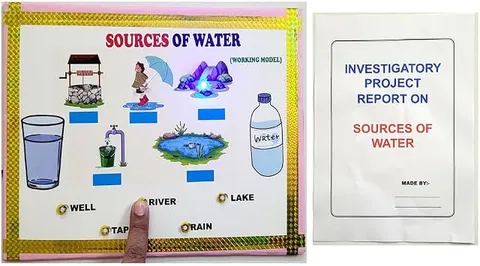
This science model shows where our water comes from, including rain, rivers, lakes, wells and underground water, and how the water cycle keeps refilling these sources. It helps students talk about why fresh water is limited and how it can be saved.
How it works
The science behind it
The idea the model demonstrates, in words you can use in your report and when you explain it.
About 97% of the water on Earth is salty ocean water. Only about 3% is fresh, and most of that is frozen in ice caps and glaciers or lies deep underground, so very little is easy to use. Rain is the main source that refills fresh water. Surface water is found in rivers, lakes, ponds and reservoirs, such as the Yamuna, which supplies part of Delhi's water. Groundwater collects when rain soaks into the soil (infiltration) and fills spaces in rock layers called aquifers; we draw it through wells, hand pumps and tube wells, and it comes out naturally at springs. All these sources are linked by the water cycle: the Sun's heat evaporates water, which condenses into clouds and falls back as rain or snow. When groundwater is pumped out faster than rain can recharge it, the water table falls. Rainwater harvesting, and old stepwells such as Delhi's Agrasen ki Baoli, show ways of storing rain.
Make it yourself
Make a sources of water model with a working tube well yourself
Build your own version from scratch, or use the steps to understand how the ready-made model is put together before you present it.
What you need 10
Step by step 8 steps
- Plan the layout
Snowy mountains at one end, a river flowing down to a lake, a village with a dug well, a hand pump and a tube well, and rain clouds above.
Build the mountains from crumpled newspaper and thermocol covered with layers of paper and paste. Let them dry fully, paint them, and add cotton snow on top.
Shape a river channel and a lake, paint them blue and cover them with cellophane, or line them with cling film to hold a little water.
Bury the clear container in one corner of the tray with gravel and water, and show the layers on its side: soil, sand, gravel and the water-holding layer (aquifer).
Put the pump inside the container and run its tube up through the straw to the overhead tank. Keep the cell holder and switch on a dry, raised spot well away from the water.
- Switch on briefly
Water rises up the tube well to the tank. Lead an overflow tube from the tank back into the container so the water goes round again.
Add a dug well, a pond and a rainwater-harvesting pit with a pipe from a house roof, to show rain recharging the groundwater.
Hang the clouds on a wire above the mountains and add arrows and labels for evaporation, condensation, rain and infiltration.
Read this first
Safety first
Go through these points before you build or switch anything on. Younger students should do this with an adult.
- Keep the cells, switch and wire joints dry; only the pump itself goes into the water.
- Do not run the pump dry, as it can overheat and be damaged.
- Keep the tray on a steady table, away from wall sockets and extension boards, and wipe up spills at once.
- An adult should do any cutting of the tray or containers and any hot gluing.
Troubleshooting
If something does not work
The usual problems with this model and how to fix them. Open a problem to see the fix.
The pump hums but no water comes up
Air may be trapped in it, it may not be fully under water, or the tube may be too high or kinked. Submerge the pump completely, shorten the tube and straighten it.
Water leaks from the buried container
Check for cracks and seal the joints with waterproof tape, or ask an adult to use a little sealant and let it dry fully.
The paper mountains stay soft or start to smell
The layers were too wet. Use thin layers and let each one dry in the sun before adding the next.
The pump runs slowly
The cells are weak. Fit fresh cells, and check the tube is not squashed.
Exhibition day
How to present it
A running order for the exhibition table or the practical, step by step.
Divide the model into surface water and groundwater and explain each part separately.
Show the water cycle with arrows for evaporation, condensation, precipitation and infiltration.
Mention a local example, such as the river or lake nearest to your town.
End with three water-saving tips that visitors can use at home or at school.
Practice
Viva questions
Practice questions on this model, with short answers. Try each one aloud before you open the answer.
What is the main source of fresh water?
Rain, which refills rivers, lakes and groundwater through the water cycle.
What is groundwater?
Water that soaks into the ground and is stored in the spaces between soil particles and rocks, in layers called aquifers.
Why can't we drink sea water directly?
It contains too much dissolved salt for the body to handle, so it must be desalinated first.
What is rainwater harvesting?
Collecting and storing rainwater from roofs and open areas, or directing it into the ground to recharge groundwater.
Project file
Project file outline
The headings of the project file, in order. Give each heading its own section and write it in your own words.
Free ebook: Writing a Science Project FileContents
- Aim: to show the different sources of water and how the water cycle refills them
- Introduction: why fresh water is precious and limited
- Rain as the main source of fresh water
- Surface water: rivers, lakes, ponds and reservoirs
- Groundwater: infiltration, aquifers, wells and tube wells
- The water cycle
- Construction and working of the model, including the tube-well pump
- Water scarcity, rainwater harvesting and saving water
- Conclusion
Buying checklist
Before you buy
What to check before you order the model, and what to do when it arrives.
1Before you order
- Check that sources of water is in your class syllabus and suits the model your teacher asked for.
- Read the listing to see what is mentioned with the model and whether batteries are needed.
- Plan whether you will carry water to the exhibition or show the model dry, and pack a cloth for spills.
- Keep the box to protect the landscape during transport.
- Check the delivery date for your PIN code on the marketplace, and order well before the exhibition or practical.
- Practise explaining it. Judges ask what the model shows and why; knowing the science matters as much as the model. The viva questions above are a good place to start.
2When it arrives
- Test any pump or lights at home soon after it arrives, with an adult nearby.
Next steps
Take it further
Ways to turn this model into a bigger investigation or a stronger exhibition entry.
Survey where your home's water comes from, such as a municipal supply, a borewell or a tanker, and present it as a chart.
Test how fast water soaks through sand, soil and clay in three cut bottles, and relate it to groundwater recharge.
Estimate how much rainwater your school roof could collect in a year from its area and your city's average rainfall.
Audience
Who it suits
Suits Class 5 to 8 science and environmental studies exhibitions and lessons on water as a resource.
- ClassClass 1 to 9
- SubjectBiology
- TypeReady-made model
Free to read
Free ebooks for this topic
Free PDF ebooks from Gurukul Technicals Institute on the science, the making and the presenting of projects like this one.
- Free PDF ebook
Biology Models Guide
Make the heart, lungs, kidney, eye, cell and more, and explain them well
- Free PDF ebook
Your Science Exhibition Guide
Choose a project, build it, present it and answer the judges with confidence
- Free PDF ebook
Writing a Science Project File
How to write the report, from the cover page to the bibliography
- Free PDF ebook
Viva Questions for Science Projects
How to answer examiner questions, with sample questions for popular projects