- Biology
- Ready-made model
- Class 1 to 9
- Printed report included
Circulatory System Readymade Science Working Project & Model in Biology with Multicolor Running Lights(with Printed Report)
Code B099R12V2G
- Paid for and delivered by Amazon. The current price and the delivery date for your PIN code are shown there.
- Sold by Gurukul Technicals Institute, Delhi.
- Need a different topic, a custom version or a school order? Ask on WhatsApp.
In this project guide
Ready-made model
About this model
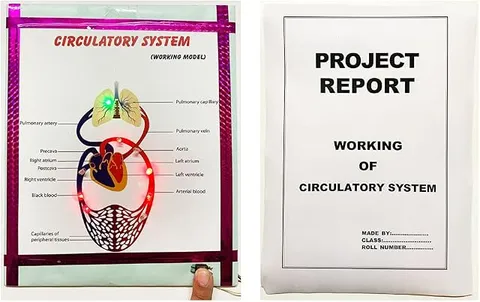
This biology working model of the human circulatory system traces how blood travels from the heart to the body and the lungs and back again. The listing says it has multicolour running lights and a printed report, and the lights can help you follow the route of the blood while presenting.
How it works
The science behind it
The idea the model demonstrates, in words you can use in your report and when you explain it.
The circulatory system is made up of the heart, the blood vessels and the blood, and it carries oxygen, digested food, hormones and wastes around the body. Humans have double circulation: blood passes through the heart twice in one complete round. In pulmonary circulation, deoxygenated blood goes from the right ventricle through the pulmonary artery to the lungs, picks up oxygen and returns through the pulmonary veins to the left atrium. In systemic circulation, the left ventricle pumps oxygenated blood through the aorta to all body parts, and deoxygenated blood returns through the venae cavae to the right atrium. Arteries carry blood away from the heart and have thick, elastic walls; veins bring it back and have valves to stop backflow; thin capillaries join the two and allow exchange of gases and nutrients. A blood pressure check at a clinic, about 120/80 mmHg for a healthy adult, measures how hard blood pushes on artery walls.
Make it yourself
Make a circulatory system model with running lights yourself
Build your own version from scratch, or use the steps to understand how the ready-made model is put together before you present it.
What you need 10
Step by step 8 steps
Draw the body outline, with the heart in the middle of the chest, the lungs on either side of it and a few body organs below.
Make the heart with four chambers, painting the right side blue for deoxygenated blood and the left side red for oxygenated blood.
- Lay the blood routes
Red from the left ventricle through the aorta to the body, blue from the body through the venae cavae to the right atrium, blue from the right ventricle to the lungs and red from the lungs back to the left atrium.
Push about ten LEDs through the board along this double loop, numbered in the order the blood flows.
Build the running-light circuit on a breadboard first: the 555 timer, wired to flash steadily, feeds the clock input of the CD4017, and each of its ten outputs drives one LED through a 1 kΩ resistor.
Connect the CD4017 outputs to the LEDs in output-number order (Q0 to the first LED, Q1 to the second and so on), using the datasheet pin diagram, and join all the LEDs' short legs to the battery negative.
When the sequence works on the breadboard, solder the circuit on a board with an adult and fix it behind the model with the switch at the side.
Add arrows and labels for each vessel and chamber, then check that the lights run in the true direction of blood flow.
Read this first
Safety first
Go through these points before you build or switch anything on. Younger students should do this with an adult.
- Solder only with an adult, keep the hot iron on its stand and work in a ventilated room.
- Insert each IC the right way round, matching the notch to the socket, or it can heat up and fail.
- Keep a resistor with every LED and switch off when the model is not on show.
- Let paints and glue dry fully before wiring, and keep them away from the circuit board.
Troubleshooting
If something does not work
The usual problems with this model and how to fix them. Open a problem to see the fix.
The LEDs light up in the wrong order
The CD4017's outputs are not in number order around the chip. Check the datasheet pin diagram and connect Q0, Q1, Q2 and so on to the LEDs in the order blood flows.
None of the LEDs light
The CD4017's reset pin and enable pin must be connected to the negative supply, the IC may be in backwards, or the battery may be flat.
One LED stays on and the sequence does not move
The 555 is not flashing. Check its timing resistors and capacitor, and that its trigger and threshold pins are joined together.
The lights run too fast or too slowly
Change the 555 timing parts: a larger resistor or capacitor slows the sequence and a smaller one speeds it up.
Exhibition day
How to present it
A running order for the exhibition table or the practical, step by step.
Trace one full round of blood, starting and ending at the right atrium, and name each vessel on the way.
Explain the colour code you use for oxygenated and deoxygenated blood, as judges often ask about it.
Point out that the pulmonary artery and pulmonary veins are exceptions to the usual rule about oxygen.
Let a visitor count their own pulse at the wrist for 15 seconds and multiply by 4.
Practice
Viva questions
Practice questions on this model, with short answers. Try each one aloud before you open the answer.
What is double circulation?
It means blood passes through the heart twice in one complete cycle, once to the lungs (pulmonary) and once to the rest of the body (systemic).
Which artery carries deoxygenated blood?
The pulmonary artery, which takes blood from the right ventricle to the lungs.
Why do veins have valves?
Blood in veins flows at low pressure, so valves stop it from flowing backwards and keep it moving towards the heart.
What is the function of capillaries?
Their very thin walls let oxygen, nutrients and wastes pass between the blood and the body's cells.
Project file
Project file outline
The headings of the project file, in order. Give each heading its own section and write it in your own words.
The listing includes a printed project report: use this outline to check that your own file covers every part.
Free ebook: Writing a Science Project FileContents
- Aim: to show the path of blood through the human circulatory system
- Introduction: parts of the circulatory system and what blood carries
- Double circulation: pulmonary and systemic circulation
- Structure of the heart and its four chambers
- Arteries, veins and capillaries
- Construction of the model and the running-light circuit
- How the lights show the direction of blood flow
- Blood pressure and keeping the heart healthy
- Conclusion and bibliography
Buying checklist
Before you buy
What to check before you order the model, and what to do when it arrives.
1Before you order
- Check that the circulatory system is in your class syllabus and that a working model suits your teacher's brief.
- Read the listing to see what is mentioned with the model, such as the lights and printed report, and whether a battery is needed.
- Practise tracing the route of blood with your finger while the lights run, from the body back to the body.
- Keep the box and carry the model flat so wires on the back are not pulled.
- Check the delivery date for your PIN code on the marketplace, and order well before the exhibition or practical.
- The project report is a learning aid. Read it, understand how the model works, and write your own observations; schools expect your own work.
2When it arrives
- Switch on the lights as soon as it arrives and again a few days before the exhibition.
Next steps
Take it further
Ways to turn this model into a bigger investigation or a stronger exhibition entry.
Measure the pulse rates of classmates at rest and after one minute of skipping, and plot the results as a bar chart.
Add a magnified inset showing how oxygen and food pass from capillaries into body cells.
Compare double circulation with the single circulation of a fish, using a small side diagram.
Audience
Who it suits
Suits Class 7 to 10 biology exhibitions and lessons on transportation in humans.
- ClassClass 1 to 9
- SubjectBiology
- TypeReady-made model
- Project reportPrinted report included
Free to read
Free ebooks for this topic
Free PDF ebooks from Gurukul Technicals Institute on the science, the making and the presenting of projects like this one.
- Free PDF ebook
Biology Models Guide
Make the heart, lungs, kidney, eye, cell and more, and explain them well
- Free PDF ebook
Your Science Exhibition Guide
Choose a project, build it, present it and answer the judges with confidence
- Free PDF ebook
Writing a Science Project File
How to write the report, from the cover page to the bibliography
- Free PDF ebook
Viva Questions for Science Projects
How to answer examiner questions, with sample questions for popular projects