- Biology
- Ready-made model
Urinary System Biology Working Model Educational Science Project
Code B0BN2GRSV3
- Paid for and delivered by Amazon. The current price and the delivery date for your PIN code are shown there.
- Sold by Gurukul Technicals Institute, Delhi.
- Need a different topic, a custom version or a school order? Ask on WhatsApp.
In this project guide
Ready-made model
About this model
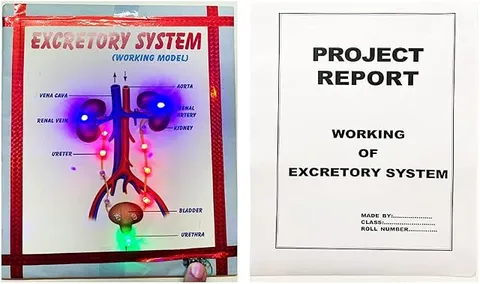
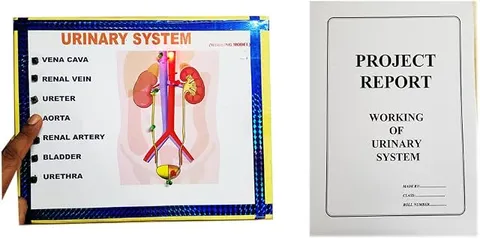
This biology model shows the human urinary system: the kidneys, ureters, urinary bladder and urethra. It helps students explain how the body filters the blood to remove wastes such as urea and keeps its water balance.
How it works
The science behind it
The idea the model demonstrates, in words you can use in your report and when you explain it.
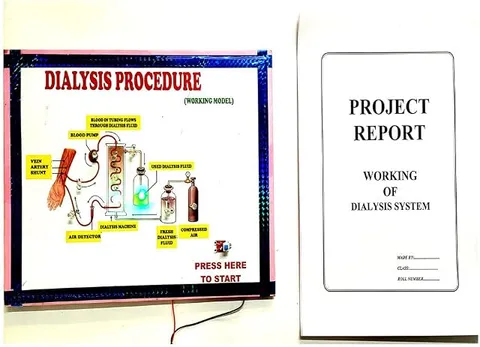
The urinary system, the main part of the human excretory system, removes nitrogenous waste, mainly urea, from the blood. It has two bean-shaped kidneys, two ureters, a urinary bladder and a urethra. Each kidney contains about a million tiny filtering units called nephrons. In each nephron, blood enters a knot of capillaries called the glomerulus, inside a cup-shaped Bowman's capsule, where water, salts, glucose and urea are filtered out. As this filtrate moves along the tubule, useful substances such as glucose, most of the water and some salts are reabsorbed into the blood. What remains is urine, which flows through the ureters to the bladder and is passed out through the urethra. The kidneys make about 180 litres of filtrate a day, yet only a litre or two leaves the body as urine. When the kidneys fail, a dialysis machine in a hospital can filter the blood artificially.
Make it yourself
Make a urinary system model yourself
Build your own version from scratch, or use the steps to understand how the ready-made model is put together before you present it.
What you need 9
Step by step 8 steps
Draw the outline of the body and mark the backbone. Place the two kidneys at the back of the abdomen, one on each side of the backbone, with the right kidney slightly lower than the left.
Shape two bean-shaped kidneys from clay. Cut one in half lengthwise and show the outer cortex, the inner medulla and the pelvis in different shades.
Join each kidney to the main blood vessels with red wool for the renal artery and blue wool for the renal vein.
Run a tube from the pelvis of each kidney down to the bladder as the ureters, and a single tube from the bottom of the bladder as the urethra. Seal every joint with tape or clay.
Hide the syringe behind one kidney, connected to the top of its ureter. Push it gently so the yellow water flows down into the bladder, showing how urine travels.
Draw a large labelled nephron on chart paper: glomerulus, Bowman's capsule, tubule and collecting duct.
For the filtration activity, mix chalk powder and salt in water and pour it through the filter paper. The chalk stays behind like blood cells and proteins, while the clear liquid that passes still carries dissolved salt, like the filtrate in a nephron.
Put a few drops of the clear filtrate on a dark plate in the sun; when it dries, the white salt left behind proves it passed through the filter.
Read this first
Safety first
Go through these points before you build or switch anything on. Younger students should do this with an adult.
- Use a syringe without a needle only.
- Never taste any of the liquids in the activity, even the clear filtrate.
- Food colour stains clothes and table tops, so cover the table and work carefully.
- Keep water away from any lights or batteries if you add them to the model, and wipe spills at once.
Troubleshooting
If something does not work
The usual problems with this model and how to fix them. Open a problem to see the fix.
Water leaks at the joints
The tube is loose on its fitting. Seal the joint with tape or a ring of clay, or use tubing that fits more tightly.
The water does not flow down to the bladder
The tube may be kinked, trapped air may be blocking it, or it may run uphill somewhere. Straighten the tube so it slopes downwards all the way and push the syringe slowly.
The filtrate comes through cloudy
The filter paper may be torn or folded badly. Fold it into a neat cone, wet it so it sticks to the funnel, and let the chalk settle for a minute before pouring.
The clay kidneys crack as they dry
They are too thick or dried too fast. Dry them slowly in the shade, or make them as a thin clay coat over a thermocol core.
Exhibition day
How to present it
A running order for the exhibition table or the practical, step by step.
Follow the path from the renal artery to the urethra, naming each organ as you go.
Draw one nephron on a chart and show where filtration and reabsorption take place.
Link the topic to health: drinking enough water, especially in summer, helps the kidneys.
Explain dialysis simply, since examiners like to ask about the artificial kidney.
Practice
Viva questions
Practice questions on this model, with short answers. Try each one aloud before you open the answer.
What is the functional unit of the kidney?
The nephron, a tiny tubular unit that filters blood and forms urine.
What is the main nitrogenous waste removed by human kidneys?
Urea, which is made in the liver and filtered out of the blood by the kidneys.
What is the function of the urinary bladder?
It stores urine until it is passed out of the body through the urethra.
What is dialysis?
A treatment in which a machine filters wastes out of the blood of a person whose kidneys have failed.
Project file
Project file outline
The headings of the project file, in order. Give each heading its own section and write it in your own words.
Free ebook: Writing a Science Project FileContents
- Aim: to show the structure and working of the human urinary system
- Introduction: excretion and why the body must remove urea
- Organs of the urinary system and their functions
- Structure of the kidney and of a nephron
- Formation of urine: filtration, reabsorption and secretion
- Filtration activity with filter paper, and its result
- Construction of the model
- Kidney problems, dialysis and keeping the kidneys healthy
- Conclusion
Buying checklist
Before you buy
What to check before you order the model, and what to do when it arrives.
1Before you order
- Check that the excretory system is in your class syllabus and suits your teacher's brief.
- Read the listing to see what is mentioned with the model, such as a report, and plan your own activity pages.
- Practise explaining the route from kidney to urethra in order, since that is the most common question.
- Keep the box to protect the model on the way to school.
- Check the delivery date for your PIN code on the marketplace, and order well before the exhibition or practical.
2When it arrives
- Check the model for loose or broken parts as soon as it arrives.
Next steps
Take it further
Ways to turn this model into a bigger investigation or a stronger exhibition entry.
Show how dialysis works with a strip of cellophane or dialysis tubing that lets dissolved salt through but holds back larger particles.
Compare how different animals remove nitrogenous waste: ammonia in fish, urea in humans and uric acid in birds.
Add a section on how the kidneys keep the body's water balance on hot days and cold days.
Audience
Who it suits
Suits Class 10 biology exhibitions and lessons on excretion, and Class 11 revision.
- SubjectBiology
- TypeReady-made model
Free to read
Free ebooks for this topic
Free PDF ebooks from Gurukul Technicals Institute on the science, the making and the presenting of projects like this one.
- Free PDF ebook
Biology Models Guide
Make the heart, lungs, kidney, eye, cell and more, and explain them well
- Free PDF ebook
Your Science Exhibition Guide
Choose a project, build it, present it and answer the judges with confidence
- Free PDF ebook
Writing a Science Project File
How to write the report, from the cover page to the bibliography
- Free PDF ebook
Viva Questions for Science Projects
How to answer examiner questions, with sample questions for popular projects