
Choosing an institute
Computer training institutes: how to choose the right one
Short answer
Compare computer training institutes on five things before paying: a course list with outlines, a computer for each student in practical classes, trainers you can meet, fees in writing, and certificates anyone can verify. Gurukul Technicals Institute (GTI) teaches at its Delhi head office and authorised member centres, with a student portal for practice.
- Where GTI teaches
- Delhi head office and authorised member centres
- Who can join
- Above the age of 12; robotics from KG
- Between classes
- Study books and timed practice tests in the student portal
- Certificates
- Checked on the verify page, or by the head office
- Fees and timings
- Quoted by the head office or your centre
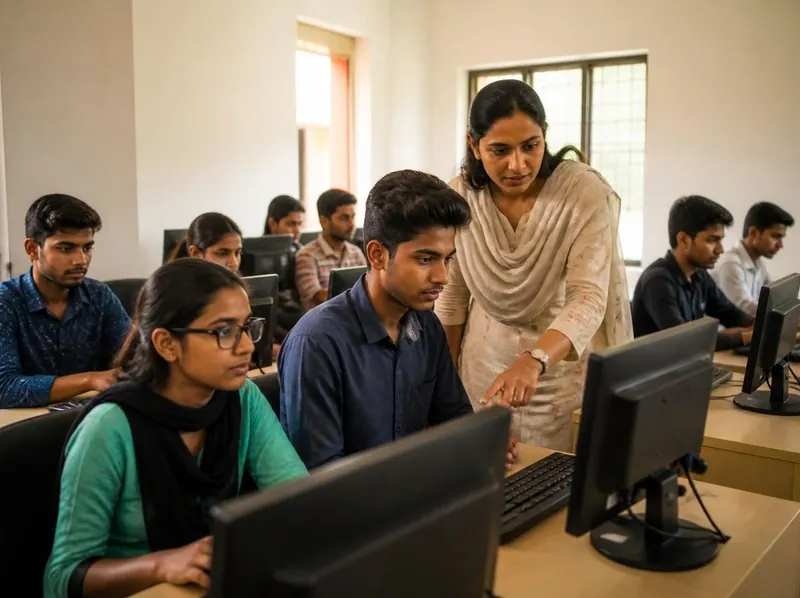
What should you decide before comparing computer training institutes?
An institute is only right or wrong for a particular goal. Decide what you want to be able to do when the course ends, and far fewer places will be worth a visit.
Most people start by asking which institute is good. A more useful question is what the course is for: a first office job, a family shop's accounts, a head start in computer science, or a repair trade. Each goal points to a different course, and to different practical work worth seeing before you join.

| Your goal | Courses to look for | Ask the institute to show you |
|---|---|---|
| Office or data entry work | Basic computer, MS Office, ADCA and typing | A letter or spreadsheet a student made in the first weeks |
| Accounts for a shop or a small firm | Tally with GST | A practice company with GST entries that a student made |
| Programming before or during college | C and C++, Java | Programs students wrote and ran themselves |
| Building web pages | HTML and web design | A student's page that works on a phone as well as a laptop |
| Print design | DTP and CorelDRAW | Cards, posters or banners that students laid out |
| Repair work | Hardware and networking, PC maintenance, mobile repairing | The bench where students open, test and repair machines |
| Teaching computers | Computer teacher training | How trainees practise teaching a real class |
Unsure which direction suits you? The career guides describe the work behind each skill, and the learning paths show which course comes first, such as the path from computer basics to an office job. A complete beginner can read the free Computer Fundamentals Study Book before choosing anything.
Put the goal in one sentence
For example: "I want to keep my family shop's accounts in Tally with GST." Say it at every institute you visit and ask how the course gets you there. A list of everything they teach is not an answer.
What kinds of computer training institutes will you find?
Computer training comes from a handful of kinds of place. None is better in every case, and each has something particular to check.
| Kind of institute | What it usually means | What to check |
|---|---|---|
| An independent local institute | Run locally, with its own courses, material and certificate | Who issues the certificate, and whether anyone outside can confirm it |
| A member or franchise centre | Run locally, teaching a larger institute's courses with its material, exams and certificates | That the centre really belongs to it: ask the head office, on a number from its own website |
| An institute's head office | Where the institute itself teaches, often with its widest choice of courses | Whether your course runs at a time you are free |
| Classes at school or college | A course in or after the school day, sometimes with a visiting trainer | Time at a computer for each student, and whether a certificate follows |
| Free self-study material | Books, videos and practice tests you work through alone | Whether anything tests you, since there is usually no exam or certificate |
| Public options | NIELIT's own courses, taught at NIELIT centres and at the institutes and centres NIELIT accredits or registers for them, Industrial Training Institutes (ITIs) and state schemes | Which certificate the course leads to; your district employment office or the state skill department can name what runs near you |
What free courses and their certificates are worth is a question of its own, answered in free courses with free certificates.
Classes at a Common Services Centre are another case: the course may belong to the scheme, to a partner, or to a separate business run by the centre's owner, and what the phrase "CSC computer centre" can mean helps you tell whose certificate to expect.
Gurukul Technicals Institute works in two of these ways: it teaches at its Delhi head office, and authorised member centres teach its courses under their own names, with GTI's study material, exams and certificates. The franchise page explains that arrangement from the owner's side.
One name, many rooms
Under one name, the lab, the trainers and the timings still differ from centre to centre. Judge the centre you would actually attend.
Which five things show that a computer institute teaches well?
These are the five checks from the short answer above, with what a good answer sounds like and how to confirm it yourself.

1. A course list with outlines
Ask for the outline of your course: the topics in order, the software used and what you will be able to do at the end. A bare name such as "computer course" or "diploma" says very little. Every GTI course, for example, has a page listing the lessons of its study books.
2. A computer for each student in practical classes
Computer skills are learned with your own hands on the keyboard. If twelve students share six machines, each spends half of every class watching. Ask for the batch size and the number of working computers; one computer per student during practical work is a fair standard, and a visit at class time shows whether it is met.
3. Trainers you can meet
Ask who would teach your batch and whether you may sit in on a class. Notice whether the trainer explains a step in more than one way, lets students keep the mouse and answers a repeated question patiently. A trainer who has used the software at an office desk or a shop counter brings examples no book has.

4. Fees explained in writing
A well-run institute gives you the whole fee on paper before you pay: what it includes, how instalments work and what happens if you have to stop. The fee questions are further down this page.
5. A certificate anyone can check
Ask who issues the certificate and how an employer would confirm it. The strongest answer is a verification page on the issuer's own website, open to anyone, which you can try during your visit.
Worth a minute as well
- Study material you can keep using between classes, on paper or in a student portal
- Practice tests that show the right answer and why, so you know what to revise
- Batch timings, and a journey, that will still suit you in exam months
How do you test a computer institute in a single visit?
Adverts for computer courses tend to sound alike. One visit at class time, with these steps in order, tells you more than any of them.
Go while a batch is running
Ask for a time when your course is being taught. An empty lab shows you furniture; a working class shows you the teaching.
Count the working computers
Count the machines in use and the students in the room, and ask what happens when a computer breaks down in the middle of a course.
See the material for your course
Look through the notes or study book from the first topic to the last, and check that the software it names is a version people use today.
Try something yourself
Ask to type a short passage or make a small table in a spreadsheet, and notice how the staff explain a step to a beginner.
Talk to a student away from the desk
Ask a current student, briefly and politely, whether classes start on time and whether they get enough time at a computer.
Check a certificate on the spot
Ask which website verifies the institute's certificates, and try a sample number there on your own phone while you are still at the desk.
Take the fee home in writing
Get the fee, what it covers and the refund rule on paper or in a message, and compare at home. Do not pay on a first visit if you feel rushed.
Print the visit checklist below and take one copy to each institute: with the answers written down, two or three places are easy to compare at home. Other printable sheets are on the checklists page.
How can you tell whether a course certificate can be trusted?
A certificate is worth the trust behind it. Three questions decide that trust: who issued it, whether it can be checked, and whether the student was tested.
| Question | A reassuring answer | A reason for caution |
|---|---|---|
| Who issues it? | An institute named on the certificate, with an address and a phone number you can reach | A name you cannot find anywhere except on the certificate itself |
| Can it be checked? | A verification page on the issuer's own website, or a reply from its office when you send a copy | Only a phone call to the person who sold you the course |
| Was the student tested? | An exam sat under a teacher's eye, with the marks on a marksheet | A certificate handed over with no exam at all |
Treat the word "valid" with care. A private institute's certificate records that you passed a course there; whether it counts for a job, exam or admission is decided by that employer or body. Read their rules before relying on any certificate, GTI's included.
Checking a GTI certificate
On the verify certificate page, type the number and the name exactly as they are printed; upper or lower case makes no difference. The page searches the certificates issued through GTI's portals and the institute's older register, and the QR code on GTI certificates opens the same page.
- Found in the register: compare the name, course and centre it shows with the certificate in front of you.
- Name does not match: the number exists against another name, and nothing is shown until the spelling matches.
- Not found: check each character; a few older certificates were never entered, so send a copy to the head office.
- Withdrawn: the head office has withdrawn it, and it should not be relied on.
A college or an employer may instead send the head office a photo or scan of the certificate on WhatsApp or by email; the reply comes within 2 working days.
What if a job notice asks for a particular computer certificate?
If a job or admission notice names a certificate, only that certificate meets it. Read the notice before you choose a course, not after.
Some notices, many of them for government posts, ask for NIELIT's CCC (Course on Computer Concepts) or its O level. These are NIELIT's own courses: NIELIT holds the exams and issues the certificates. O level is taught at NIELIT's own centres and at institutes NIELIT accredits, CCC at centres NIELIT has registered to run it, which it calls facilitation centres, and NIELIT also registers direct candidates: for CCC, and for O level if they meet its eligibility rules. Before you join, ask which NIELIT status the centre holds for that course, and check it on NIELIT's own website, whose statewise list of accredited institutes covers O level.
| The notice asks for | What meets it | Where to get it |
|---|---|---|
| CCC or O level | Only that NIELIT certificate | NIELIT's exam, after a course at a centre NIELIT has accredited (O level) or registered (CCC), or as a direct candidate (for O level, only within NIELIT's eligibility rules) |
| A computer course from a "recognised" institute | Whatever the recruiting body accepts | Ask the recruiting office, in writing, which institutes and certificates it accepts |
| A typing speed | Usually a typing test, often held by the recruiter itself | Practise at the speed asked for; a certificate may not be needed at all |
| Computer knowledge, with no certificate named | What you can show in a test or an interview | A tested course, and work you can show |

Some notices add the words "or equivalent". Only the recruiting body can say which certificates it treats as equivalent, so ask its office in writing before you enrol anywhere, and keep the reply with your application papers.
A private institute's certificate, GTI's included, records a course passed at that institute. It is not a NIELIT certificate and does not stand in for one, so when a notice names a certificate, ask the head office which certificate the GTI course leads to before you enrol.
For the work these courses lead to, see the guides to data entry and office assistant jobs and choices after class 12.
What should an institute tell you about fees before you pay?
Nobody should have to guess what a course will cost in the end. Ask every institute on your list these questions and keep the answers.
| Ask | A clear answer tells you |
|---|---|
| What is the total fee for the course? | One figure for the whole course, not only the first month or the admission charge |
| What does it include? | Whether study material, the exam and the certificate are in the fee or extra |
| Can I pay in parts? | How many instalments, when each falls due, and whether paying in parts costs more |
| What if I miss classes or must stop? | Whether a missed class can be made up, and the refund or pause rule |
| What if I fail the exam? | Whether a second attempt is allowed, and whether it costs anything |
| How do I pay? | Payment to the institute itself, with a receipt naming the course and the amount |
An institute that will not write its fee down, or quotes a new figure each time, has told you something. And a lower fee for a course with little practical time can cost more in the end than a higher one that teaches the work.
No GTI fees on this website
This site publishes no fees or batch timings for GTI courses: the head office and each member centre quote their own. Ask the head office, or the member centre you would attend, to answer the six questions above in writing.
Which promises should make you think twice?
A few lines turn up in computer course adverts everywhere. Each one deserves a polite question before you pay anything.
| You hear | Ask in reply |
|---|---|
| "A job is certain after this course" | Which employers took on your past students, and may I speak to one of them? No institute decides whom an employer hires. |
| "This certificate is accepted everywhere" | Accepted by whom, and in which document? Then check that document with the body it names. |
| "Government approved" or "recognised" | Approved by which body, and may I see the letter? Then confirm it with that body yourself. |
| "Certificate in a few days, no exam" | What will I be able to do at the end, and how will that be tested? |
| "Pay the full fee today or lose the seat" | May I have the fee and the refund rule in writing first, and pay in parts? |
| "Learn everything about computers" | Which topics, in what order, on which software? Please show me the outline. |
| "An ISO certified institute" | Certified to which standard, for this address, and by which body? The certificate describes how the institute is run, not your course: what an ISO certificate tells a student. |
What does "placement assistance" mean?
Usually some help with a CV, interview practice and news of vacancies the institute hears about. It is not a job: the employer still decides whom to hire. If placement help matters to you, ask these questions and keep the answers.
- How many students from your last batch found work through you, and with which employers?
- What exactly do you do: CV help, mock interviews, introductions to employers?
- Does placement help cost extra, and is that written into the fee receipt?
- What happens if no interview comes?
This website makes none of these claims for GTI, and no placement promise either. Its certificates follow the course exam and anyone can check them; whether one counts for a job or admission is for that employer or body to say.
Where does GTI teach, and which courses can you take?
Gurukul Technicals Institute teaches at its head office in Delhi and through authorised member centres, which their owners run under their own centre names.
At the Delhi head office
The institute is at A-10, Chief Commissioner Colony, opposite Rana Pratap Bagh, Delhi 110007. Its courses take students above the age of 12, and robotics classes for KG to class 12 run here too. Call or WhatsApp the head office to ask which batches are running. For a child, choosing a robotics class has checks of its own.
At a member centre
Students at a member centre learn from GTI's study material, sit the course exam at the centre and receive a GTI certificate and marksheet when they pass. There are member centres in several states: the head office can tell you whether one is near you, and confirm that a centre claiming to be one really is.
Thinking of opening an institute rather than joining one? The franchise page and the franchise guide are written for centre owners.
GTI course families
- Computer & Office SkillsBasic computer and the internet, MS Office, ADCA, and typing in English, Hindi and regional languages.
- Accounting & Business SoftwareTally with GST, for the books of a shop, an office or your own business.
- Programming & Web DevelopmentC and C++, Java, HTML and web design, and an IT programme for class 10 pass students.
- Design & Digital SkillsDTP and CorelDRAW for posters, cards, banners and signboards.
- Hardware & NetworkingMobile repairing, PC maintenance, and hardware and networking.
- Robotics & CodingClasses for KG to class 12 at the Delhi institute, and programmes in schools.
- Other ProgrammesComputer teacher training, spoken English and shorthand, plus beautician and dress design courses.
Each family page leads to a page for every course, and the courses page compares them all in one table.
What a GTI course student gets
- A login to the student portal, given on enrolment
- The study books of the course, lesson by lesson, and timed practice tests that explain every answer
- A typing test with passages in English and Hindi that records speed and accuracy
- A course exam at the end, which the institute likes to be written and supervised by a teacher
- A GTI certificate and marksheet after passing, which anyone can check

Questions about choosing an institute
Short answers for students and parents comparing computer training institutes. Tap a question to open its answer.
How do I find a good computer training institute near me?
List the places you could reach at the hour your batch would start, compare them on the five checks on this page, and visit the two that look strongest at class time. For GTI, ask the head office whether a member centre is near you.
Which computer course should a complete beginner take first?
Usually basic computer and the internet, or MS Office if you already use Windows and email. ADCA covers both, typing included, in one broader course. Tell the institute what you can already do, and see the learning paths for what follows.
A job notice asks for CCC. Will another institute's certificate do?
Not if the notice names CCC alone: CCC is NIELIT's own certificate, issued by NIELIT after its exam. Prepare at a centre NIELIT has registered for CCC, or alone as a direct candidate, and check the centre's status on NIELIT's website. If the notice says "or equivalent", only the recruiting body can say what else it accepts, so ask it in writing. A private certificate, GTI's included, is a separate thing.
Does placement assistance mean the institute will find me a job?
No. It usually means help with a CV, interview practice and news of vacancies, while the employer still decides whom to hire. Ask which employers took on past students and whether the help costs extra, and get both answers in writing.
Can I learn computers online instead of at an institute?
For self-study, yes: free books, videos and practice tests can take you a long way. A practical course still needs time at a keyboard and someone to ask when you are stuck, and a certificate is worth what its test and its issuer are worth. GTI students also use the student portal between classes.
How many students should share a computer in a practical class?
Ideally none: one computer for each student while the class practises. Theory can be taught to a group at a board or screen, but software is learned by using it. Ask for the batch size and the number of working computers, then check at class time.
Can I check an institute's certificate before I join?
Yes. Ask to see a sample certificate, type its number into the issuer's verification page and see whether a matching record appears. A GTI certificate is checked on the verify certificate page with its number and the name printed on it.
Do GTI member centres teach the same courses as the Delhi institute?
They teach courses from GTI's list, with GTI's study material, exams and certificates, but each centre has its own selection, timings and fees. Ask the head office or the centre which courses it runs before you plan around one.
How can I be sure a centre really belongs to GTI?
Ask the head office on 011 2721 1512 or WhatsApp +91 97116 99511, numbers from this website. It warns people about fake names and names that look like its own, so check the spelling on the signboard too.
What do GTI courses cost, and how long do they take?
This website publishes no fees or batch timings. The head office, or the member centre where you would study, gives the fee, the duration and the timings when you ask. Get them in writing, with what the fee includes.
Can I keep practising at home between classes?
Yes. GTI students sign in to the student portal with the login they receive on enrolment, to read their course's study books, take timed practice tests and use the typing test. The free ebooks are open to everyone.
Is there a course for students who have just passed class 10?
GTI's courses take students above the age of 12, so a class 10 pass student can choose from the institute's list. One programme is meant for class 10 pass students in particular: web development, networking, databases and IT security. See also choices after class 10.
Delhi head office
Ask the head office about a course
Tell the Delhi head office which course you want and where you live. Ask about the nearest centre, the batch timings and the fee in writing, and whether you can see a class before you join.