- Physics
- Ready-made model
Reflex Arc and Reflex Action Science Working Model and Project Educational Electronic Hobby Kit
Code B0DTYNWVKM
- Paid for and delivered by Amazon. The current price and the delivery date for your PIN code are shown there.
- Sold by Gurukul Technicals Institute, Delhi.
- Need a different topic, a custom version or a school order? Ask on WhatsApp.
In this project guide
Ready-made model
About this model
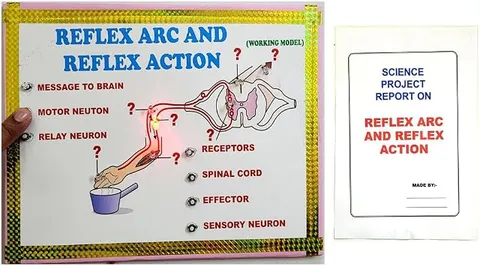
This biology model shows the reflex arc, the nerve pathway behind quick, automatic actions such as pulling your hand back from something hot. It shows how a message travels from a sense organ to the spinal cord and back to a muscle without waiting for the brain.
How it works
The science behind it
The idea the model demonstrates, in words you can use in your report and when you explain it.
A reflex action is a quick, automatic response to a stimulus that happens without conscious thinking, and the path the nerve impulse follows is called the reflex arc. A receptor in the skin detects the stimulus, a sensory neuron carries the impulse to the spinal cord, a relay neuron in the spinal cord passes it on, and a motor neuron carries it to an effector, usually a muscle, which responds. Because the spinal cord handles the response, it is much faster than sending the message to the brain and waiting for a decision. The brain is informed at the same time, which is why you feel the pain a moment after moving your hand. Reflexes protect the body from harm: when your hand touches a hot tawa in the kitchen, you pull it away before you even think. Sneezing, coughing and blinking are other reflexes, and the knee-jerk reflex uses only a sensory and a motor neuron.
Make it yourself
Make a reflex arc model with lights yourself
Build your own version from scratch, or use the steps to understand how the ready-made model is put together before you present it.
What you need 10
Step by step 8 steps
Draw an arm and hand on one side of the board and a cross-section of the spinal cord in the middle, showing the butterfly-shaped grey matter.
Mark the receptor in the skin of a fingertip and the effector, a muscle in the upper arm.
Lay green clay from the receptor into the back of the spinal cord for the sensory neuron, yellow inside the grey matter for the relay neuron, and red from the front of the spinal cord to the muscle for the motor neuron.
Push the LEDs through the board along each path in matching colours.
Wire all the LEDs in parallel, each with its own 1 kΩ resistor, between one side of the push button and the battery negative. Connect the battery positive to the other side of the button.
Fix the button at the fingertip beside the picture of the hot object. Pressing it lights the whole arc and shows the path of the impulse; add arrows for its direction.
Draw a dotted branch from the spinal cord up towards the brain, to show that the brain is told what happened after the reflex has already acted.
- Prepare the ruler-drop activity
A partner drops the ruler between your fingers and you catch it; the distance it falls gives your reaction time from t = √(2d ÷ g).
Read this first
Safety first
Go through these points before you build or switch anything on. Younger students should do this with an adult.
- Use only a picture of a flame or hot object; never use a real candle or heater in the model or the demonstration.
- Keep a resistor with every LED, and disconnect the battery when the model is not on show.
- Use a cutter only with an adult.
- Do the ruler-drop activity with a plastic ruler, keeping fingers and faces clear of its path.
Troubleshooting
If something does not work
The usual problems with this model and how to fix them. Open a problem to see the fix.
Some LEDs do not light
Those LEDs may be the wrong way round or have a loose joint. Turn them round so the long leg faces the button side, and re-make the joint.
The LEDs light without the button being pressed
A four-legged push button has two pairs of legs that are always connected. Use two diagonally opposite legs, which always belong to different pairs, so it connects only when pressed.
The LEDs are dim
The battery is weak or a resistor of too high a value is fitted. Use a fresh battery and check the colour code of each resistor.
Visitors think the brain controls the reflex
Point out that the arc turns round in the spinal cord, which is why the hand moves before you feel the pain. The brain is informed at the same time but does not give the order.
Exhibition day
How to present it
A running order for the exhibition table or the practical, step by step.
Trace the five parts of the arc in order: receptor, sensory neuron, relay neuron, motor neuron and effector.
Do a gentle knee-jerk or blink test with a volunteer to show a real reflex.
Explain why the spinal cord, and not the brain, controls the response.
Compare a reflex action with a voluntary action such as picking up a pen.
Practice
Viva questions
Practice questions on this model, with short answers. Try each one aloud before you open the answer.
What is a reflex action?
It is a sudden, automatic and involuntary response to a stimulus, such as pulling your hand away from a hot object.
Which part of the nervous system controls most reflex actions?
The spinal cord, which receives the sensory message and sends back the motor command.
Why are reflex actions faster than voluntary actions?
The impulse travels a shorter path through the spinal cord and does not wait for the brain to think and decide.
Name the parts of a reflex arc.
Receptor, sensory neuron, relay neuron in the spinal cord, motor neuron and effector.
Project file
Project file outline
The headings of the project file, in order. Give each heading its own section and write it in your own words.
Free ebook: Writing a Science Project FileContents
- Aim: to show the path of a nerve impulse in a reflex arc
- Introduction: the nervous system and neurons
- Voluntary actions, involuntary actions and reflex actions
- Parts of the reflex arc: receptor, sensory neuron, relay neuron, motor neuron and effector
- Common reflexes: knee jerk, blinking and pulling the hand away
- Construction and circuit of the model
- Activity: measuring reaction time with a falling ruler
- Why reflex actions protect the body
- Conclusion
Buying checklist
Before you buy
What to check before you order the model, and what to do when it arrives.
1Before you order
- Check that the reflex arc is in your class syllabus and suits what your teacher asked for.
- Read the listing to see what is mentioned with the model and whether a battery is needed.
- Practise naming the five parts of the arc in order while pointing at them.
- Keep the box to protect the model during transport.
- Check the delivery date for your PIN code on the marketplace, and order well before the exhibition or practical.
2When it arrives
- Try any lights or switches when it arrives and again a few days before the exhibition.
Next steps
Take it further
Ways to turn this model into a bigger investigation or a stronger exhibition entry.
Make the LEDs light one after another with a timer circuit, to show the direction the impulse travels.
Collect ruler-drop reaction times from classmates and compare them, explaining why this voluntary reaction is slower than a true reflex.
Add a magnified diagram of a synapse showing how the impulse crosses from one neuron to the next.
Audience
Who it suits
Suits Class 10 biology exhibitions and lessons on control and coordination, and Class 11 revision of the nervous system.
- SubjectPhysics
- TypeReady-made model
Free to read
Free ebooks for this topic
Free PDF ebooks from Gurukul Technicals Institute on the science, the making and the presenting of projects like this one.
- Free PDF ebook
Physics Working Models Explained
Twenty classic models, how each works and how to make it
- Free PDF ebook
Your Science Exhibition Guide
Choose a project, build it, present it and answer the judges with confidence
- Free PDF ebook
Writing a Science Project File
How to write the report, from the cover page to the bibliography
- Free PDF ebook
Viva Questions for Science Projects
How to answer examiner questions, with sample questions for popular projects