- Physics
- Kit
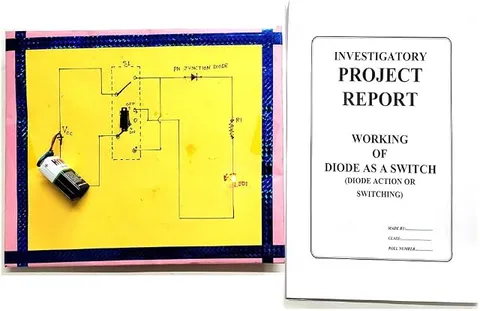
Generic Diode Switching Educational Science Project Kit - Electronics Principles, Diode Action, Switching - For Adults & Older Children - Unisex - 33cm(W) X 23cm(L) - No Assembly Required - Science
Code B0C3H576ZT
- Paid for and delivered by Amazon. The current price and the delivery date for your PIN code are shown there.
- Sold by Gurukul Technicals Institute, Delhi.
- Need a different topic, a custom version or a school order? Ask on WhatsApp.
In this project guide
Kit
About this kit
This educational kit demonstrates how a semiconductor diode acts as a one-way switch, letting current through in one direction and blocking it in the other. The listing says no assembly is required and gives its size as 33 cm by 23 cm, so it is meant to be used straight away as a demonstration board.
What the listing says
- Generic Diode Switching Educational Science Project Kit
- Electronics Principles, Diode Action, Switching
- For Adults & Older Children
- 33cm(W) X 23cm(L)
- No Assembly Required
How it works
The science behind it
The idea the kit demonstrates, in words you can use in your report and when you explain it.
A diode is made by joining p-type and n-type semiconductor to form a p-n junction. At the junction a depletion layer forms, which acts as a barrier. When the diode is forward biased, with the p-side (anode) connected to the positive terminal, the barrier shrinks and current flows once the voltage crosses about 0.7 V for silicon or 0.3 V for germanium. When it is reverse biased, the barrier widens and only a tiny leakage current flows, so the diode behaves like an open switch. This on-off behaviour is diode switching. It is used to protect circuits from a battery connected the wrong way round, to steer signals in logic circuits, and to convert AC to DC in rectifiers. The mobile charger you plug into a 230 V socket uses diodes to change alternating current into the direct current your phone battery needs.
Make it yourself
Make a diode switching demonstration board yourself
Everything you need and the order to do it in. Tick off the materials as you collect them.
What you need 8
Step by step 8 steps
Test each diode on the multimeter's diode mode: one way it reads about 0.5 to 0.7 V, and the other way it shows 'OL' or 1, meaning it blocks.
Wire the battery to the middle pins of the DPDT switch and cross-connect its outer pins, so flipping it swaps positive and negative going to the board.
- Branch 1
A bulb alone across the switched supply. It lights in both switch positions and is your reference.
- Branch 2
The second bulb in series with a diode. It lights in one switch position only, because the diode blocks reverse current.
- Branch 3
The motor, with the red and green LEDs side by side facing opposite ways and the 470 Ω resistor in series with the pair, connected across the motor.
- Flip the switch
The motor reverses and the other LED lights, showing the direction of the current.
Measure the voltage across the diode in branch 2 when it conducts (about 0.7 V) and when it blocks (nearly the full battery voltage).
Label each branch, and make 'forward biased' and 'reverse biased' cards to turn over as you flip the switch.
Read this first
Safety first
Go through these points before you build or switch anything on. Younger students should do this with an adult.
- Use AA cells only (6 V); no part of this board should be connected to mains.
- The LEDs always need their resistor; without it they burn out even at 6 V.
- Bulbs get warm, so do not leave them on for long or touch them while lit.
- Drilling the board and soldering need adult supervision.
Troubleshooting
If something does not work
The usual problems with this kit and how to fix them. Open a problem to see the fix.
The bulb with the diode never lights
The switch may not really be reversing the supply, or the diode is damaged. Check the switch wiring with the multimeter, and test the diode on diode mode.
Both LEDs on the motor light at the same time
They are facing the same way. Turn one round so their long legs point in opposite directions.
The bulb with the diode is dimmer than the plain bulb
That is expected: the diode drops about 0.7 V, so its bulb gets a little less voltage. Note it in your observations.
The multimeter reads OL in both directions
The diode is open (broken), or the meter is not on diode mode. Try another diode.
Exhibition day
How to present it
A running order for the exhibition table or the practical, step by step.
Show the diode conducting in forward bias, then reverse it and show the current stop.
Draw the diode symbol and mark the anode and cathode; the band on the diode's body marks the cathode.
Explain the 0.7 V knee voltage and why a little voltage is always lost across a silicon diode.
Give real uses: reverse-polarity protection, rectifiers in chargers, and logic circuits.
Practice
Viva questions
Practice questions on this kit, with short answers. Try each one aloud before you open the answer.
What is forward bias?
It is when the p-side of the diode is connected to the positive terminal and the n-side to the negative terminal, so that current flows.
What is the knee (cut-in) voltage of a silicon diode?
About 0.7 V; for a germanium diode it is about 0.3 V.
Why does a diode act as a switch?
It conducts freely in forward bias (ON) and hardly at all in reverse bias (OFF).
What is a depletion layer?
A thin region at the p-n junction that has no free charge carriers and acts as a barrier to current.
Project file
Project file outline
The headings of the project file, in order. Give each heading its own section and write it in your own words.
Free ebook: Writing a Science Project FileContents
- Aim: to show that a p-n junction diode conducts in one direction and works as a switch
- Introduction: semiconductors, p-type and n-type material
- Materials and circuit diagrams of the three branches
- Theory: forward bias, reverse bias and the depletion layer
- Procedure: flipping the reversing switch and recording each branch
- Observations: bulb and LED states in each switch position, and the forward voltage of each diode (table)
- Uses: reverse-polarity protection, rectifiers and logic gates
- Conclusion: the diode as a one-way switch, and precautions
Buying checklist
Before you buy
What to check before you order the kit, and what to do when it arrives.
1Before you order
- The listing says no assembly is required and gives the board size as 33 × 23 cm; check it fits your display table and your bag.
- Diodes are a senior secondary topic, while younger students can show the one-way idea; check what your class needs.
- See in the listing whether batteries are needed and whether they are included.
- Keep the box, because a flat board this size cracks easily in transport.
- Check the delivery date for your PIN code on the marketplace, and order well before the exhibition or practical.
2When it arrives
- Test every demonstration on arrival and a few days before the exhibition.
Next steps
Take it further
Ways to turn this kit into a bigger investigation or a stronger exhibition entry.
Plot the forward V-I characteristic of a diode with a potentiometer, a series resistor and two multimeters.
Build a bridge rectifier from four diodes, powered from a low-voltage AC adapter that an adult connects (never mains wiring), and show the output is DC.
Compare the forward voltage of a silicon diode with that of a germanium diode or an LED.
Audience
Who it suits
Suits Class 12 physics projects on semiconductor devices, diploma and engineering electronics labs, and teacher demonstrations.
- SubjectPhysics
- TypeKit
Free to read
Free ebooks for this topic
Free PDF ebooks from Gurukul Technicals Institute on the science, the making and the presenting of projects like this one.
- Free PDF ebook
Electricity and Magnetism Experiments
Hands-on experiments with cells, wires, bulbs and magnets
- Free PDF ebook
Physics Working Models Explained
Twenty classic models, how each works and how to make it
- Free PDF ebook
Your Science Exhibition Guide
Choose a project, build it, present it and answer the judges with confidence
- Free PDF ebook
Writing a Science Project File
How to write the report, from the cover page to the bibliography