- Physics
- Ready-made model
- Class 1 to 9
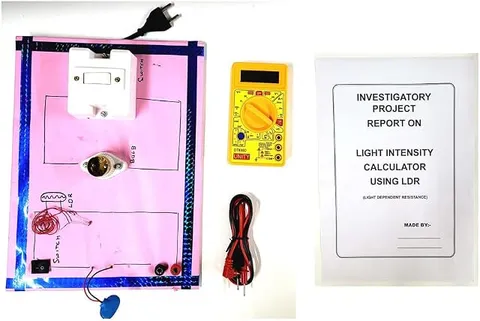
Generic Light Intensity Measurement Meter Using LDR Educational Science Project for Kids, Teens & Young Adults - LDR, Multimeter, 9V Battery (Not Included), Circuit Board, Wooden Card Board
Code B0DK246PT3
- Paid for and delivered by Amazon. The current price and the delivery date for your PIN code are shown there.
- Sold by Gurukul Technicals Institute, Delhi.
- Need a different topic, a custom version or a school order? Ask on WhatsApp.
In this project guide
Ready-made model
About this model
This science project builds a simple light intensity meter using an LDR. The listing title names an LDR, a multimeter, a circuit board and a wooden card board, and says the 9V battery is not included, so check the listing for exactly what is supplied. It lets students measure how bright a place is and see how light changes with distance from a source.
What the listing says
- Generic Light Intensity Measurement Meter Using LDR Educational Science Project for Kids, Teens & Young Adults
- LDR, Multimeter, 9V Battery (Not Included), Circuit Board, Wooden Card Board
How it works
The science behind it
The idea the model demonstrates, in words you can use in your report and when you explain it.
An LDR is a resistor made of a photoconductive semiconductor: the more light falls on it, the more charge carriers are freed and the lower its resistance. Connected to a multimeter, either directly in resistance mode or through a battery-powered voltage divider, its reading changes with brightness, so it can serve as a light meter. The response is not linear, so the meter gives relative readings unless it is calibrated against a proper lux meter. The brightness of light falling on a surface, called illuminance, is measured in lux. A good experiment is the inverse square law: for a small source, illuminance is proportional to 1/d², so doubling the distance from a bulb cuts it to one quarter. Moving the LDR to 10 cm, 20 cm and 30 cm from a small bare bulb shows how quickly the light falls off. Students can also check whether their study table gets enough light for evening study.
Make it yourself
Make an LDR light intensity meter yourself
Build your own version from scratch, or use the steps to understand how the ready-made model is put together before you present it.
What you need 9
Step by step 8 steps
Fix the LDR on the stand at the same height as the torch, and slip the black tube over it so it sees only light from the front.
Set the multimeter to a resistance range and measure the LDR in room light, in shade and with your hand covering it; switch to a higher range if the meter shows OL or 1.
- Make a voltage divider
The 10 kΩ resistor from the battery's positive to one leg of the LDR, the other LDR leg to negative, and measure the voltage across the 10 kΩ resistor, which rises as the light gets brighter.
Darken the room, place the torch 20 cm from the LDR, switch it on and note the voltage once it settles.
Move the torch back to 30, 40, 60 and 80 cm, keeping it pointed straight at the LDR, and record the voltage at each distance.
Plot the reading against distance, and then against 1 ÷ distance², and describe how quickly the brightness falls away.
Use the meter to compare places such as a study table, a corridor and a spot near a window, and decide which have enough light for reading.
If you have a phone light-meter app, take its lux readings beside yours at a few places, remembering that phone sensors are only approximate too.
Read this first
Safety first
Go through these points before you build or switch anything on. Younger students should do this with an adult.
- Never measure the LDR's resistance with the battery connected; disconnect it first, or the reading will be wrong and the meter can be damaged.
- Do not look straight into the torch, and never shine it into anyone's eyes.
- Use a cool LED torch rather than a hot halogen lamp close to the LDR.
- Do not short the 9 V battery terminals, and unclip it when you finish.
Troubleshooting
If something does not work
The usual problems with this model and how to fix them. Open a problem to see the fix.
The meter shows OL or 1 in the dark
The LDR's resistance is higher than the selected range. Switch to a higher resistance range, such as 2 MΩ or 20 MΩ.
The readings keep jumping
A hand's shadow, a flickering tube light or a wobbling torch is changing the light. Put the torch on a stand, keep still and darken the room.
The voltage goes down when the light gets brighter
You are measuring across the LDR instead of the 10 kΩ resistor. Measure across the resistor, or swap the two parts round.
Readings hardly change close to the torch
In bright light the LDR's resistance is already very low and changes little. Start further away, or use a dimmer torch.
Exhibition day
How to present it
A running order for the exhibition table or the practical, step by step.
Take readings at several distances from one lamp and plot them on a graph to test the inverse square law.
Compare readings in sunlight, room light and shade to show the wide range of light levels.
Explain that the meter gives relative values unless it is calibrated against a lux meter.
Keep the source and the LDR in line and block stray light so the readings are consistent.
Practice
Viva questions
Practice questions on this model, with short answers. Try each one aloud before you open the answer.
What is the SI unit of illuminance, the light falling on a surface?
The lux, which equals one lumen per square metre.
How does the resistance of an LDR vary with light?
Its resistance decreases as the light intensity increases.
What is the inverse square law for light?
For a point source, the illuminance at a surface is inversely proportional to the square of its distance from the source.
Why are the readings of this meter called relative?
Because an LDR's response is not linear and varies from one LDR to another, so without calibration the readings compare brightness rather than give exact lux values.
Project file
Project file outline
The headings of the project file, in order. Give each heading its own section and write it in your own words.
Free ebook: Writing a Science Project FileContents
- Aim: to make a light meter with an LDR and study how light falls off with distance
- Light, illuminance and the unit lux
- The LDR and photoconductivity
- Circuit diagram of the voltage divider and why it is used
- Construction of the meter on its stand
- Observation table: distance from the torch and meter reading
- Graphs of reading against distance and against 1/d², compared with the inverse square law
- Light levels measured at home or at school
- Conclusion, sources of error and limitations
Buying checklist
Before you buy
What to check before you order the model, and what to do when it arrives.
1Before you order
- The listing title says the 9 V battery is not included, so buy one separately before the project is due.
- The title names an LDR, a multimeter, a circuit board and a wooden card board; read the listing to see exactly what is supplied, and do not assume anything more is in the box.
- Practise the distance experiment at home a few days before, and use your own readings in the report.
- Keep the box so the multimeter and stand travel safely.
- Check the delivery date for your PIN code on the marketplace, and order well before the exhibition or practical.
2When it arrives
- When it arrives, check that the multimeter switches on and reads resistance, and learn which range to use.
Next steps
Take it further
Ways to turn this model into a bigger investigation or a stronger exhibition entry.
Calibrate your meter against a proper lux meter, if your school lab has one, and draw a conversion graph.
Compare how much light passes through materials such as plain glass, tinted film and tracing paper.
Connect the LDR to a microcontroller board to log light levels through a whole day and plot the result.
Audience
Who it suits
Class 8 to 12 physics projects on light and sensors, and kids, teens and young adults who enjoy measurement-based experiments.
- ClassClass 1 to 9
- SubjectPhysics
- TypeReady-made model
Free to read
Free ebooks for this topic
Free PDF ebooks from Gurukul Technicals Institute on the science, the making and the presenting of projects like this one.
- Free PDF ebook
Electricity and Magnetism Experiments
Hands-on experiments with cells, wires, bulbs and magnets
- Free PDF ebook
Physics Working Models Explained
Twenty classic models, how each works and how to make it
- Free PDF ebook
Your Science Exhibition Guide
Choose a project, build it, present it and answer the judges with confidence
- Free PDF ebook
Writing a Science Project File
How to write the report, from the cover page to the bibliography