- Physics
- Class 1 to 9
Laser Light Security Alarm Educational Circuit Board
Code B07NYMZMDC
- Paid for and delivered by Amazon. The current price and the delivery date for your PIN code are shown there.
- Sold by Gurukul Technicals Institute, Delhi.
- Need a different topic, a custom version or a school order? Ask on WhatsApp.
In this project guide
Physics
About this model
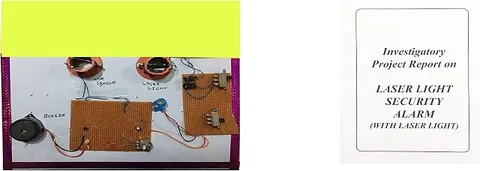
This educational circuit board is a laser light security alarm, in which an alarm sounds when something breaks a laser beam. It is a popular exhibition project that shows how light and electronics combine in security systems.
How it works
The science behind it
The idea the model demonstrates, in words you can use in your report and when you explain it.
A laser produces light that is very different from a torch's. It is nearly monochromatic (one wavelength), coherent (all the waves in step) and highly directional, so the beam spreads very little and can cross a room as a thin, bright line. In a laser security alarm, the beam usually falls on a light dependent resistor (LDR) or another light sensor. While the beam reaches it, the LDR's resistance stays low and the alarm stays quiet. When a person or object cuts the beam, the LDR is suddenly in darkness, its resistance rises sharply, and the change in voltage switches on a transistor that sounds a buzzer, often through a latch so it keeps ringing. Mirrors can bounce the beam back and forth across a doorway, and the law of reflection, angle of incidence equals angle of reflection, tells you where to place them. Laser tripwires like this are used to protect valuable exhibits and restricted areas.
Make it yourself
Make a laser beam security alarm yourself
Build your own version from scratch, or use the steps to understand how the ready-made model is put together before you present it.
What you need 10
Step by step 8 steps
Fix the LDR at the back of its short black tube on one side of a model doorway, so it sees the laser spot but little room light.
Wire the LDR from the positive line to pin 2 of the 555, and the 47 kΩ preset from pin 2 to negative. While the laser shines on the LDR, pin 2 stays high and the alarm is quiet.
- Make the 555 a timer
Pin 1 to negative, pins 4 and 8 to positive, the 100 kΩ resistor from pin 8 to pins 6 and 7 (joined), the 100 µF capacitor from pins 6 and 7 to negative, and the 0.01 µF from pin 5 to negative.
Connect the buzzer, and the red LED with its resistor, from pin 3 to negative. When the beam is broken, pin 2 goes low and the alarm sounds for about 1.1 × R × C, roughly 11 seconds.
Mount the laser on the other side, below waist height, and add two mirrors to bounce the beam in a zigzag across the doorway before it reaches the LDR.
Switch on and adjust the preset so the alarm stays quiet while the beam reaches the LDR but sounds as soon as a hand cuts the beam anywhere along its path.
Spray a fine water mist near the beam so visitors can see its zigzag path, then walk a toy figure through to set off the alarm.
Record how long the beam path can be, and how many mirrors it can bounce off, before the alarm stops working reliably.
Read this first
Safety first
Go through these points before you build or switch anything on. Younger students should do this with an adult.
- Never look into the laser beam or its reflection in a mirror, and never point it at people, animals, vehicles or aircraft.
- Use only a low-power laser (Class 2 or lower) and keep the beam below waist height, angled so that reflections cannot reach anyone's eyes.
- Switch the laser off while adjusting the mirrors, and let an adult check the final alignment.
- Use the soldering iron only with an adult, and handle the glass mirrors by their edges.
Troubleshooting
If something does not work
The usual problems with this model and how to fix them. Open a problem to see the fix.
The alarm sounds all the time
The beam is not landing on the LDR, often because a mirror has moved. Hold a white card in front of the tube to find the spot, re-aim the mirrors, and adjust the preset.
Breaking the beam does nothing
Room light is reaching the LDR, so it stays bright with or without the laser. Use a longer tube, dim the room a little, or turn the preset.
The alarm stops at once instead of ringing for a while
The timing parts are the wrong value or pins 6 and 7 are not joined. Check the 100 kΩ resistor and the 100 µF capacitor.
The beam slowly drifts off the LDR
A mirror stand is being knocked, or the laser's batteries are getting weak and dim. Fix the mirrors down with putty or tape, and fit fresh batteries in the laser.
Exhibition day
How to present it
A running order for the exhibition table or the practical, step by step.
Never look into the laser or point it at anyone's eyes, and remind your audience of this too.
Break the beam with your hand to show the alarm responding.
If you can, use a mirror to bend the beam and explain the law of reflection.
Explain why a laser beam stays narrow over a long distance while a torch beam spreads out.
Practice
Viva questions
Practice questions on this model, with short answers. Try each one aloud before you open the answer.
What are the special properties of laser light?
It is monochromatic, coherent and highly directional, so it spreads very little.
What is the role of the LDR in a typical laser alarm?
It senses the laser beam; when the beam is cut its resistance rises, which triggers the alarm.
Why is a mirror useful in a laser alarm?
It reflects the beam so that one laser can guard a wider area, following the law of reflection.
What does LASER stand for?
Light Amplification by Stimulated Emission of Radiation.
Project file
Project file outline
The headings of the project file, in order. Give each heading its own section and write it in your own words.
Free ebook: Writing a Science Project FileContents
- Aim: to make an alarm that sounds when a laser beam is broken
- Introduction: security systems in museums, banks and shops
- Properties of laser light: monochromatic, coherent and directional
- Reflection of the beam by plane mirrors and the laws of reflection
- The LDR and the 555 timer in monostable mode, t = 1.1 × R × C
- Circuit diagram and construction
- Observations: beam length, number of mirrors and response to different objects
- Laser safety rules
- Conclusion and bibliography
Buying checklist
Before you buy
What to check before you order the model, and what to do when it arrives.
1Before you order
- Check that the project fits your class, and that your school allows laser projects at the exhibition.
- Read the listing to see what kind of laser and sensor it uses and what powers it.
- Plan your space You need a clear straight path where nobody will lean across the beam at eye level.
- Keep the box so the laser and sensor stay protected in transport.
- Check the delivery date for your PIN code on the marketplace, and order well before the exhibition or practical.
- Practise explaining it. Judges ask what the model shows and why; knowing the science matters as much as the model. The viva questions above are a good place to start.
2When it arrives
- Test the alignment as soon as it arrives and again a few days before the exhibition.
Next steps
Take it further
Ways to turn this model into a bigger investigation or a stronger exhibition entry.
Measure the angles of incidence and reflection at each mirror and show that they are equal.
Add a latch so the alarm keeps sounding until a hidden switch is pressed.
Compare the laser with an ordinary LED torch over 1, 2 and 3 m and explain the difference in terms of beam spread.
Audience
Who it suits
Class 8 to 12 students preparing a security or optics project for an exhibition.
- ClassClass 1 to 9
- SubjectPhysics
Free to read
Free ebooks for this topic
Free PDF ebooks from Gurukul Technicals Institute on the science, the making and the presenting of projects like this one.
- Free PDF ebook
Electricity and Magnetism Experiments
Hands-on experiments with cells, wires, bulbs and magnets
- Free PDF ebook
Physics Working Models Explained
Twenty classic models, how each works and how to make it
- Free PDF ebook
Your Science Exhibition Guide
Choose a project, build it, present it and answer the judges with confidence
- Free PDF ebook
Writing a Science Project File
How to write the report, from the cover page to the bibliography