- Physics
- Ready-made model
Thermoelectric Generator Using Peltier Module 12706 Heat to Electricity Project
Code B0G2TBCNVL
- Paid for and delivered by Amazon. The current price and the delivery date for your PIN code are shown there.
- Sold by Gurukul Technicals Institute, Delhi.
- Need a different topic, a custom version or a school order? Ask on WhatsApp.
In this project guide
Ready-made model
About this model
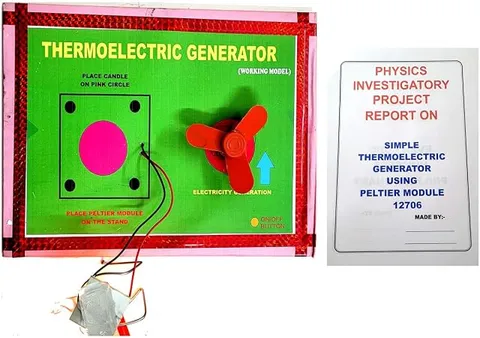
This investigatory project uses a Peltier module, the 12706 type named in the title, to turn a temperature difference directly into electricity. It demonstrates the Seebeck effect, where warming one side and cooling the other produces a small voltage with no moving parts.
How it works
The science behind it
The idea the model demonstrates, in words you can use in your report and when you explain it.
When two different conductors or semiconductors are joined and their two junctions are kept at different temperatures, a voltage appears; this is the Seebeck effect. A Peltier module contains many small pairs of p-type and n-type semiconductor blocks, connected electrically in series so their small voltages add, and thermally in parallel. In the common part number TEC1-12706, 127 is the number of semiconductor pairs and 06 is the maximum rated current in amperes. When one plate is warm and the other cool, the module gives a DC voltage that grows with the temperature difference, so the cold side needs a heat sink or ice water to stay cold. Its efficiency is low, only a few per cent. The reverse effect, the Peltier effect, uses a current to make one side cold. Resting one side on a cup of hot chai and the other on cold water is a simple way to show it.
Make it yourself
Make a Peltier thermoelectric generator yourself
Build your own version from scratch, or use the steps to understand how the ready-made model is put together before you present it.
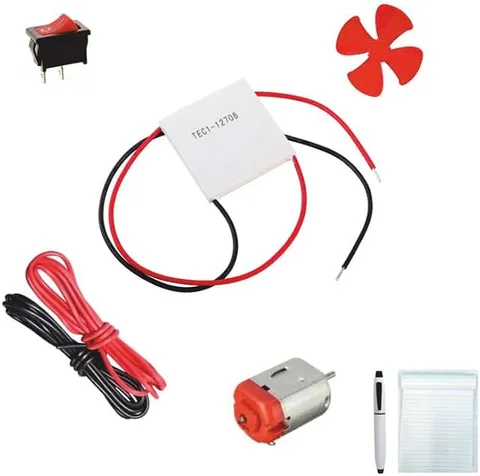
What you need 9
Step by step 8 steps
Note which face of the module carries the printed part number. When the module is used as a generator, swapping which face is hot reverses the output polarity.
Spread a thin, even layer of thermal paste on both faces and press the module between the two heat sinks. Hold them together with rubber bands or clamps, firmly but without crushing it.
Connect the module's red and black leads to the multimeter set to DC volts.
Stand the lower heat sink in the tray of ice water. An adult then places the steel tumbler of hot water on the upper heat sink.
Read the voltage and measure the temperature of each side; record both every minute as the hot water cools and the ice melts.
Connect the boost converter's input to the module and the LED to its output, observing the polarity marked on the module board, and show the LED lighting from heat alone.
Repeat with both sides at room temperature and show the voltage is almost zero, which proves it is the temperature difference that matters.
Plot voltage against temperature difference and add the graph to your project file.
Read this first
Safety first
Go through these points before you build or switch anything on. Younger students should do this with an adult.
- Only an adult should pour and carry the hot water. Use hot water that is not boiling, and keep the setup on a stable tray so nothing can tip over.
- Never put a candle, flame or stove directly on the module; it can overheat and the solder inside can melt.
- Do not connect the module to a battery while it is clamped in the setup; when powered, it pumps heat and one side can become very hot or very cold quickly.
- The ceramic plates are brittle, so do not overtighten the clamps or drop the module.
- Keep the multimeter and wires away from spilled water and wipe up any spills at once.
Troubleshooting
If something does not work
The usual problems with this model and how to fix them. Open a problem to see the fix.
The voltage is very small
The temperature difference is small or the contact is poor. Use thermal paste with no air gaps, add fresh ice, use larger heat sinks, and make sure the hot tumbler sits flat on the heat sink.
The reading is negative
The hot and cold sides are swapped relative to the leads, or the probes are reversed. This does no harm; note it and swap the probes.
The meter shows a voltage but the LED will not light
An LED needs about 2 V, and the module's voltage drops when a load is connected. Use the boost converter, check its polarity and that the module gives at least the converter's minimum starting voltage.
The voltage falls after a few minutes
The cold side is warming up and the hot side cooling down. Refresh the ice water, ask an adult to top up the hot water, and take readings promptly.
Exhibition day
How to present it
A running order for the exhibition table or the practical, step by step.
Measure the output with a multimeter and show how the voltage rises as the temperature difference grows.
Use a heat sink or a bowl of ice water on the cold side and explain why keeping it cold matters.
Choose a safe heat source; a cup of hot water is better than a flame at a school stall.
Compare it with a battery and a solar cell to show a third way of producing DC electricity.
Practice
Viva questions
Practice questions on this model, with short answers. Try each one aloud before you open the answer.
What is the Seebeck effect?
It is the production of a voltage when the two junctions of two different conductors or semiconductors are kept at different temperatures.
How is the Peltier effect different from the Seebeck effect?
It is the reverse: passing a current through the junctions makes one side absorb heat and the other side give it out.
Why does the output fall if the cold side is not cooled?
Heat flows through the module and warms the cold side, so the temperature difference, and with it the voltage, becomes smaller.
Where are thermoelectric generators used in real life?
In some space probes, which use heat from a radioactive source, and in remote sensors that run on waste heat.
Project file
Project file outline
The headings of the project file, in order. Give each heading its own section and write it in your own words.
Free ebook: Writing a Science Project FileContents
- Aim: to generate electricity from a temperature difference using a Peltier module
- Introduction: the Seebeck effect and thermoelectricity
- Structure of a Peltier module
- Materials and construction of the generator
- Procedure and safety precautions with hot and cold water
- Observations: temperature difference and output voltage
- Graph of voltage against temperature difference
- Applications: waste-heat recovery and thermoelectric power in space probes
- Conclusion
Buying checklist
Before you buy
What to check before you order the model, and what to do when it arrives.
1Before you order
- Check that thermoelectricity or energy conversion is acceptable as your project topic with your teacher.
- Read the listing to see what is mentioned with the project, such as a report, an LED or a heat sink, and plan for anything you must add.
- Plan how you will get hot and cold water at the exhibition venue, or carry them in insulated flasks.
- Keep the box and padding, because the module's ceramic plates crack easily.
- Check the delivery date for your PIN code on the marketplace, and order well before the exhibition or practical.
- Practise explaining it. Judges ask what the model shows and why; knowing the science matters as much as the model. The viva questions above are a good place to start.
2When it arrives
- Test it with ice water and warm water at home soon after it arrives, with an adult handling the hot water.
Next steps
Take it further
Ways to turn this model into a bigger investigation or a stronger exhibition entry.
Connect a load resistor and measure both voltage and current, then calculate the power output at different temperature differences.
Try warming one side with sunlight on a black-painted metal plate, or with your hand, and compare the outputs.
Connect two modules in series and in parallel, and compare their voltages and currents.
Discuss how waste heat from vehicles or factories could be turned into electricity, and why the efficiency is low.
Audience
Who it suits
Suits Class 11 and 12 physics investigatory projects on energy conversion and science fairs on renewable or waste-heat energy.
- SubjectPhysics
- TypeReady-made model
Free to read
Free ebooks for this topic
Free PDF ebooks from Gurukul Technicals Institute on the science, the making and the presenting of projects like this one.
- Free PDF ebook
Electricity and Magnetism Experiments
Hands-on experiments with cells, wires, bulbs and magnets
- Free PDF ebook
Physics Working Models Explained
Twenty classic models, how each works and how to make it
- Free PDF ebook
Your Science Exhibition Guide
Choose a project, build it, present it and answer the judges with confidence
- Free PDF ebook
Writing a Science Project File
How to write the report, from the cover page to the bibliography