- Physics
- Ready-made model
- Class 1 to 9
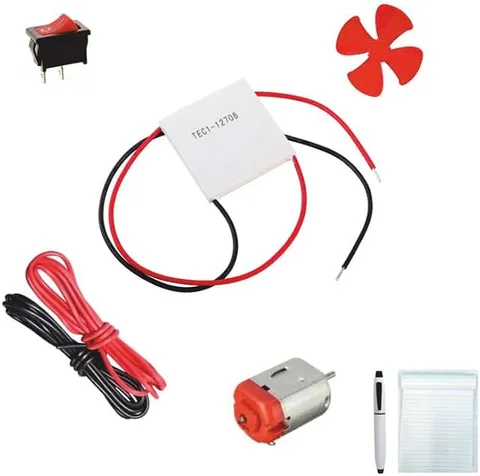
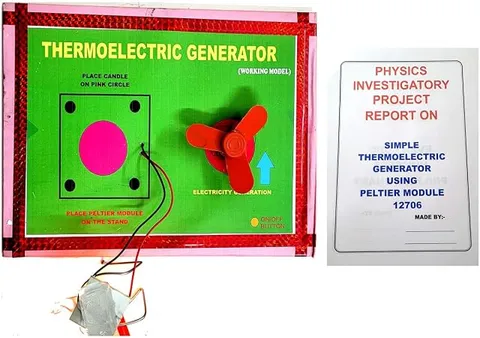
Thermoelectric Generator Using Peltier Module 12706 Renewable Energy Working Model
Code B0G2T9NHN5
- Paid for and delivered by Amazon. The current price and the delivery date for your PIN code are shown there.
- Sold by Gurukul Technicals Institute, Delhi.
- Need a different topic, a custom version or a school order? Ask on WhatsApp.
In this project guide
Ready-made model
About this model
A renewable energy working model that uses a Peltier module of type 12706 as a thermoelectric generator, producing electricity directly from a difference in temperature. It shows that heat can be turned into electrical energy with no moving parts at all, which makes it an unusual and memorable exhibition project.
How it works
The science behind it
The idea the model demonstrates, in words you can use in your report and when you explain it.
This model runs on the Seebeck effect: when the two junctions of a circuit made from two different conductors are kept at different temperatures, a voltage appears. A Peltier module contains many small pairs of p-type and n-type semiconductor blocks, usually bismuth telluride, connected electrically in series between two ceramic plates. In the common naming of the TEC1-12706, 127 is the number of p-n couples and 06 is the maximum current in amperes. When one plate is heated and the other kept cool, charge carriers diffuse from the hot side towards the cold side and a small voltage builds up. The larger the temperature difference, the higher the voltage, so the cold side must be cooled with a heat sink, ice or water. Efficiency is low, but the same idea powers some space probes from radioactive heat. A steel glass of hot water on one plate and ice water below the other shows the effect on a multimeter.
Make it yourself
Make a waste-heat thermoelectric generator model yourself
Build your own version from scratch, or use the steps to understand how the ready-made model is put together before you present it.
What you need 10
Step by step 8 steps
Spread a thin layer of thermal paste on one face of the module and press the heat sink onto it, fins down, then stand the heat sink in the tray of ice water so the module sits just above the water.
Spread paste on the module's top face. Either face can be the hot one when the module is used as a generator; swapping them only reverses the output polarity.
Connect the module's two leads to the multimeter on the DC volts range: with both faces at room temperature it reads almost zero.
Ask an adult to fill the steel tumbler with hot water and stand it firmly on the top face. The voltage rises within seconds.
Record the hot-water temperature, the ice-water temperature and the voltage every minute for 15 minutes as the hot water cools, and plot voltage against the temperature difference.
Disconnect the meter and connect the low-voltage motor: with a large enough temperature difference the propeller turns, showing heat turned into motion with no moving parts in the generator itself.
Put the meter in series with the motor to measure the current, and work out the power as voltage × current.
Build the scene around the generator to show the idea of recovering waste heat, and label the hot side, cold side, Seebeck effect and output.
Read this first
Safety first
Go through these points before you build or switch anything on. Younger students should do this with an adult.
- Only an adult should prepare and pour the hot water; stand the tumbler firmly so it cannot tip onto the wires or your hands.
- Never put the module on a flame or a hot stove; too much heat melts the solder inside and ruins it.
- Do not connect a battery to the module while it is set up with hot water; driven that way it pumps heat and can overheat.
- Keep water away from the multimeter and the module's leads, and dry everything after use.
Troubleshooting
If something does not work
The usual problems with this model and how to fix them. Open a problem to see the fix.
The voltage is only a few millivolts
Heat is not flowing well through the module, so its faces are not very different in temperature. Use thermal paste on both faces, press everything together firmly, and use hotter water and more ice.
The voltage starts high and then falls
The hot water cools and the heat sink warms, so the temperature difference shrinks. Add ice and refresh the hot water; the fall itself is a good observation for your graph.
The motor does not turn although the meter shows a voltage
An ordinary toy motor needs more current than the module can give. Use a low-start solar motor, give the propeller a flick, or show the output on the meter instead.
The voltage reading is negative
The meter leads are the other way round, or the other face is the hot one. Swap the leads; the voltage reverses when the hot and cold sides swap.
Exhibition day
How to present it
A running order for the exhibition table or the practical, step by step.
Show the multimeter reading at room temperature first, then with hot water on one side, so the judges see the voltage appear.
Explain the difference between the Seebeck effect (heat to electricity) and the Peltier effect (electricity to heating and cooling).
Keep the cold side cool with ice or a heat sink; the output falls as both sides reach the same temperature.
Never heat the module on a direct flame; use hot water so it is not damaged.
Practice
Viva questions
Practice questions on this model, with short answers. Try each one aloud before you open the answer.
What is the Seebeck effect?
When the two junctions of a circuit made of two different conductors are at different temperatures, a voltage is produced; this is the Seebeck effect.
What does 12706 mean in the module's name?
In the usual naming, 127 is the number of p-n couples inside the module and 06 means it is rated for a maximum current of about 6 amperes.
Why must the cold side be kept cool?
The voltage depends on the temperature difference, so if the cold side warms up the difference shrinks and the output drops.
Where can thermoelectric generators be useful?
They can produce electricity from waste heat, such as from a stove or an engine, and some space probes use them with heat from radioactive material.
Project file
Project file outline
The headings of the project file, in order. Give each heading its own section and write it in your own words.
Free ebook: Writing a Science Project FileContents
- Aim: to generate electricity directly from a temperature difference using a Peltier module
- Introduction: renewable energy and recovering waste heat
- The Seebeck effect and the Peltier effect
- Structure of a Peltier module: p-type and n-type blocks connected in series
- Construction of the model
- Observations: voltage and temperature difference over time, with a graph
- Output power, and how it compares with a small solar panel
- Uses of thermoelectric generators, from space probes to waste-heat recovery
- Conclusion and bibliography
Buying checklist
Before you buy
What to check before you order the model, and what to do when it arrives.
1Before you order
- Check that energy conversion or renewable energy fits your syllabus or exhibition theme, and plan the explanation for your class.
- Read the listing to see how the model is meant to be heated and cooled, and arrange hot water and ice for the exhibition.
- Ask whether hot water will be available at the venue, or plan for an adult to bring it in a flask.
- Keep the module and its leads dry, and pack the model in its box.
- Check the delivery date for your PIN code on the marketplace, and order well before the exhibition or practical.
- Practise explaining it. Judges ask what the model shows and why; knowing the science matters as much as the model. The viva questions above are a good place to start.
2When it arrives
- Test it on arrival and note the best voltage you can get, so you know what to expect on the day.
Next steps
Take it further
Ways to turn this model into a bigger investigation or a stronger exhibition entry.
Connect two modules in series and compare the voltage with one module at the same temperature difference.
Repeat the test starting from three different hot-water temperatures and show that the voltage is roughly proportional to the temperature difference.
Estimate the efficiency from the heat lost by the hot water (mass × 4.2 J per gram per °C × temperature fall) and the electrical energy produced.
Audience
Who it suits
Suits Class 9 to 12 physics exhibitions on renewable energy and investigatory projects on energy conversion.
- ClassClass 1 to 9
- SubjectPhysics
- TypeReady-made model
Free to read
Free ebooks for this topic
Free PDF ebooks from Gurukul Technicals Institute on the science, the making and the presenting of projects like this one.
- Free PDF ebook
Electricity and Magnetism Experiments
Hands-on experiments with cells, wires, bulbs and magnets
- Free PDF ebook
Physics Working Models Explained
Twenty classic models, how each works and how to make it
- Free PDF ebook
Your Science Exhibition Guide
Choose a project, build it, present it and answer the judges with confidence