- Physics
- Ready-made model
- Printed report included
Series Step-Up Transformer Science Project Physics Working Model with Report
Code B0G2T964L6
- Paid for and delivered by Amazon. The current price and the delivery date for your PIN code are shown there.
- Sold by Gurukul Technicals Institute, Delhi.
- Need a different topic, a custom version or a school order? Ask on WhatsApp.
In this project guide
Ready-made model
About this model
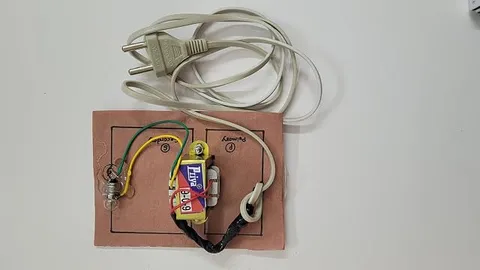
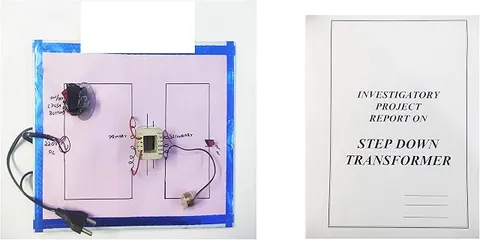
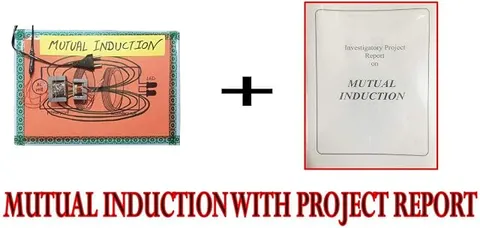
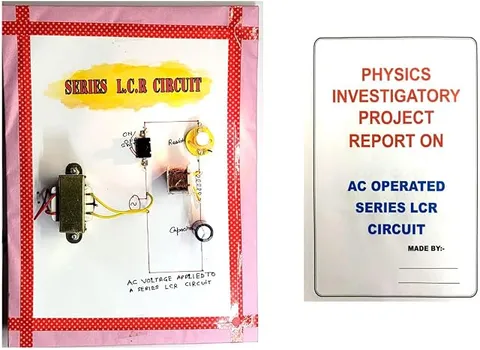
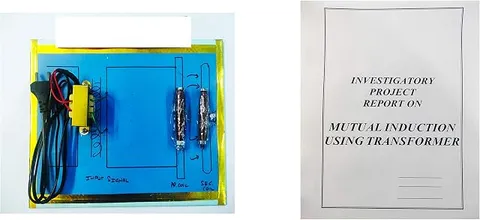
This physics working model is about the step-up transformer, a device that raises an alternating voltage using two coils wound on a common iron core. The title calls it a series step-up transformer, and the listing says a report is included for the written part of an investigatory project.
How it works
The science behind it
The idea the model demonstrates, in words you can use in your report and when you explain it.
A transformer works on mutual induction. An alternating current in the primary coil produces a changing magnetic flux in the soft iron core, and this changing flux links the secondary coil and induces an alternating emf in it (Faraday's law). For an ideal transformer, Vs ÷ Vp = Ns ÷ Np. In a step-up transformer the secondary has more turns than the primary, so the output voltage is higher: with 100 primary turns, 500 secondary turns and a 12 V input, the output is 60 V. Power is ideally conserved (Vp × Ip = Vs × Is), so the current is stepped down in the same ratio. A transformer does not work on steady DC, because a constant current gives no change in flux. Power stations step voltage up for long-distance lines to cut I²R losses, and the transformer on the pole in your colony steps it back down to 230 V.
Make it yourself
Make a series step-up transformer model yourself
Build your own version from scratch, or use the steps to understand how the ready-made model is put together before you present it.
What you need 8
Step by step 9 steps
Wind a primary coil of 200 turns on the first bobbin and tape it.
Wind two secondary coils of 200 turns each on the other bobbins, both in the same direction, and mark the start S1, S2 and the finish F1, F2 of each.
Clean the enamel off each wire end with sandpaper and fix the ends to their labelled terminals.
Slide all three bobbins onto the core and close it tightly with no air gaps.
With the adapter unplugged, connect it to the primary terminals, then ask an adult to plug it in and switch on.
Measure the AC voltage across each secondary on its own. Each should read roughly the same as the input, because it has as many turns as the primary.
Ask the adult to switch off, join F1 to S2, switch on again and measure across S1 and F2. The coils now act as one coil of 400 turns and the voltage roughly doubles.
Switch off, join F1 to F2 instead and measure across S1 and S2. The two voltages now oppose and nearly cancel, showing the coils must be joined the right way round.
Use the series-aiding connection to light the 12 V bulb and show the stepped-up output.
Read this first
Safety first
Go through these points before you build or switch anything on. Younger students should do this with an adult.
- Use only a low-voltage AC adapter, plugged in and switched off by an adult. Never connect any coil to a wall socket; a step-up transformer would then produce a dangerous voltage.
- Ask the adult to switch off before you change any connection between the coils.
- Stop if the adapter or the primary coil gets warm, and check for scratched enamel or too few primary turns.
- Handle the core strips with care, as their edges can be sharp.
Troubleshooting
If something does not work
The usual problems with this model and how to fix them. Open a problem to see the fix.
The series voltage is nearly zero
The two secondaries are joined in opposition, perhaps because one bobbin was slid on the other way round. Move the link to the other end of the second coil (for example from S2 to F2) and measure across the two free ends.
One secondary gives a much lower voltage than the other
It may have fewer turns than you think, a break, or ends that are not fully cleaned. Check its continuity and recount the turns if needed.
There is no output when I use a battery
A transformer needs a changing current, and a battery gives steady DC. Use the low-voltage AC adapter, and check that its label says AC output.
The bulb glows dimly although the meter showed a good voltage
A homemade transformer's output falls under load. Close the core more tightly, or use a bulb that needs less current.
Exhibition day
How to present it
A running order for the exhibition table or the practical, step by step.
Draw the core, primary and secondary on a chart and mark the turns ratio so judges can follow the voltage calculation.
Measure the input and output voltages with an AC voltmeter or multimeter and compare their ratio with Ns ÷ Np.
Explain why the core is laminated and name the main losses: copper loss, eddy current loss, hysteresis loss and flux leakage.
Keep fingers away from the output terminals while it is working, because a step-up transformer gives out a higher voltage than it receives.
Practice
Viva questions
Practice questions on this model, with short answers. Try each one aloud before you open the answer.
Which phenomenon makes a transformer work?
It works on mutual induction: a changing current in one coil induces an emf in a nearby coil linked by the same magnetic flux.
What would happen if a steady DC supply were connected to the primary?
No emf would be induced in the secondary, except for a brief moment when switching on or off, because steady DC gives a constant flux.
Why is the iron core made of thin insulated sheets instead of one solid block?
Thin insulated sheets break up the paths of eddy currents, which reduces the energy lost as heat in the core.
When a transformer steps up voltage, what happens to the current?
In an ideal transformer the current is stepped down in the same ratio, so that Vp × Ip equals Vs × Is.
Project file
Project file outline
The headings of the project file, in order. Give each heading its own section and write it in your own words.
The listing includes a printed project report: use this outline to check that your own file covers every part.
Free ebook: Writing a Science Project FileContents
- Aim: to show how a step-up transformer raises an AC voltage, and how secondary coils joined in series add their voltages
- Apparatus
- Theory: mutual induction and the turns ratio
- Winding details of the primary and the two secondary coils
- Observation table: each secondary alone, series aiding and series opposing
- Comparison of the voltage ratio with the turns ratio
- Result
- Precautions
- Uses of step-up transformers at power stations
Buying checklist
Before you buy
What to check before you order the model.
1Check these first
- Transformers are studied in senior secondary physics under alternating current; ask your teacher what explanation they expect at your level.
- Check in the listing what power source the model uses and whether it is included; any AC adapter must be connected by an adult.
- If a report is included, add your own voltage readings so the file matches your model.
- Try the model with an adult a few days before the exhibition.
- Keep the box to protect the coils and terminals.
- Check the delivery date for your PIN code on the marketplace, and order well before the exhibition or practical.
- Practise explaining it. Judges ask what the model shows and why; knowing the science matters as much as the model. The viva questions above are a good place to start.
Next steps
Take it further
Ways to turn this model into a bigger investigation or a stronger exhibition entry.
Measure the primary and secondary currents to show that current steps down as voltage steps up.
Remove the I strips to open the core and show how much the output falls.
Wind the coils on a straight iron bar instead and slide the secondary along it to show the effect of flux leakage.
Audience
Who it suits
Suits Class 12 physics investigatory projects on electromagnetic induction and alternating current, and Class 10 science exhibitions.
- SubjectPhysics
- TypeReady-made model
- Project reportPrinted report included
Free to read
Free ebooks for this topic
Free PDF ebooks from Gurukul Technicals Institute on the science, the making and the presenting of projects like this one.
- Free PDF ebook
Electricity and Magnetism Experiments
Hands-on experiments with cells, wires, bulbs and magnets
- Free PDF ebook
Physics Working Models Explained
Twenty classic models, how each works and how to make it
- Free PDF ebook
Your Science Exhibition Guide
Choose a project, build it, present it and answer the judges with confidence
- Free PDF ebook
Writing a Science Project File
How to write the report, from the cover page to the bibliography