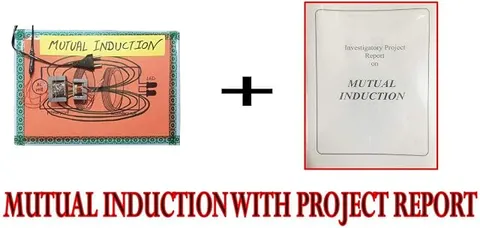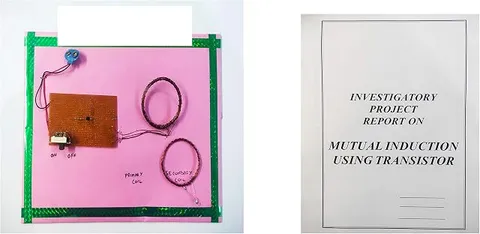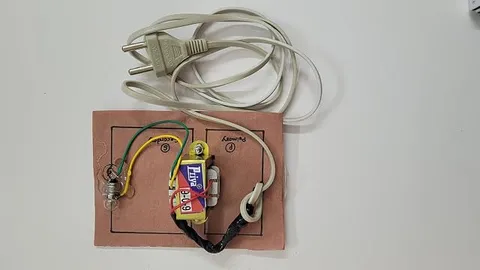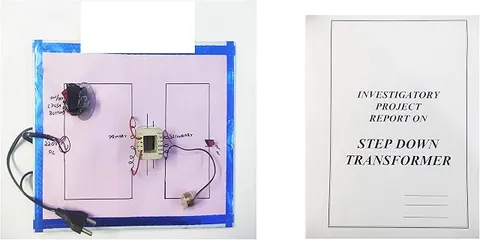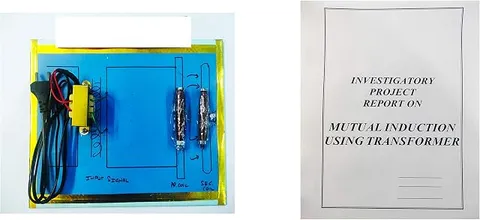
Mutual Induction Using Transformer Educational Circuit Board
Code B082YHPLJ9
- Paid for and delivered by Amazon. The current price and the delivery date for your PIN code are shown there.
- Sold by Gurukul Technicals Institute, Delhi.
- Need a different topic, a custom version or a school order? Ask on WhatsApp.
In this project guide
Physics
About this model
This educational circuit board uses a transformer to demonstrate mutual induction, in which a changing current in one coil induces a voltage in another coil that has no wire connecting it to the first. It is well suited to explaining how energy passes between two circuits through a magnetic field alone.
How it works
The science behind it
The idea the model demonstrates, in words you can use in your report and when you explain it.
Two coils are magnetically coupled when the flux of one passes through the other. A changing current in the primary produces a changing flux that links the secondary and induces an emf in it, though no wire joins the two. The flux linkage of the secondary is proportional to the primary current, N₂Φ₂ = M × I₁, where M is the mutual inductance, measured in henry (H). M is larger when the coils have more turns and a larger area, when they are close together, and when they share a soft iron core, which guides almost all the flux between them. A transformer makes this coupling as strong as possible. With AC in the primary the flux changes continuously, so an alternating voltage appears across the secondary. With steady DC, a voltage appears only at the instant of switching on or off. Wireless phone chargers pass energy between two coils on the same principle.
Make it yourself
Make a mutual induction transformer model with a removable core yourself
Build your own version from scratch, or use the steps to understand how the ready-made model is put together before you present it.
What you need 8
Step by step 8 steps
Wind 300 turns on each bobbin in the same direction, taping each layer, and sand the wire ends clean.
Slide one bobbin onto each limb of the U-core: the primary on the left and the secondary on the right. No wire joins the two coils.
With the adapter unplugged, connect the primary to the adapter's terminals through the first 6 V bulb, and connect the second bulb and the multimeter (AC volts) across the secondary.
Lay the straight piece across the top of the U to close the core, and ask an adult to plug in and switch on. Note the secondary voltage and how brightly each bulb glows.
Ask the adult to switch off, remove the straight piece, then switch on again. The secondary voltage falls sharply and the primary bulb glows brighter, because without a closed core the primary coil holds back the current less.
Repeat with the slip of wood, and then the aluminium sheet, between the U and the straight piece, and compare the readings with the closed core.
With the core closed, disconnect the secondary bulb and watch the primary bulb dim: when no energy is taken from the secondary, the primary draws less current.
Record all the readings in a table, and ask the adult to switch off and unplug the adapter at the end.
Read this first
Safety first
Go through these points before you build or switch anything on. Younger students should do this with an adult.
- Use only a low-voltage AC adapter, plugged in and switched off by an adult; never connect any coil to a 230 V socket and never open the adapter.
- Ask the adult to switch off before you move the core piece or change any connection.
- Keep the open-core tests short and switch off if the coils or the adapter feel warm; the series bulb limits the current, but the coil can still heat up.
- Let an adult take apart any old transformer for its core, as the strips have sharp edges.
Troubleshooting
If something does not work
The usual problems with this model and how to fix them. Open a problem to see the fix.
The secondary bulb does not glow at all
Check the secondary voltage on the meter first. If it reads well, the bulb's rating is too high or its holder is loose; if it reads nothing, sand the secondary's wire ends again and close the core firmly.
The primary bulb glows brightly even with the core closed and no load
The secondary or some primary turns may be shorted through scratched enamel, or the core piece is not sitting flat. Check the coils with the meter and press the core piece down evenly.
The core buzzes and vibrates
Loose strips vibrate at 100 times a second with 50 Hz AC. Press them together and tape them tightly.
The readings change every time the core piece is put back
Dust or uneven placing leaves small air gaps. Wipe the faces clean, press the piece down the same way each time, and average three readings.
Exhibition day
How to present it
A running order for the exhibition table or the practical, step by step.
Show that the primary and secondary coils have no wire between them, yet the secondary gives an output.
Explain how the iron core links the flux of one coil with the other.
Discuss what happens with AC compared with a steady DC supply.
Treat any mains-powered board with care and switch it off before touching any connection.
Practice
Viva questions
Practice questions on this model, with short answers. Try each one aloud before you open the answer.
What is mutual inductance, and what is its SI unit?
It is the property of a pair of coils by which a changing current in one induces an emf in the other; its SI unit is the henry (H).
On what factors does mutual inductance depend?
The number of turns and area of the coils, the distance and orientation between them, and the material of the core.
Why is a soft iron core used?
It has high permeability, so it concentrates the magnetic flux and links almost all of it with the secondary coil.
Is there any electrical connection between the primary and secondary coils?
No. Energy passes from one to the other only through the changing magnetic flux.
Project file
Project file outline
The headings of the project file, in order. Give each heading its own section and write it in your own words.
Free ebook: Writing a Science Project FileContents
- Aim: to show mutual induction between two coils linked only by a magnetic core
- Introduction: magnetic coupling and energy transfer without wires
- Theory: N₂Φ₂ = M × I₁, and what makes the mutual inductance M large
- Construction of the coils and the removable soft iron core
- Observations: secondary voltage and bulb brightness with the core closed, open, and with wood or aluminium in the gap
- Why the primary current rises when the secondary is loaded
- Uses: transformers, wireless phone chargers and induction cooktops
- Safety: a low-voltage AC adapter connected by an adult, and never mains wiring
- Conclusion and bibliography
Buying checklist
Before you buy
What to check before you order the model, and what to do when it arrives.
1Before you order
- Check whether mutual induction is in your syllabus at your class level, as it is usually taught in the senior classes.
- Read the listing to see how the board is powered, and make sure an adult connects any adapter or plug.
- Practise explaining why the secondary works even though no wire joins it to the primary.
- Keep the box and padding, since a heavy core can work loose in transport.
- Check the delivery date for your PIN code on the marketplace, and order well before the exhibition or practical.
2When it arrives
- Test it with an adult as soon as it arrives, and note what the indicator shows.
Next steps
Take it further
Ways to turn this model into a bigger investigation or a stronger exhibition entry.
Put both coils on one long straight iron bar, slide the secondary away from the primary, and plot its voltage against the distance between them.
Wind a second secondary of 150 turns and show that the output depends on the turns ratio as well as on the coupling.
Show with two AA cells in place of the adapter that a steady current gives only a brief flick at switch-on and switch-off, and explain why transformers need AC.
Audience
Who it suits
Class 12 physics students and diploma learners studying mutual induction, inductance and transformers.
- SubjectPhysics
Free to read
Free ebooks for this topic
Free PDF ebooks from Gurukul Technicals Institute on the science, the making and the presenting of projects like this one.
- Free PDF ebook
Electricity and Magnetism Experiments
Hands-on experiments with cells, wires, bulbs and magnets
- Free PDF ebook
Physics Working Models Explained
Twenty classic models, how each works and how to make it
- Free PDF ebook
Your Science Exhibition Guide
Choose a project, build it, present it and answer the judges with confidence
- Free PDF ebook
Writing a Science Project File
How to write the report, from the cover page to the bibliography