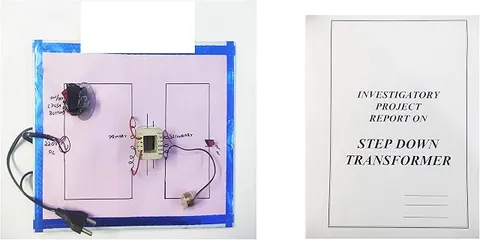
Step Down Transformer Educational Circuit Board
Code B082YGTRC8
- Paid for and delivered by Amazon. The current price and the delivery date for your PIN code are shown there.
- Sold by Gurukul Technicals Institute, Delhi.
- Need a different topic, a custom version or a school order? Ask on WhatsApp.
In this project guide
Physics
About this model
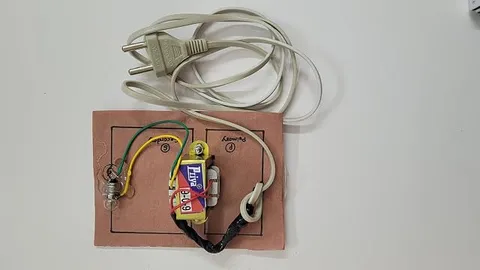
This educational circuit board demonstrates a step-down transformer, a device that lowers an alternating voltage. It helps students see how the number of turns in the two coils decides the output voltage, a key idea behind adapters and the power supply to our homes.
How it works
The science behind it
The idea the model demonstrates, in words you can use in your report and when you explain it.
Inside a step-down transformer, an input coil (the primary) and an output coil (the secondary) share one soft iron core. Alternating current in the primary produces a changing magnetic flux in the core, which induces an alternating voltage in the secondary by mutual induction. The voltages are in the ratio of the turns: Vs / Vp = Ns / Np. In a step-down transformer the secondary has fewer turns than the primary, so Vs is smaller than Vp. With 1000 primary turns and 50 secondary turns, for example, 230 V becomes 230 × 50 / 1000 = 11.5 V. In an ideal transformer no power is lost, so Vp × Ip = Vs × Is, and the current is stepped up in the same ratio as the voltage is stepped down. It does not work on steady DC, which produces no change in flux. Pole-mounted transformers step the distribution voltage down to the 230 V used in homes.
Make it yourself
Make a step-down transformer model yourself
Build your own version from scratch, or use the steps to understand how the ready-made model is put together before you present it.
What you need 9
Step by step 9 steps
Cover the centre limb of the core with one layer of paper so its edges cannot scrape the enamel, and make two bobbins that slide onto it.
Wind the primary on the first bobbin: 400 turns in one direction, counting in tens and taping each layer, leaving 15 cm of wire free at both ends.
Wind the secondary on the second bobbin with 200 turns, twisting out a small loop (a tap) after the 50th and the 100th turn and carrying on in the same direction.
Sand the enamel off the ends and the tap loops until the copper shines, and fix them to terminals labelled 0, 50, 100 and 200 turns.
Slide both bobbins onto the core and close it with the I strips pressed tight and taped, leaving no air gap.
With the adapter unplugged, connect its output to the primary terminals. Then an adult plugs it in and switches on.
Measure the primary voltage, then the voltage from 0 to each tap, and write each one beside its number of turns. Expect roughly one eighth, one quarter and one half of the primary voltage.
Connect the 6 V bulb to each tap in turn and watch it glow brighter as the number of secondary turns rises.
Ask the adult to switch off, remove the I strips, switch on for a quick reading only, and compare the output without a closed core.
Read this first
Safety first
Go through these points before you build or switch anything on. Younger students should do this with an adult.
- Use only a low-voltage AC adapter, plugged in and switched off by an adult. Never connect any coil to a 230 V wall socket, and never open the adapter.
- Ask the adult to switch off before you change taps or any connection.
- Keep the open-core test short, and switch off if the primary coil or the adapter feels warm.
- Let an adult take the old transformer apart, as the strips have sharp edges, and wash your hands after sanding the wire.
Troubleshooting
If something does not work
The usual problems with this model and how to fix them. Open a problem to see the fix.
The output is much lower than the turns ratio predicts
There may be an air gap in the core, loose strips, or flux leaking out. Press the I strips tight and tape them, and take the reading with nothing connected to the output.
One tap reads zero
The enamel was not fully removed at that tap, or the loop has broken off. Sand the loop again and check it with the multimeter's continuity range.
The primary coil gets warm quickly
It has too few turns for the adapter's voltage, or some turns are shorted where the enamel is scratched. Add turns to the primary or rewind it carefully.
The core buzzes loudly
Loose strips vibrate at 100 times a second with 50 Hz AC. Clamp or tape the strips tightly together.
Exhibition day
How to present it
A running order for the exhibition table or the practical, step by step.
Draw the transformer symbol and label the primary and secondary coils with their turns.
Work out one turns-ratio example on a chart, such as 230 V down to 11.5 V.
Explain why a transformer needs AC and will not work from a battery.
If the board runs from the mains, let a teacher handle the plug and never touch exposed connections.
Practice
Viva questions
Practice questions on this model, with short answers. Try each one aloud before you open the answer.
What is the relation between voltage and number of turns in a transformer?
Vs / Vp = Ns / Np.
How do you identify a step-down transformer?
Its secondary coil has fewer turns than its primary, so its output voltage is lower than its input voltage.
Why does a transformer not work with DC?
Steady DC produces no change in magnetic flux, so no voltage is induced in the secondary.
When a step-down transformer lowers the voltage, what happens to the current?
In an ideal transformer the secondary current increases in the same ratio, because Vp × Ip = Vs × Is.
Project file
Project file outline
The headings of the project file, in order. Give each heading its own section and write it in your own words.
Free ebook: Writing a Science Project FileContents
- Aim: to show how a step-down transformer lowers an AC voltage
- Introduction: why devices such as doorbells and chargers need lower voltages
- Principle: mutual induction between coils on a shared soft iron core
- Theory: Vs / Vp = Ns / Np, with a worked example
- Construction: winding the primary and the tapped secondary
- Observations: turns, measured voltage and expected voltage for each tap
- Losses in a real transformer: copper loss, eddy currents and flux leakage
- Why the model uses a low-voltage adapter connected by an adult and never 230 V mains
- Conclusion and bibliography
Buying checklist
Before you buy
What to check before you order the model, and what to do when it arrives.
1Before you order
- Check whether your teacher expects a transformer at your class level, since it is usually taught in the senior classes.
- Read the listing to find out how the board is powered and what output it shows, and make sure an adult handles any plug.
- Practise a worked example of the turns ratio, as examiners often ask you to calculate an output voltage.
- Keep the box for transport, since a heavy core can break loose if the board is dropped.
- Check the delivery date for your PIN code on the marketplace, and order well before the exhibition or practical.
2When it arrives
- Test it with an adult as soon as it arrives, and again a few days before the exhibition.
Next steps
Take it further
Ways to turn this model into a bigger investigation or a stronger exhibition entry.
Wind extra taps and plot output voltage against secondary turns to show the straight-line relationship.
Measure the current in both coils with a bulb on the output and estimate the efficiency, (Vs × Is) / (Vp × Ip).
Compare a solid iron bar core with a laminated core and explain the difference in heating with eddy currents.
Audience
Who it suits
Class 10 to 12 students making a project on electromagnetic induction, transformers or electricity supply.
- SubjectPhysics
Free to read
Free ebooks for this topic
Free PDF ebooks from Gurukul Technicals Institute on the science, the making and the presenting of projects like this one.
- Free PDF ebook
Electricity and Magnetism Experiments
Hands-on experiments with cells, wires, bulbs and magnets
- Free PDF ebook
Physics Working Models Explained
Twenty classic models, how each works and how to make it
- Free PDF ebook
Your Science Exhibition Guide
Choose a project, build it, present it and answer the judges with confidence
- Free PDF ebook
Writing a Science Project File
How to write the report, from the cover page to the bibliography