Series & Parallel Capacitor with Charging and Discharging 2 in 1 Combo
Code B0G2T948Q2
- Paid for and delivered by Amazon. The current price and the delivery date for your PIN code are shown there.
- Sold by Gurukul Technicals Institute, Delhi.
- Need a different topic, a custom version or a school order? Ask on WhatsApp.
In this project guide
Physics
About this model
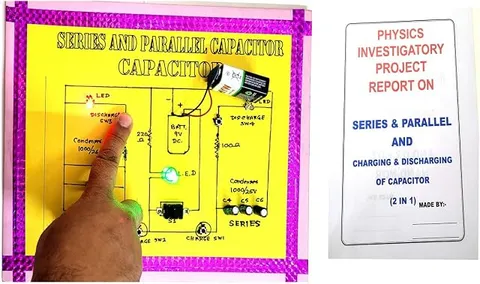
This 2 in 1 combo covers two capacitor topics together: how capacitors combine in series and in parallel, and how a capacitor charges and discharges over time. It suits a student who wants one project that links capacitance formulas with an effect that can be watched.
How it works
The science behind it
The idea the model demonstrates, in words you can use in your report and when you explain it.
Capacitors combine in the opposite way to resistors. In parallel, each capacitor gets the same voltage and their charges add, so the total capacitance is C = C1 + C2 + C3. In series, each capacitor carries the same charge and their voltages add, so 1/C = 1/C1 + 1/C2 + 1/C3, which makes the total smaller than the smallest one. For example, two 100 µF capacitors give 200 µF in parallel but 50 µF in series. When a capacitor charges through a resistor R, its voltage rises quickly at first and then more slowly, following V = V₀(1 − e^(−t/RC)). The product RC is the time constant τ: in one time constant the capacitor reaches about 63% of the supply voltage, and when discharging it falls to about 37% in the same time. After about five time constants it is practically full or empty. A ceiling fan's capacitor is an everyday example.
Make it yourself
Make a series and parallel capacitor charging board yourself
Build your own version from scratch, or use the steps to understand how the ready-made model is put together before you present it.
What you need 9
Step by step 9 steps
Mount the two capacitors with each leg on its own screw terminal, and mark + and − clearly beside every terminal.
Join the negative end of the capacitor group to the battery negative, then wire the SPDT switch: the middle terminal to the positive end of the group, one end to the battery positive through a 10 kΩ resistor (charge), and the other end to negative through the second 10 kΩ resistor (discharge).
Connect the voltmeter across the capacitor group so it shows the voltage all the time, and fit the push button, LED and 470 Ω resistor across the group as well.
- Single capacitor
Discharge it fully, switch to charge, start the stopwatch and write down the voltage every 5 seconds for 60 seconds.
Switch to discharge and record the voltage every 5 seconds as it falls.
- Parallel
Join the two positive terminals together and the two negatives together with clip leads, and repeat. Series: join the first capacitor's negative to the second's positive, use the two free ends, and repeat.
For each arrangement, find the time at which the charging voltage reaches 63% of the battery's measured voltage (about 5.7 V for 9 V). This is the time constant τ = RC, so C = τ ÷ R.
- Compare the three results
About 10 s for one capacitor, 20 s in parallel and 5 s in series, which matches C = C1 + C2 and 1/C = 1/C1 + 1/C2.
Charge each arrangement, press the flash-test button, and compare how long the LED glows.
Read this first
Safety first
Go through these points before you build or switch anything on. Younger students should do this with an adult.
- Connect each capacitor with its long (positive) leg to the positive side, and use capacitors rated 25 V or more; a reversed electrolytic can bulge or burst.
- Discharge the capacitors through the 10 kΩ resistor before rearranging them, and never short them with a wire or screwdriver.
- Use only the 9 V battery; this experiment needs nothing more.
- Do not use capacitors rated below 16 V, even in series, because leakage can make the voltage share unevenly between them.
Troubleshooting
If something does not work
The usual problems with this model and how to fix them. Open a problem to see the fix.
The voltage never quite reaches 9 V
Most 9 V batteries read a little above or below 9 V, and capacitors leak slightly. Measure the battery first and use 63% of its real voltage for the time constant.
The time constants do not match the formula
Electrolytic capacitors can differ from their marked value by 20% or more, and reaction time with the stopwatch adds error. Repeat each run three times, average, and list the tolerances as sources of error.
The series arrangement charges as slowly as a single capacitor
A clip lead is shorting one capacitor, or the pair is really wired in parallel. Check that only the two free ends connect to the circuit and that nothing joins them in the middle.
The voltage slowly drops in the hold position
Leakage inside the capacitors and the voltmeter's own resistance let a little charge escape. This is normal; record the drop over a minute and mention it.
Exhibition day
How to present it
A running order for the exhibition table or the practical, step by step.
Show the series and parallel connections and work out the total capacitance of each on a chart.
During charging and discharging, point out how fast the change is at first and how it slows down.
If the component values are marked, calculate the time constant RC.
Explain why capacitors in series give a smaller total, unlike resistors in series.
Practice
Viva questions
Practice questions on this model, with short answers. Try each one aloud before you open the answer.
What is the total capacitance of capacitors connected in parallel?
The sum of the individual capacitances, C = C1 + C2 + C3 and so on.
What is the time constant of an RC circuit?
τ = R × C, the time in which a charging capacitor reaches about 63% of the supply voltage.
Which quantity is the same for capacitors in series?
The charge on each capacitor is the same.
Why is a series combination smaller than the smallest capacitor?
Because 1/C is the sum of all the reciprocals, it is larger than any single one of them, so C is smaller than any single capacitance.
Project file
Project file outline
The headings of the project file, in order. Give each heading its own section and write it in your own words.
Free ebook: Writing a Science Project FileContents
- Aim: to find the combined capacitance of capacitors in series and in parallel by timing how they charge
- Introduction: capacitance, charge and voltage, Q = C × V
- Theory: C = C1 + C2 in parallel and 1/C = 1/C1 + 1/C2 in series
- Charging and discharging through a resistor, V = V₀(1 − e^(−t/RC)), and the time constant τ = RC
- Circuit diagram of the charge, hold and discharge board
- Observation tables of voltage against time for one capacitor, parallel and series
- Charging and discharging graphs, with the time constant read from each
- Comparison of measured and calculated capacitance, and sources of error
- Conclusion and bibliography
Buying checklist
Before you buy
What to check before you order the model, and what to do when it arrives.
1Before you order
- Check that capacitor combinations and charging curves match your syllabus and your teacher's brief.
- Read the listing to see which capacitor values and what kind of meter it uses, and arrange a multimeter if needed.
- Practise working out a series and a parallel value for two capacitors, since examiners often ask for one.
- Keep the box for transport.
- Check the delivery date for your PIN code on the marketplace, and order well before the exhibition or practical.
2When it arrives
- Run one full charge and discharge as soon as it arrives and keep the readings as a back-up set.
Next steps
Take it further
Ways to turn this model into a bigger investigation or a stronger exhibition entry.
Plot ln(V₀ − V) against time while charging and find RC from the slope of the straight line.
Add a third capacitor of a different value and test mixed series-parallel combinations.
Repeat with a 22 kΩ resistor and show that the time constant depends on R as well as C.
Audience
Who it suits
Class 12 physics students preparing a capacitor investigatory project, and diploma learners revising RC circuits.
- SubjectPhysics
Free to read
Free ebooks for this topic
Free PDF ebooks from Gurukul Technicals Institute on the science, the making and the presenting of projects like this one.
- Free PDF ebook
Physics Working Models Explained
Twenty classic models, how each works and how to make it
- Free PDF ebook
Your Science Exhibition Guide
Choose a project, build it, present it and answer the judges with confidence
- Free PDF ebook
Writing a Science Project File
How to write the report, from the cover page to the bibliography
- Free PDF ebook
Viva Questions for Science Projects
How to answer examiner questions, with sample questions for popular projects