- Physics
- Ready-made model
- Class 1 to 9
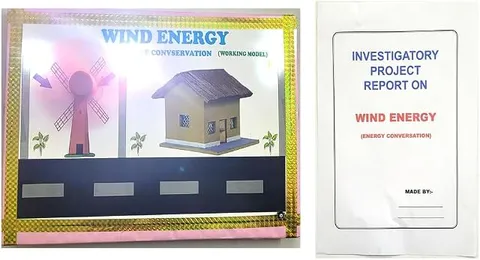
Wind Mill Energy Electricity Generation Science Project Model Educational Electronic Hobby Kit
Code B0DTYL26N2
- Paid for and delivered by Amazon. The current price and the delivery date for your PIN code are shown there.
- Sold by Gurukul Technicals Institute, Delhi.
- Need a different topic, a custom version or a school order? Ask on WhatsApp.
In this project guide
Ready-made model
About this model
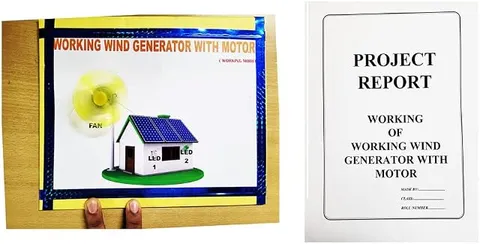
A windmill working model that shows how moving air can turn blades and generate electricity. It is a popular renewable energy project that lets students explain the full chain of energy conversion, from the kinetic energy of the wind to electrical energy.
How it works
The science behind it
The idea the model demonstrates, in words you can use in your report and when you explain it.
Wind is moving air, and moving air has kinetic energy. When wind strikes the angled blades of a windmill, it pushes them round and turns the rotor. The rotating shaft drives a generator, often a small DC motor working in reverse in school models, and electromagnetic induction produces a voltage as its coil turns in a magnetic field. So kinetic energy of air becomes mechanical energy of the rotor and then electrical energy. The power in wind is P = ½ρAv³, where ρ is air density, A is the area swept by the blades and v is wind speed. Because power depends on the cube of speed, doubling the wind speed gives eight times the power, and longer blades sweep more area. Even an ideal turbine cannot capture more than about 59 percent of this power, the Betz limit. Tamil Nadu and Gujarat have large wind farms along their coasts and hills.
Make it yourself
Make a windmill that generates electricity yourself
Build your own version from scratch, or use the steps to understand how the ready-made model is put together before you present it.
What you need 9
Step by step 8 steps
Fix the tower upright in the middle of the base with glue or a clamp, and check it does not lean.
Fix the motor at the top of the tower, lying flat with its shaft pointing towards where the wind will come from, using glue and tape.
Cut the blades all the same size and weight, sand the edges smooth, and twist each one to the same angle, about 20 to 30 degrees from flat.
Glue the blades onto the hub evenly spaced, 90 degrees apart for four blades or 120 degrees apart for three, and push the hub firmly onto the motor shaft.
Run the motor's two wires down the tower to two terminals on the base, and connect the multimeter (DC volts) or the LED there.
Place the fan about 50 cm in front of the blades and switch it on. The blades should turn and the meter should show a voltage.
If you are using the LED and it stays dark, swap its two legs: the motor's output polarity depends on which way it spins. A red LED also needs about 1.8 V, so it may only glow at higher speeds.
Note the voltage with the fan at different distances or speeds, and with the blades at different angles.
Read this first
Safety first
Go through these points before you build or switch anything on. Younger students should do this with an adult.
- Keep fingers, hair and faces away from the turning blades, and round off the blade tips so there are no sharp points.
- Cut the bottle plastic only with an adult nearby, and sand all cut edges smooth.
- An adult should handle the table fan's plug; keep the model's wires well away from the fan.
- Use hot glue only with an adult, and let it cool before touching.
Troubleshooting
If something does not work
The usual problems with this model and how to fix them. Open a problem to see the fix.
The blades spin but the LED does not glow
The LED may be the wrong way round for this direction of spin, so swap its legs. If it still does not glow, the motor is turning too slowly to give 1.8 V: move the fan closer, use longer blades, or show the output on the multimeter instead.
The blades do not start turning
The blade angle may be too flat or too steep, or the hub may be slipping on the shaft. Set every blade to the same moderate twist, push the hub on firmly, and give the blades a gentle flick to start them.
The windmill shakes and rattles
The blades are not equal in weight or the hub is off-centre. Trim the heavier blade, check that the hub sits straight, and tighten the motor's mounting.
The reading jumps up and down
The fan's swing setting or a gusty breeze changes the wind speed. Turn off the swing, keep the fan still and read the meter after the blades settle.
Exhibition day
How to present it
A running order for the exhibition table or the practical, step by step.
Use a table fan at different speeds to show the output rising with wind speed, and mention the cube law.
Trace the energy conversion chain aloud: kinetic energy of air, mechanical energy of the rotor, electrical energy.
Explain why the blades are angled: flat blades facing the wind squarely would be pushed but would not turn.
Mention the limitation that wind does not blow steadily everywhere, which is why wind farms are built at windy sites.
Practice
Viva questions
Practice questions on this model, with short answers. Try each one aloud before you open the answer.
What energy conversion takes place in a windmill generator?
The kinetic energy of the wind is converted into mechanical energy of the rotating blades and then into electrical energy by the generator.
What happens to wind power if the wind speed doubles?
It becomes eight times as large, because wind power is proportional to the cube of wind speed.
Why is wind energy called renewable?
Wind is produced continuously by the uneven heating of the Earth by the Sun, so it does not run out like coal or oil.
What is the Betz limit?
It is the theoretical maximum fraction of the wind's power that a turbine can extract, about 59.3 percent.
Project file
Project file outline
The headings of the project file, in order. Give each heading its own section and write it in your own words.
Free ebook: Writing a Science Project FileContents
- Aim: to show how the kinetic energy of wind is changed into electrical energy
- Introduction: wind as a renewable source of energy
- Principle: electromagnetic induction in a DC motor used as a generator
- Materials and construction of the blades, hub and tower
- The energy chain: kinetic energy of air to mechanical energy of the rotor to electrical energy
- Observations: output voltage at different fan distances and blade angles
- Why power depends on the cube of wind speed (P = ½ρAv³)
- Advantages and limitations of wind energy
- Conclusion and bibliography
Buying checklist
Before you buy
What to check before you order the model, and what to do when it arrives.
1Before you order
- Check that a renewable energy model suits your class syllabus and what your teacher has asked for.
- Read the listing to see whether it mentions a battery, lights or a report, so you know what else you need.
- Test it with a table fan a few days before the exhibition, and plan to carry a small fan if there will be no breeze at the venue.
- Keep the box and carry the blades protected so they do not bend on the way.
- Check the delivery date for your PIN code on the marketplace, and order well before the exhibition or practical.
- Practise explaining it. Judges ask what the model shows and why; knowing the science matters as much as the model. The viva questions above are a good place to start.
2When it arrives
- Blades are the most delicate part, so check them for cracks as soon as it arrives.
Next steps
Take it further
Ways to turn this model into a bigger investigation or a stronger exhibition entry.
Compare two, three and four blades, and different blade angles, and plot the output voltage for each.
Measure the voltage across a known resistor, calculate the electrical power (P = V²/R), and compare it with the wind power using P = ½ρAv³ to estimate efficiency.
Store the output by charging a large capacitor through a diode, and show it lighting an LED after the fan is switched off.
Audience
Who it suits
Suits Class 6 to 10 science exhibitions on renewable energy and Class 11 and 12 projects on energy conversion.
- ClassClass 1 to 9
- SubjectPhysics
- TypeReady-made model
Free to read
Free ebooks for this topic
Free PDF ebooks from Gurukul Technicals Institute on the science, the making and the presenting of projects like this one.
- Free PDF ebook
Electricity and Magnetism Experiments
Hands-on experiments with cells, wires, bulbs and magnets
- Free PDF ebook
Physics Working Models Explained
Twenty classic models, how each works and how to make it
- Free PDF ebook
Your Science Exhibition Guide
Choose a project, build it, present it and answer the judges with confidence
- Free PDF ebook
Writing a Science Project File
How to write the report, from the cover page to the bibliography