- Physics
- Ready-made model
- Class 1 to 9
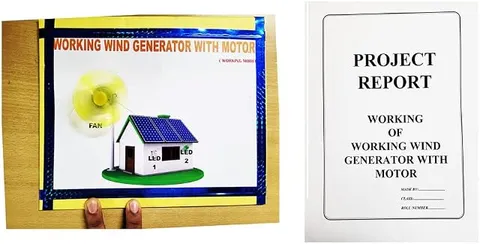
Working Wind Generator Physics Working Model Educational Science Project
Code B0BN2KFPZ3
- Paid for and delivered by Amazon. The current price and the delivery date for your PIN code are shown there.
- Sold by Gurukul Technicals Institute, Delhi.
- Need a different topic, a custom version or a school order? Ask on WhatsApp.
In this project guide
Ready-made model
About this model
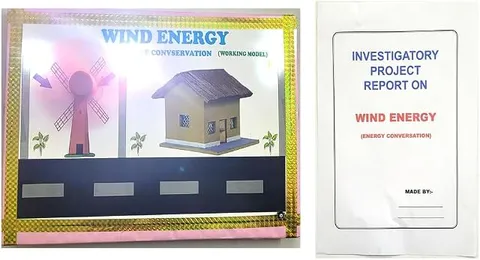
This working wind generator model turns the push of moving air into electricity. It demonstrates the principle behind the giant wind turbines that stand in wind farms.
How it works
The science behind it
The idea the model demonstrates, in words you can use in your report and when you explain it.
Wind is simply air in motion, so it carries kinetic energy. As it flows past the angled blades of a turbine, it pushes them round and turns a shaft connected to a generator. Inside the generator, a coil and magnets move relative to each other, so the magnetic flux through the coil keeps changing and an electric current is induced. This is electromagnetic induction, discovered by Michael Faraday. In small models, a DC motor spun by the blades often serves as the generator. The energy chain runs from wind energy to rotational energy to electrical energy. The power available in wind is P = ½ × ρ × A × v³, where ρ is the density of air, A is the area swept by the blades and v is the wind speed, so doubling the wind speed gives eight times the power. India has large wind farms in states such as Tamil Nadu and Gujarat, where strong, steady winds blow.
Make it yourself
Make a working wind generator model yourself
Build your own version from scratch, or use the steps to understand how the ready-made model is put together before you present it.
What you need 10
Step by step 8 steps
Ask an adult to cut four equal blades, each about 10 cm long, from the curved side of the bottle, and round off the tips.
Glue the blades evenly round the hub, all twisted the same way at about 20 to 30° from flat, checking with the protractor.
Push the hub firmly onto the motor shaft so it does not wobble or slip.
Fix the motor to the top of the tower with its shaft pointing forward, and fix the tower firmly to the base.
Connect the motor's two leads to the multimeter on DC volts, place the fan 50 cm in front of the blades and switch it on.
Record the voltage at the fan's low, medium and high settings, and with the fan at 50, 100 and 150 cm.
Try two, three and six blades, and different blade angles, and find the arrangement that gives the highest voltage.
Connect the two opposite-facing LEDs across the motor leads: one of them lights whichever way the blades turn, showing that the motor is now making electricity.
Read this first
Safety first
Go through these points before you build or switch anything on. Younger students should do this with an adult.
- Let an adult cut the plastic bottle, as cut edges can be sharp, and tape or sand the blade edges.
- Keep the fan's guard on, and keep fingers away from both the fan and the model's spinning blades.
- Use hot glue only with an adult, and check every blade is firmly fixed before running at high speed so nothing flies off.
- An adult should plug in and switch the fan, and its cable should be kept out of the way.
Troubleshooting
If something does not work
The usual problems with this model and how to fix them. Open a problem to see the fix.
The blades spin but the meter shows almost nothing
The motor is turning too slowly to make much voltage. Use a larger motor, longer blades or more blades, or move the fan closer.
The LEDs do not light
A red LED needs about 1.8 V before it glows, and a small model may not reach that. Turn the fan to high, add a pulley to speed up the motor shaft, or show the output on the meter instead.
The blades will not start turning
The blade angle may be too flat or too steep, or the hub may be rubbing on the motor. Set the angle to about 20 to 30°, free the hub, and give the blades a gentle flick to start.
The model wobbles badly
The blades are not equal in size or weight, or the hub is off-centre. Trim the blades to match and re-glue the hub at the centre.
Exhibition day
How to present it
A running order for the exhibition table or the practical, step by step.
Use a table fan at different speeds and show that faster wind gives a bigger output.
Explain the energy chain from wind to electricity on a chart.
Explain why wind farms are built on coasts, open plains and hilltops.
Discuss the advantages and limits of wind power, such as no fuel cost but changing wind.
Practice
Viva questions
Practice questions on this model, with short answers. Try each one aloud before you open the answer.
On which principle does a wind generator work?
Electromagnetic induction: turning a coil relative to magnets changes the magnetic flux and induces a current.
What energy change takes place in a wind generator?
The kinetic energy of the wind is converted into rotational energy of the blades and then into electrical energy.
How does wind power depend on wind speed?
It is proportional to the cube of the wind speed, so doubling the speed gives eight times the power.
Name two Indian states with large wind farms.
Tamil Nadu and Gujarat.
Project file
Project file outline
The headings of the project file, in order. Give each heading its own section and write it in your own words.
Free ebook: Writing a Science Project FileContents
- Aim: to show how wind energy can be changed into electrical energy
- Introduction: wind as moving air, and wind farms in India
- Principle: electromagnetic induction in a generator
- Energy chain: wind energy to rotational energy to electrical energy
- Construction of the blades, hub and tower
- Observations: voltage at different fan speeds, distances and numbers of blades
- Advantages and limitations of wind power
- Conclusion and bibliography
Buying checklist
Before you buy
What to check before you order the model, and what to do when it arrives.
1Before you order
- Check that energy resources or electricity generation is in your syllabus and that a working model suits your teacher's brief.
- Read the listing to see how the model shows its output, for example a light or a meter, so you know what to point out.
- Ask in advance whether a fan or power point will be available at the exhibition, since the model needs moving air to work.
- Keep the box and protect the blades, which bend or snap easily in transport.
- Check the delivery date for your PIN code on the marketplace, and order well before the exhibition or practical.
- Practise explaining it. Judges ask what the model shows and why; knowing the science matters as much as the model. The viva questions above are a good place to start.
2When it arrives
- Test it in front of a fan as soon as it arrives, and again a few days before the exhibition.
Next steps
Take it further
Ways to turn this model into a bigger investigation or a stronger exhibition entry.
Measure the current through a 100 Ω load and calculate the electrical power at each fan speed.
Add a tail vane so the turbine turns to face the wind by itself.
Use P = ½ρAv³ to explain why doubling the wind speed gives eight times the power, and check whether your readings rise steeply with fan speed.
Store the output in a small capacitor through a diode and time how long it can light an LED afterwards.
Audience
Who it suits
Class 6 to 10 students preparing an exhibition model on renewable energy or sources of energy.
- ClassClass 1 to 9
- SubjectPhysics
- TypeReady-made model
Free to read
Free ebooks for this topic
Free PDF ebooks from Gurukul Technicals Institute on the science, the making and the presenting of projects like this one.
- Free PDF ebook
Electricity and Magnetism Experiments
Hands-on experiments with cells, wires, bulbs and magnets
- Free PDF ebook
Physics Working Models Explained
Twenty classic models, how each works and how to make it
- Free PDF ebook
Your Science Exhibition Guide
Choose a project, build it, present it and answer the judges with confidence
- Free PDF ebook
Writing a Science Project File
How to write the report, from the cover page to the bibliography