- Physics
- Kit
- Printed report included
Generic Variation of Current and Voltage in Conductor Educational Project Kit (Educational Circuit Board, Printed Report) for Kids & Teens
Code B0C3H4CZM9
- Paid for and delivered by Amazon. The current price and the delivery date for your PIN code are shown there.
- Sold by Gurukul Technicals Institute, Delhi.
- Need a different topic, a custom version or a school order? Ask on WhatsApp.
In this project guide
Kit
About this kit
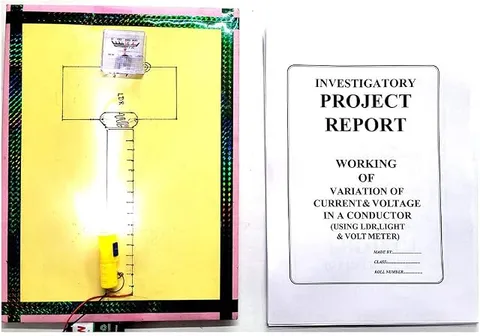
This project is for studying how the current through a conductor changes as the voltage across it is changed. The listing says it includes an educational circuit board and a printed report, and the experiment leads students to the V-I graph and Ohm's law through their own readings.
How it works
The science behind it
The idea the kit demonstrates, in words you can use in your report and when you explain it.
When the potential difference across a metal conductor is increased step by step, the free electrons drift through it faster, so more charge passes each second and the current increases. Taking a set of voltage and current readings, for example by adding cells one at a time or adjusting a rheostat, and plotting them gives a straight line through the origin for a metal wire kept at constant temperature. This shows that V/I stays constant, and that constant is the conductor's resistance. On a graph with V on the y-axis, a longer wire of the same material gives a steeper line, a thicker wire gives a flatter one, and a different material, such as nichrome instead of copper, changes the slope because of its resistivity. If the conductor heats up, its resistance usually rises and the graph curves. The element of an electric kettle or immersion rod is made of nichrome because of its high resistivity.
Make it yourself
Make a current and voltage experiment board yourself
Everything you need and the order to do it in. Tick off the materials as you collect them.
What you need 8
Step by step 8 steps
Fix the conductor between the two screw terminals on the board and label it. If you use nichrome wire, keep it straight and note its length.
Connect one cell, the switch, the ammeter and the conductor in series, so that the same current passes through all of them.
Set the ammeter multimeter to the 200 mA DC range with its red lead in the mA socket, connected so that current enters at the red lead.
Connect the voltmeter, on DC volts, directly across the two ends of the conductor, with its red lead on the side nearer the cells' positive terminal.
Press the switch, read the voltage and the current, then release it. Keep the switch on only while reading, so the conductor does not heat up.
Add a second cell in series and take the next pair of readings, then a third and a fourth. Take each reading twice and use the average.
Fill in a table of V, I and V divided by I, and plot V against I on graph paper.
Draw the best straight line through the points and find its slope. Compare it with the resistance the multimeter shows on its ohms range, with the cells disconnected.
Read this first
Safety first
Go through these points before you build or switch anything on. Younger students should do this with an adult.
- Never connect the ammeter straight across the cells; without the conductor in the circuit that is a short circuit, which heats the wires and can blow the meter's fuse.
- Use no more than four 1.5 V cells, and do not mix old and new cells, which can leak.
- Release the switch between readings, because a thin wire carrying current for long can get hot enough to hurt a finger.
- Ask an adult to help when cutting and stripping wires.
Troubleshooting
If something does not work
The usual problems with this kit and how to fix them. Open a problem to see the fix.
The ammeter reads zero even though the voltmeter shows a voltage
The red lead may be in the wrong socket, the meter's fuse may have blown, or a clip may be loose. Check each joint, then try the meter's 10 A socket to see whether the mA fuse is the problem.
The readings show a minus sign
The meter is connected the wrong way round. Swap its two leads so that current enters at the red lead.
The points on my graph curve instead of lying on a straight line
The conductor is heating up as the current rises, which raises its resistance. Take readings quickly with the switch released in between, or use a resistor with a higher power rating.
Adding a cell hardly raises the voltage
One of the cells is weak or a holder spring is not touching. Check each cell on its own with the voltmeter and replace any that read well below 1.5 V.
Exhibition day
How to present it
A running order for the exhibition table or the practical, step by step.
Record at least five pairs of voltage and current readings in a neat table before plotting the graph.
Plot the readings live on graph paper and draw the best straight line through them.
Change the length or the type of wire if you can, and show how the slope changes.
Point out any reading that does not fit the line and discuss what might have caused it.
Practice
Viva questions
Practice questions on this kit, with short answers. Try each one aloud before you open the answer.
How does the current change when the voltage across a conductor is doubled?
For an ohmic conductor at constant temperature, the current also doubles.
What is the shape of the V-I graph for a metallic conductor?
A straight line passing through the origin, as long as the temperature stays constant.
Why is nichrome used in heating elements?
It has a high resistivity and does not oxidise easily at high temperatures.
What is the role of a rheostat in this experiment?
It changes the resistance in the circuit so that the current and the voltage across the conductor can be varied step by step.
Project file
Project file outline
The headings of the project file, in order. Give each heading its own section and write it in your own words.
The listing includes a printed project report: use this outline to check that your own file covers every part.
Free ebook: Writing a Science Project FileContents
- Aim: to study how the current through a conductor changes with the potential difference across it
- Apparatus and materials
- Theory: Ohm's law and resistance
- Circuit diagram with the ammeter in series and the voltmeter in parallel
- Procedure
- Observation table: number of cells, V, I and V/I
- Graph of V against I and resistance from its slope
- Result and conclusion
- Precautions and sources of error
Buying checklist
Before you buy
What to check before you order the kit.
1Check these first
- The V-I relationship is part of the Class 10 electricity chapter and comes again in Class 12; ask your teacher how many readings and which graph they expect.
- Look in the listing for what the circuit board needs to work, such as cells or meters, and buy anything missing before project week.
- If a printed report comes with it, use it as a guide but write up your own readings, because examiners often ask how you got them.
- Try the board at home a few days before the practical, so you can replace weak cells or fix a loose joint in time.
- Keep the box to carry the board, so the wires and terminals are not bent on the way to school.
- Check the delivery date for your PIN code on the marketplace, and order well before the exhibition or practical.
- Check whether it arrives assembled. The listing calls it a kit, so look at the photos and the box contents on the marketplace before you order.
Next steps
Take it further
Ways to turn this kit into a bigger investigation or a stronger exhibition entry.
Repeat the experiment with two wires of the same material but different lengths or thicknesses and compare the slopes of their graphs.
Replace the resistor with a small torch bulb to get a curved graph, because a filament's resistance rises as it heats up.
Measure the length and diameter of a nichrome wire and calculate its resistivity from your graph.
Audience
Who it suits
Suits Class 10 and 12 physics practicals and investigatory projects on current electricity.
- SubjectPhysics
- TypeKit
- Project reportPrinted report included
Free to read
Free ebooks for this topic
Free PDF ebooks from Gurukul Technicals Institute on the science, the making and the presenting of projects like this one.
- Free PDF ebook
Electricity and Magnetism Experiments
Hands-on experiments with cells, wires, bulbs and magnets
- Free PDF ebook
Physics Working Models Explained
Twenty classic models, how each works and how to make it
- Free PDF ebook
Your Science Exhibition Guide
Choose a project, build it, present it and answer the judges with confidence
- Free PDF ebook
Writing a Science Project File
How to write the report, from the cover page to the bibliography