- Physics
- Ready-made model
Artificial Kidney Process Science Working Project and Model Educational Electronic Hobby Kit
Code B0DTY9KL1S
- Paid for and delivered by Amazon. The current price and the delivery date for your PIN code are shown there.
- Sold by Gurukul Technicals Institute, Delhi.
- Need a different topic, a custom version or a school order? Ask on WhatsApp.
In this project guide
Ready-made model
About this model
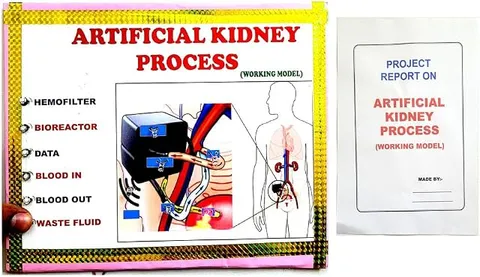
This model explains how an artificial kidney, or dialysis machine, cleans the blood of a person whose kidneys have stopped working properly. It links the work of the real kidney to the process of haemodialysis in a way students can explain step by step.
How it works
The science behind it
The idea the model demonstrates, in words you can use in your report and when you explain it.
Healthy kidneys filter blood through tiny units called nephrons, removing urea, extra salts and water as urine while keeping proteins and blood cells in the body. When the kidneys fail, these wastes build up, and dialysis takes over the job. In haemodialysis, blood is taken from the patient, mixed with an anticoagulant such as heparin so it does not clot, and passed through long tubes lined with a semi-permeable membrane. The tubes sit in a tank of dialysing fluid, which has the same osmotic pressure as blood but contains no nitrogenous wastes. Urea and excess salts diffuse out of the blood into the fluid, from higher to lower concentration, while large molecules such as proteins and blood cells stay in. The cleaned blood is returned to a vein. Unlike a real kidney, the machine does not reabsorb anything. District hospitals offer dialysis under the Pradhan Mantri National Dialysis Programme.
Make it yourself
Make an artificial kidney (dialysis) model yourself
Build your own version from scratch, or use the steps to understand how the ready-made model is put together before you present it.
What you need 10
Step by step 9 steps
Plan the layout on the base: the patient's arm and blood bottle on the left, the dialyser tank in the middle and the kidney diagram on the right, with arrows for the direction of blood flow.
Fill the first bottle with water coloured red and sit the pump at its bottom; the pump must be fully under water before it is switched on.
Fix one end of the clear tube to the pump outlet, coil the middle of the tube several times inside the second bottle, and bring the other end back into the first bottle so the red water returns to the patient.
Fill the second bottle with clear water to stand for the dialysing fluid, and label the two tube ends 'blood with urea' and 'cleaned blood'.
Run the pump wires through the switch to the cell holder, keeping the cells and switch on the dry side of the base, above the level of any water.
Switch on and check that the red water flows steadily through the coil and back; if a joint leaks, switch off before sealing it.
Prepare the membrane test with an adult: tie a little starch solution inside the dialysis tubing, rinse the outside, and hang it in a glass of water with a few drops of iodine added.
After 15 to 30 minutes, show that the liquid inside the tubing has turned blue-black while the water outside has not: iodine is small enough to cross the membrane, but starch is too big to come out.
Use this result to explain that in a dialyser small waste molecules such as urea pass out into the fluid, while blood cells and proteins stay in the blood.
Read this first
Safety first
Go through these points before you build or switch anything on. Younger students should do this with an adult.
- Keep the cells, switch and wires away from the water, and dry your hands before touching the switch.
- Never run the pump dry, as it can overheat; switch it off before lifting it out of the bottle.
- Iodine stains skin and clothes and must never be swallowed; use it only with an adult and wash your hands afterwards.
- Use the glue gun and any cutter only with adult supervision.
Troubleshooting
If something does not work
The usual problems with this model and how to fix them. Open a problem to see the fix.
The pump makes a sound but no water moves
Air is trapped in it or it is not fully under water. Switch off, tilt the pump under water to let the bubbles out, and check the tube is not kinked or too long for such a small pump.
Water leaks where the tube joins the pump
The tube is a loose fit on the outlet. Use a tube with the right inner size, or wrap the joint with thread and seal it after switching off; let any glue cool fully first.
The colour in the membrane test does not change
The tubing may not be a semi-permeable type, or a knot is leaking. Use proper dialysis tubing or a cellophane bag, tie both ends tightly, check the starch is inside, and wait longer.
The pump gets slower during the exhibition
The cells are running down. Fit fresh ones, and switch the pump off between visitors to save them.
Exhibition day
How to present it
A running order for the exhibition table or the practical, step by step.
Trace the path of blood through the model: from the body, through the dialyser, and back.
Explain diffusion across the semi-permeable membrane with a simple concentration diagram.
Compare the artificial kidney with a real nephron and point out what the machine cannot do.
Add a short note on kidney health: drinking enough water and regular check-ups for diabetes and high blood pressure.
Practice
Viva questions
Practice questions on this model, with short answers. Try each one aloud before you open the answer.
What is haemodialysis?
It is the removal of nitrogenous wastes and excess salts from the blood using an artificial kidney when the kidneys fail.
Why is heparin added to the blood during dialysis?
Heparin is an anticoagulant, so it stops the blood from clotting inside the machine.
Why does the dialysing fluid contain no urea?
So that urea moves out of the blood into the fluid by diffusion, from higher to lower concentration.
What is the main difference between a real kidney and an artificial kidney?
A real kidney reabsorbs useful substances such as glucose and water back into the blood, but the artificial kidney involves no reabsorption.
Project file
Project file outline
The headings of the project file, in order. Give each heading its own section and write it in your own words.
Free ebook: Writing a Science Project FileContents
- Aim: to show how a dialysis machine removes urea and extra salts from the blood when the kidneys fail
- Structure and work of the human kidney and the nephron
- Causes and effects of kidney failure
- Working of haemodialysis, with a labelled diagram of the model
- Materials used and how the model was built
- Membrane experiment: procedure, observations and result
- Haemodialysis and peritoneal dialysis compared
- Habits that help keep kidneys healthy
- Conclusion: what the model teaches about dialysis, and sources used
Buying checklist
Before you buy
What to check before you order the model, and what to do when it arrives.
1Before you order
- Check the class level in the listing and confirm with your teacher that the model suits the chapter on excretion.
- Read the listing to see whether batteries, a pump or a printed report are mentioned; do not assume anything is in the box.
- Look for loose tubes and leaks before filling it with coloured water, and keep a towel at your stall.
- Keep the original box and some padding so the tubes do not crack on the way to school.
- Check the delivery date for your PIN code on the marketplace, and order well before the exhibition or practical.
- Practise explaining it. Judges ask what the model shows and why; knowing the science matters as much as the model. The viva questions above are a good place to start.
2When it arrives
- When it arrives, test any flowing or moving part a few days before the exhibition, not on the morning of it.
Next steps
Take it further
Ways to turn this model into a bigger investigation or a stronger exhibition entry.
Make the dialysing fluid flow in the opposite direction to the blood and explain why real dialysers use this counter-current flow.
Repeat the membrane test with warm and cold water and compare how quickly the colour changes, to show that diffusion is faster when warmer.
Add a panel comparing dialysis with a kidney transplant: what each involves and its limits, using your textbook as the source.
Audience
Who it suits
Suits Class 10 biology projects on excretion in life processes, and Class 11 human physiology exhibitions.
- SubjectPhysics
- TypeReady-made model
Free to read
Free ebooks for this topic
Free PDF ebooks from Gurukul Technicals Institute on the science, the making and the presenting of projects like this one.
- Free PDF ebook
Biology Models Guide
Make the heart, lungs, kidney, eye, cell and more, and explain them well
- Free PDF ebook
Physics Working Models Explained
Twenty classic models, how each works and how to make it
- Free PDF ebook
Your Science Exhibition Guide
Choose a project, build it, present it and answer the judges with confidence
- Free PDF ebook
Writing a Science Project File
How to write the report, from the cover page to the bibliography