- Biology
- Ready-made model
- Class 1 to 9
Life Cycle of Malaria Parasite Biology Working Model Educational Science Project
Code B0C3H3JY73
- Paid for and delivered by Amazon. The current price and the delivery date for your PIN code are shown there.
- Sold by Gurukul Technicals Institute, Delhi.
- Need a different topic, a custom version or a school order? Ask on WhatsApp.
In this project guide
Ready-made model
About this model
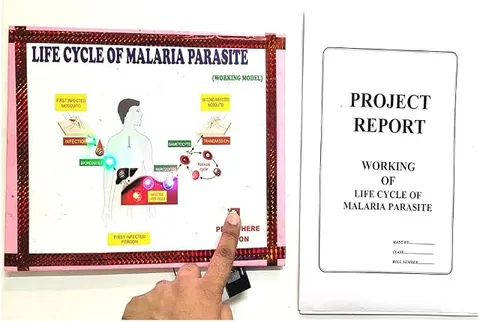
This working model shows the life cycle of the malaria parasite, Plasmodium, as it passes between a human and a mosquito. It helps students explain how the disease spreads and why controlling mosquitoes prevents it, which makes it a strong health-awareness exhibit. It suits Class 12 biology projects and senior secondary exhibitions.
How it works
The science behind it
The idea the model demonstrates, in words you can use in your report and when you explain it.
Malaria is caused by Plasmodium, a protozoan, and spread by the bite of an infected female Anopheles mosquito. The parasite needs two hosts. When the mosquito bites, it injects sporozoites, the infective stage, into the person's blood. These travel to the liver, multiply asexually inside liver cells and are then released into the blood, where they attack red blood cells (RBCs) and keep multiplying. When the RBCs burst, they release a toxin called haemozoin, which causes the chill and high fever that return in cycles; in Plasmodium vivax malaria this often happens about every 48 hours. Some parasites develop into gametocytes. When a female Anopheles bites this person, it takes them in; fertilisation and development take place in the mosquito's gut, and the new sporozoites gather in its salivary glands, ready for the next bite. Cases rise in India during and after the monsoon, when stagnant water lets mosquitoes breed.
Make it yourself
Make a malaria parasite life cycle model yourself
Build your own version from scratch, or use the steps to understand how the ready-made model is put together before you present it.
What you need 10
Step by step 8 steps
Divide the board into two halves, the human host on one side and the mosquito host on the other, and draw a loop of arrows linking them so the cycle reads in one direction.
Model the human stages in order along the arrows: sporozoites entering the blood from the bite, the liver cell where they multiply, merozoites released into the blood, red blood cells being invaded and bursting, and gametocytes forming.
Model the mosquito stages in order: gametocytes taken in with the blood meal, male and female gametes fusing in the stomach, the zygote becoming a moving ookinete, the oocyst on the stomach wall, and sporozoites moving to the salivary glands.
Make a hole beside each stage and push an LED through from the front, using one colour for the human stages and the other for the mosquito stages; note that the longer leg is the positive one.
On the back, connect the LEDs to the chaser outputs in the same order as the stages, so the light runs round the cycle the way the parasite travels.
Join the module to the battery through the switch, switch on and check that every LED lights in turn; switch off before correcting any joint.
Fix a label card beside each stage naming it and saying where it happens, for example 'Liver cell: asexual multiplication'.
Add a prevention panel at the bottom: mosquito nets, repellents, removing stagnant water, and a blood test when a fever keeps coming back.
Read this first
Safety first
Go through these points before you build or switch anything on. Younger students should do this with an adult.
- Use the glue gun and the pin for making holes only with an adult, and let the glue cool before touching the joints.
- Do not short the 9 V battery terminals, and unclip the battery when the model is not on show.
- Never use real mosquitoes, blood samples or medicines in the model; clay models and pictures are enough.
- Wash your hands after working with clay and keep it away from food.
Troubleshooting
If something does not work
The usual problems with this model and how to fix them. Open a problem to see the fix.
One LED does not light when its turn comes
It is probably the wrong way round or has a loose joint. Turn it so the longer leg goes to the positive side, and re-twist the connection, or have it re-soldered with an adult.
The lights run round the cycle in the wrong direction
The LEDs are connected to the module outputs in reverse order. Rewire them so the first output goes to the bite and the last one to the salivary glands.
The lights run too fast for visitors to follow
Many chaser modules have a small preset for speed. Turn it slowly with a small screwdriver until each stage stays lit long enough to point at.
The clay pieces crack or fall off the board
Air-dry clay shrinks as it dries. Keep the pieces thin and flat, let them dry fully before fixing, and glue them on with a dab of craft glue or hot glue.
Exhibition day
How to present it
A running order for the exhibition table or the practical, step by step.
Follow the arrows around the model in order: mosquito bite, liver, red blood cells, gametocytes, mosquito gut, salivary glands.
Clearly label which stages happen in humans and which happen in the mosquito.
Explain why the fever comes in cycles by linking it to the bursting of red blood cells.
End with prevention: mosquito nets, repellents, no stagnant water, and fish such as Gambusia in ponds.
Practice
Viva questions
Practice questions on this model, with short answers. Try each one aloud before you open the answer.
Which organism causes malaria and which spreads it?
Malaria is caused by the protozoan Plasmodium and spread by the female Anopheles mosquito.
What is the infective stage of Plasmodium for humans?
The sporozoite, which is injected into the blood when an infected mosquito bites.
What causes the recurring chill and fever in malaria?
The release of the toxin haemozoin when infected red blood cells burst.
Where does the sexual stage of Plasmodium take place?
In the gut of the female Anopheles mosquito, where the gametes fuse; the sporozoites formed later move to its salivary glands.
Project file
Project file outline
The headings of the project file, in order. Give each heading its own section and write it in your own words.
Free ebook: Writing a Science Project FileContents
- Aim: to show how the malaria parasite completes its life cycle in a human and a mosquito
- Introduction: malaria, its cause and why it matters for public health in India
- Plasmodium and its two hosts, and the role of the female Anopheles mosquito
- Stages in the human: the liver stage and the red blood cell stage, with a labelled diagram
- Stages in the mosquito: fertilisation, the oocyst and sporozoites in the salivary glands
- Why the fever comes back in cycles
- Materials used and how the model and its running lights were made
- Prevention and control of malaria at home and in the community
- Conclusion and sources used
Buying checklist
Before you buy
What to check before you order the model, and what to do when it arrives.
1Before you order
- The listing suggests it for senior classes, so check with your teacher that it suits your class and the chapter on human health and disease.
- Read the listing to see whether batteries or a printed report are mentioned; do not assume either is in the box.
- Switch the lights on a few days before the exhibition and carry a spare battery on the day.
- Keep the box and some padding, as clay figures and LED legs can break on the way to school.
- Check the delivery date for your PIN code on the marketplace, and order well before the exhibition or practical.
- Practise explaining it. Judges ask what the model shows and why; knowing the science matters as much as the model. The viva questions above are a good place to start.
2When it arrives
- When it arrives, compare every label on the model with your textbook diagram and cover any mistake with a neat new label.
Next steps
Take it further
Ways to turn this model into a bigger investigation or a stronger exhibition entry.
Add a panel on the sickle-cell trait and explain, from a reliable biology source, why carriers of one copy of the gene resist malaria better.
Add a short history panel on how Ronald Ross showed that the mosquito carries the parasite, using a trusted reference.
Survey your area for places where mosquitoes can breed, such as coolers, old tyres and flower pots, and show the results as a chart beside the model.
Audience
Who it suits
Class 12 biology projects on human health and disease, and Class 8 to 12 health-awareness science exhibitions.
- ClassClass 1 to 9
- SubjectBiology
- TypeReady-made model
Free to read
Free ebooks for this topic
Free PDF ebooks from Gurukul Technicals Institute on the science, the making and the presenting of projects like this one.
- Free PDF ebook
Biology Models Guide
Make the heart, lungs, kidney, eye, cell and more, and explain them well
- Free PDF ebook
Your Science Exhibition Guide
Choose a project, build it, present it and answer the judges with confidence
- Free PDF ebook
Writing a Science Project File
How to write the report, from the cover page to the bibliography
- Free PDF ebook
Viva Questions for Science Projects
How to answer examiner questions, with sample questions for popular projects