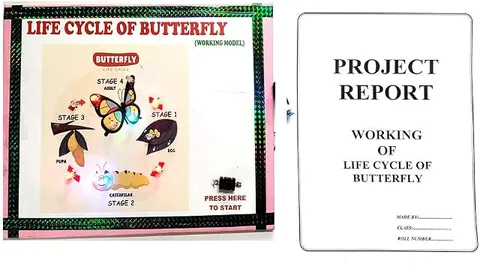
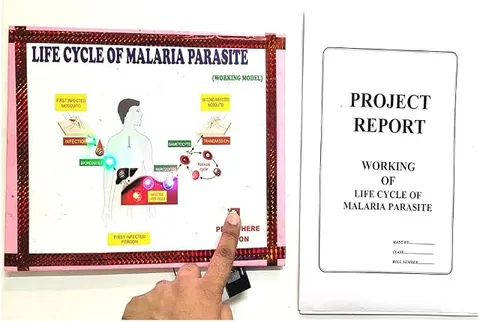
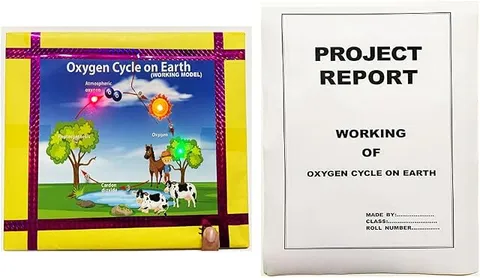
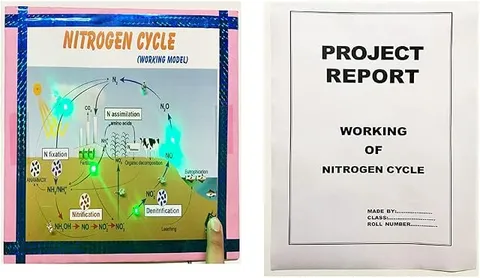
- Biology
- Ready-made model
- Class 1 to 9
- Printed report included
Carbon Cycle Readymade Science Working Project & Model in Biology with Multicolor Running Lights (with Printed Report)
Code B099QZB3RV
- Paid for and delivered by Amazon. The current price and the delivery date for your PIN code are shown there.
- Sold by Gurukul Technicals Institute, Delhi.
- Need a different topic, a custom version or a school order? Ask on WhatsApp.
In this project guide
Ready-made model
About this model
A readymade biology working model of the carbon cycle, tracing how carbon moves between the air, living things, oceans and fossil fuels. The listing says it has multicolour running lights and a printed report, and the lights give a vivid way to follow carbon from one stage of the cycle to the next.
How it works
The science behind it
The idea the model demonstrates, in words you can use in your report and when you explain it.
Carbon is present in every living thing and keeps moving between the atmosphere, living organisms, oceans and rocks. Green plants take carbon dioxide from the air during photosynthesis: 6CO₂ + 6H₂O → C₆H₁₂O₆ + 6O₂, in the presence of sunlight and chlorophyll. Animals get this carbon by eating plants. Plants and animals both return carbon dioxide to the air through respiration. When organisms die, decomposers break them down and release carbon dioxide; remains buried for millions of years can turn into coal, petroleum and natural gas. Burning these fossil fuels or wood releases the stored carbon quickly, and oceans dissolve a large amount of carbon dioxide. When more carbon is released than plants and oceans absorb, carbon dioxide builds up and traps heat, adding to global warming. Crop stubble burning in Punjab and Haryana each autumn is an Indian example of carbon returned to the air all at once.
Make it yourself
Make a carbon cycle model with running lights yourself
Build your own version from scratch, or use the steps to understand how the ready-made model is put together before you present it.
What you need 9
Step by step 8 steps
Divide the board into the sky at the top (carbon dioxide in the air), the land in the middle with the tree, the cow, the house, the factory and the car, the sea on one side, and the ground at the bottom where buried remains slowly turn into coal and oil.
- Draw arrows for each process
Photosynthesis (air to plant), feeding (plant to animal), respiration (plants and animals to air), decomposition (dead remains to soil and air), fossil fuel formation (deep burial), combustion (fuel to air) and exchange between the air and the sea.
Choose ten stages in story order, for example: sunlight, carbon dioxide entering a leaf, the plant, the cow eating the plant, respiration, death and decay, burial, fossil fuels, the factory and car burning fuel, and carbon dioxide dissolving in the sea. Put one LED at each stage.
- Build the chaser
555 pins 8 and 4 to positive, pin 1 to negative, 1 kΩ from positive to pin 7, 47 kΩ from pin 7 to pins 6 and 2 joined, the 22 µF capacitor from pin 2 to negative (long leg to pin 2), and pin 3 to the CD4017's clock, pin 14; the counter's pin 16 goes to positive and pins 8, 13 and 15 to negative. With the 22 µF capacitor, the light moves on about once every one and a half seconds.
Connect the counter's outputs Q0 to Q9 to the LEDs in story order. Join all the LEDs' short legs and take them to negative through the single 470 Ω resistor.
Label each arrow with its process, and write the photosynthesis equation, 6CO₂ + 6H₂O → C₆H₁₂O₆ + 6O₂, near the tree.
Hide the circuit behind the board with the battery and switch at the front edge, then switch on: the light walks round the cycle.
Write a short commentary with one sentence for each light, so you can explain the cycle as the light moves.
Read this first
Safety first
Go through these points before you build or switch anything on. Younger students should do this with an adult.
- Solder only with an adult present, and keep the hot iron in its stand.
- Keep cotton wool well away from the soldering iron and hot glue.
- Fit the ICs with their notches the right way round; if one gets hot, switch off at once.
- Unclip the battery when the model is not on show.
Troubleshooting
If something does not work
The usual problems with this model and how to fix them. Open a problem to see the fix.
The lights do not follow the story order
The counter's outputs are not in pin-number order: Q0 is pin 3, Q1 pin 2, Q2 pin 4, Q3 pin 7, Q4 pin 10, Q5 pin 1, Q6 pin 5, Q7 pin 6, Q8 pin 9 and Q9 pin 11. Rewire each LED to the right pin.
The light stops on one LED
The 555 is not sending clock pulses, or the clock wire to pin 14 is loose. Check the timer's capacitor and resistors.
The light moves too fast to explain each stage
Use a bigger capacitor, such as 47 µF, or a bigger resistor between the 555's pins 7 and 6.
Several LEDs glow faintly at the same time
The counter's reset (pin 15) or clock-enable (pin 13) pin is floating. Connect both firmly to negative.
Exhibition day
How to present it
A running order for the exhibition table or the practical, step by step.
Follow one carbon atom round the cycle as the lights run: air, plant, animal, decomposer and back to air.
Write the balanced photosynthesis equation on a card beside the model.
Explain how human activities such as burning fuels and cutting forests upset the balance.
Prepare from the printed report the listing mentions, and add a current example such as stubble burning.
Practice
Viva questions
Practice questions on this model, with short answers. Try each one aloud before you open the answer.
Which process removes carbon dioxide from the atmosphere?
Photosynthesis, in which green plants use carbon dioxide and water to make glucose in the presence of sunlight.
Name two processes that return carbon dioxide to the air.
Respiration by living organisms and the burning of fuels; decomposition of dead matter also releases it.
How are fossil fuels part of the carbon cycle?
They formed from the remains of ancient organisms buried for millions of years, and burning them releases that stored carbon as carbon dioxide.
How does extra carbon dioxide cause global warming?
Carbon dioxide is a greenhouse gas that traps heat given off by the Earth, so more of it raises the average temperature.
Project file
Project file outline
The headings of the project file, in order. Give each heading its own section and write it in your own words.
The listing includes a printed project report: use this outline to check that your own file covers every part.
Free ebook: Writing a Science Project FileContents
- Aim: to show how carbon moves between the air, living things, the oceans and fossil fuels
- Introduction: carbon as the basis of all living things
- Processes that remove carbon dioxide from the air: photosynthesis and dissolving in the oceans
- Processes that return carbon dioxide to the air: respiration, decomposition and combustion
- How fossil fuels formed from buried remains
- Human impact: burning fossil fuels, cutting forests and the greenhouse effect
- Ways to reduce our carbon footprint
- Construction of the model and the running-light circuit
- Conclusion and bibliography
Buying checklist
Before you buy
What to check before you order the model, and what to do when it arrives.
1Before you order
- Check that the carbon cycle is in your class syllabus and that a working model is what your teacher wants.
- The listing mentions a printed report; read it and check that the model shows all the processes your textbook lists, such as combustion and exchange with the oceans.
- Keep the box and carry the model flat so the cut-outs do not bend.
- Check the delivery date for your PIN code on the marketplace, and order well before the exhibition or practical.
- The project report is a learning aid. Read it, understand how the model works, and write your own observations; schools expect your own work.
- Practise explaining it. Judges ask what the model shows and why; knowing the science matters as much as the model. The viva questions above are a good place to start.
2When it arrives
- Test the running lights as soon as it arrives and again a few days before the exhibition.
Next steps
Take it further
Ways to turn this model into a bigger investigation or a stronger exhibition entry.
Show a lime water test beside the model: breathe gently through a straw into lime water and it turns milky, proving that we breathe out carbon dioxide. Do this with your teacher, and never drink the lime water.
Work out your family's monthly carbon emissions from the units on an electricity bill, using an emission factor from a government source, and suggest ways to cut them.
Add a second panel showing the nitrogen cycle or the water cycle for comparison.
Audience
Who it suits
Suits Class 6 to 10 science and environmental studies exhibitions, and ecology revision for Class 11 and 12.
- ClassClass 1 to 9
- SubjectBiology
- TypeReady-made model
- Project reportPrinted report included
Free to read
Free ebooks for this topic
Free PDF ebooks from Gurukul Technicals Institute on the science, the making and the presenting of projects like this one.
- Free PDF ebook
Biology Models Guide
Make the heart, lungs, kidney, eye, cell and more, and explain them well
- Free PDF ebook
Your Science Exhibition Guide
Choose a project, build it, present it and answer the judges with confidence
- Free PDF ebook
Writing a Science Project File
How to write the report, from the cover page to the bibliography
- Free PDF ebook
Viva Questions for Science Projects
How to answer examiner questions, with sample questions for popular projects