- Biology
- Ready-made model
- Class 1 to 9
- Printed report included
Oxygen Cycle Readymade Science Working Project & Model in Biology with Multicolor Running Lights(with Printed Report)
Code B099QYNFSR
- Paid for and delivered by Amazon. The current price and the delivery date for your PIN code are shown there.
- Sold by Gurukul Technicals Institute, Delhi.
- Need a different topic, a custom version or a school order? Ask on WhatsApp.
In this project guide
Ready-made model
About this model
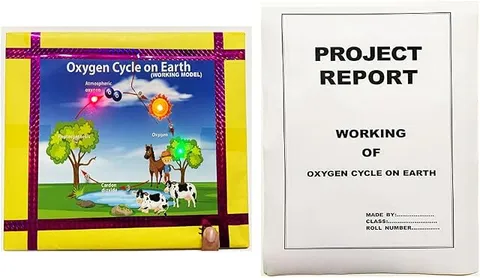
This readymade working model shows the oxygen cycle, the way oxygen moves between the air, living things and the environment. The listing says it has multicolour running lights and a printed report. It helps students explain how the oxygen we breathe is constantly used up and replaced, a key idea in environmental science.
How it works
The science behind it
The idea the model demonstrates, in words you can use in your report and when you explain it.
Oxygen makes up about 21% of the air, and its amount stays nearly steady because it is used and returned in a cycle. Green plants, algae and phytoplankton release oxygen during photosynthesis: 6CO2 + 6H2O → C6H12O6 + 6O2, in the presence of sunlight and chlorophyll. The oxygen given out comes from the water molecules, not from carbon dioxide. Animals and plants use oxygen in respiration to release energy from food, giving out carbon dioxide and water. Oxygen is also used up in combustion when fuels burn, in the decay of dead matter by decomposers, and in rusting. High in the stratosphere, some oxygen forms ozone (O3), which absorbs harmful ultraviolet rays from the Sun. Every time a gas stove is lit in an Indian kitchen, combustion takes oxygen from the air, and the trees in a neighbourhood park help to put it back.
Make it yourself
Make an oxygen cycle model with running lights yourself
Build your own version from scratch, or use the steps to understand how the ready-made model is put together before you present it.
What you need 9
Step by step 8 steps
Sketch the cycle on the base: the Sun at the top, plants and algae on one side, people, animals, burning fuel and decay on the other, and the ozone layer high in the sky.
Paint the background and fix the clay or cut-out figures in place.
- Draw two loops of arrows
Oxygen from plants and algae to the living things and fires that use it, and carbon dioxide back from them to the plants.
Make small holes along the arrows and push in the LEDs, blue along the oxygen path and the other colour along the carbon dioxide path; the longer leg is positive.
Connect each line of LEDs to the chaser outputs in order, so the light runs along the arrows in the right direction.
Connect the battery through the switch, test every LED, and switch off before fixing any loose joint.
Add labels for each process, and a card with the word equations for photosynthesis and respiration.
Add a small panel showing how cutting forests and burning fuels upset the balance, and how planting trees helps.
Read this first
Safety first
Go through these points before you build or switch anything on. Younger students should do this with an adult.
- Use the glue gun and the nail for making holes only with an adult.
- Do not short the battery, and switch the lights off when nobody is watching.
- Let the poster colours dry fully before fitting the LEDs and wiring.
- Wash your hands after using clay and paints.
Troubleshooting
If something does not work
The usual problems with this model and how to fix them. Open a problem to see the fix.
One LED in a line stays dark
It is reversed or its joint is loose. Turn it so the longer leg goes to the positive side, and re-twist the joint, or have it re-soldered with an adult.
The light runs the wrong way along an arrow
The LEDs are connected to the outputs in reverse order. Rewire that line so the first output is at the tail of the arrow.
All the LEDs are dim
The battery is weak, or too many LEDs share one output. Fit a fresh battery, or use a second module so each output drives fewer LEDs.
The paint has cracked round the LED holes
The holes were made after painting, or the board is flexing. Touch up the paint and glue the board onto a stiffer backing.
Exhibition day
How to present it
A running order for the exhibition table or the practical, step by step.
Follow the running lights and narrate each step: release by plants, then use in respiration, combustion and decay.
Write the photosynthesis and respiration equations on the chart and show that they are roughly reverse processes.
Mention that the oxygen released in photosynthesis comes from water, a point examiners like to ask.
End with a message on planting trees and protecting the ozone layer.
Practice
Viva questions
Practice questions on this model, with short answers. Try each one aloud before you open the answer.
Which process releases oxygen into the atmosphere?
Photosynthesis by green plants, algae and phytoplankton.
What percentage of air is oxygen?
About 21% by volume.
Name three processes that use up oxygen.
Respiration, combustion and the decomposition of dead matter; rusting also uses oxygen.
What is the role of ozone?
The ozone layer in the stratosphere absorbs most of the harmful ultraviolet radiation coming from the Sun.
Project file
Project file outline
The headings of the project file, in order. Give each heading its own section and write it in your own words.
The listing includes a printed project report: use this outline to check that your own file covers every part.
Free ebook: Writing a Science Project FileContents
- Aim: to show how oxygen moves between the air, living things and the environment
- Composition of air and why the amount of oxygen stays nearly steady
- Processes that add oxygen: photosynthesis by plants, algae and phytoplankton
- Processes that use oxygen: respiration, burning, decay and rusting
- Ozone in the upper atmosphere and why it matters
- Human activities that disturb the cycle
- Diagram of the model and how the running lights show the flow
- Conclusion and sources used
Buying checklist
Before you buy
What to check before you order the model, and what to do when it arrives.
1Before you order
- Check that the oxygen cycle suits your class and the chapter on natural resources or the environment.
- The listing says a printed report is included; read it alongside your textbook and add your own diagrams.
- Read the listing for the battery the lights need; do not assume one is in the box.
- Keep the box and padding so the figures and LEDs are not knocked off in transport.
- Check the delivery date for your PIN code on the marketplace, and order well before the exhibition or practical.
- Practise explaining it. Judges ask what the model shows and why; knowing the science matters as much as the model. The viva questions above are a good place to start.
2When it arrives
- When it arrives, switch the lights on and check that every arrow lights in the right direction.
Next steps
Take it further
Ways to turn this model into a bigger investigation or a stronger exhibition entry.
Add a panel for the carbon cycle and show how the two cycles are linked.
Count the oxygen bubbles from a water plant such as hydrilla in sunlight and in shade, and show the results beside the model.
Survey the trees on your school campus and present a plan for planting more, explaining their part in the cycle.
Audience
Who it suits
Class 6 to 9 science and environmental studies exhibitions on natural cycles and air.
- ClassClass 1 to 9
- SubjectBiology
- TypeReady-made model
- Project reportPrinted report included
Free to read
Free ebooks for this topic
Free PDF ebooks from Gurukul Technicals Institute on the science, the making and the presenting of projects like this one.
- Free PDF ebook
Biology Models Guide
Make the heart, lungs, kidney, eye, cell and more, and explain them well
- Free PDF ebook
Your Science Exhibition Guide
Choose a project, build it, present it and answer the judges with confidence
- Free PDF ebook
Writing a Science Project File
How to write the report, from the cover page to the bibliography
- Free PDF ebook
Viva Questions for Science Projects
How to answer examiner questions, with sample questions for popular projects