- Biology
- Ready-made model
- Class 1 to 9
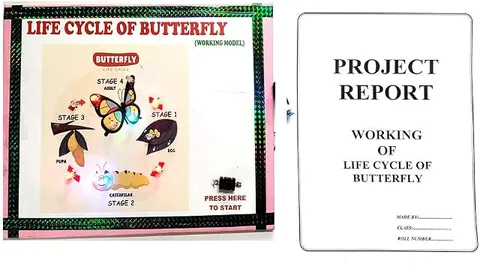
Life Cycle of Butterfly Biology Handmade Working Model and Educational Science Project
Code B0C3H5JR28
- Paid for and delivered by Amazon. The current price and the delivery date for your PIN code are shown there.
- Sold by Gurukul Technicals Institute, Delhi.
- Need a different topic, a custom version or a school order? Ask on WhatsApp.
In this project guide
Ready-made model
About this model
This handmade working model shows the life cycle of a butterfly, from egg to adult, in clear stages. It helps students explain complete metamorphosis, one of the most striking changes in the animal world, with a visual aid that holds attention at an exhibition. It suits primary and middle school biology and environmental studies projects.
How it works
The science behind it
The idea the model demonstrates, in words you can use in your report and when you explain it.
A butterfly shows complete metamorphosis, which has four distinct stages. The female lays tiny eggs on the leaves of a particular food plant. A caterpillar (larva) hatches and spends almost all its time eating and growing; because its outer skin cannot stretch much, it moults several times. Next it becomes a pupa, protected inside a hard case called the chrysalis. The pupa seems to rest, but inside it the larval body is broken down and rebuilt into an adult with wings, legs and antennae. Finally the adult butterfly emerges, dries its wings, feeds on nectar and reproduces, and the cycle begins again. The silk moth, whose cocoon gives us silk, passes through the same four stages. Insects such as cockroaches show incomplete metamorphosis instead (egg, nymph, adult), with no pupa stage. In Indian gardens, the lime butterfly lays its eggs on lemon and other citrus leaves, where its caterpillars can often be spotted.
Make it yourself
Make a butterfly life cycle model yourself
Build your own version from scratch, or use the steps to understand how the ready-made model is put together before you present it.
What you need 8
Step by step 8 steps
Divide the round board into four equal parts labelled Egg, Larva (caterpillar), Pupa (chrysalis) and Adult, with arrows going round in a circle.
Make tiny clay eggs and stick them on the underside of a leaf in the first part.
Shape a striped caterpillar from clay or pipe cleaners and place it on a nibbled leaf, with a shed skin beside it to show moulting.
Hang a smooth green or brown clay chrysalis from the twig in the third part.
Cut a pair of colourful wings, fix them to a clay body with pipe-cleaner antennae, and set the butterfly on the flower in the last part.
For a working model, fix the board's centre on the slow motor's shaft so it turns gently, with a pointer at the front to show the stage being explained.
Or fit an LED under each stage and switch them on one by one as you explain.
Beside each label, write how long that stage lasts for one butterfly species found in India, taken from your textbook or another trusted source.
Read this first
Safety first
Go through these points before you build or switch anything on. Younger students should do this with an adult.
- Use the glue gun, and any craft knife for the wings, only with an adult.
- Keep the motor slow and the board balanced so it cannot wobble off.
- Wash your hands after using clay and paint.
- Watch real butterflies in a garden without catching them or disturbing their eggs and caterpillars.
Troubleshooting
If something does not work
The usual problems with this model and how to fix them. Open a problem to see the fix.
The board does not turn, or turns unevenly
It is too heavy or off-centre for the motor. Use a lighter board, centre the shaft hole carefully, and use a slow geared motor rather than a fast toy motor.
Clay pieces crack after drying
The clay dried too fast or was too thick. Make thinner pieces and fill cracks with a little wet clay.
The wings droop
The paper is too soft. Back the wings with thin card or a stiff plastic sheet.
Exhibition day
How to present it
A running order for the exhibition table or the practical, step by step.
Point to each stage in order and say one thing that happens in it.
Ask the audience which stage eats the most, then explain that it is the caterpillar.
Compare complete metamorphosis with incomplete metamorphosis using a cockroach or grasshopper example.
Explain how the silk moth's cocoon stage gives us silk, to connect the model with daily life.
Practice
Viva questions
Practice questions on this model, with short answers. Try each one aloud before you open the answer.
What is metamorphosis?
Metamorphosis is the major change in body form that some animals go through as they develop from young to adult.
Name the four stages in the life cycle of a butterfly.
Egg, larva (caterpillar), pupa (chrysalis) and adult.
Why does a caterpillar moult?
Its outer covering cannot grow with it, so it sheds the old skin several times as it gets bigger.
What is the difference between complete and incomplete metamorphosis?
Complete metamorphosis has four stages including a pupa, while incomplete metamorphosis has three stages, egg, nymph and adult, with no pupa.
Project file
Project file outline
The headings of the project file, in order. Give each heading its own section and write it in your own words.
Free ebook: Writing a Science Project FileContents
- Aim: to show the four stages of complete metamorphosis in a butterfly
- Complete and incomplete metamorphosis compared
- Egg stage: where eggs are laid and why on a particular plant
- Larva stage: feeding, growth and moulting
- Pupa stage: the changes inside the chrysalis
- Adult stage: feeding on nectar, pollination and reproduction
- How the model was made, with labelled photographs
- Butterflies in the ecosystem and why they need protecting
- Conclusion, and the books or websites used for the stage timings
Buying checklist
Before you buy
What to check before you order the model, and what to do when it arrives.
1Before you order
- Check the class level in the listing; a life cycle model suits primary and middle school biology and EVS.
- See whether the listing says the model moves or lights up and whether it needs batteries.
- Keep the box, and wrap the wings separately for the journey to school.
- Check the delivery date for your PIN code on the marketplace, and order well before the exhibition or practical.
- Practise explaining it. Judges ask what the model shows and why; knowing the science matters as much as the model. The viva questions above are a good place to start.
2When it arrives
- When it arrives, check that no part is broken and that every label is correct and spelled right.
Next steps
Take it further
Ways to turn this model into a bigger investigation or a stronger exhibition entry.
Add a second panel comparing the butterfly with the incomplete metamorphosis of a cockroach.
Grow a caterpillar food plant and some nectar plants in pots or the school garden and record which butterflies visit.
Add a panel on the moth's life cycle and the main differences between moths and butterflies.
Audience
Who it suits
Class 4 to 8 science exhibitions and biology projects on animal life cycles and metamorphosis.
- ClassClass 1 to 9
- SubjectBiology
- TypeReady-made model
Free to read
Free ebooks for this topic
Free PDF ebooks from Gurukul Technicals Institute on the science, the making and the presenting of projects like this one.
- Free PDF ebook
Biology Models Guide
Make the heart, lungs, kidney, eye, cell and more, and explain them well
- Free PDF ebook
Your Science Exhibition Guide
Choose a project, build it, present it and answer the judges with confidence
- Free PDF ebook
Writing a Science Project File
How to write the report, from the cover page to the bibliography
- Free PDF ebook
Viva Questions for Science Projects
How to answer examiner questions, with sample questions for popular projects