- Biology
- Ready-made model
- Class 1 to 9
- Printed report included
Nitrogen Cycle Readymade Science Working Project & Model in Biology with Multicolor Running Lights(with Printed Report)
Code B099QZFJY8
- Paid for and delivered by Amazon. The current price and the delivery date for your PIN code are shown there.
- Sold by Gurukul Technicals Institute, Delhi.
- Need a different topic, a custom version or a school order? Ask on WhatsApp.
In this project guide
Ready-made model
About this model
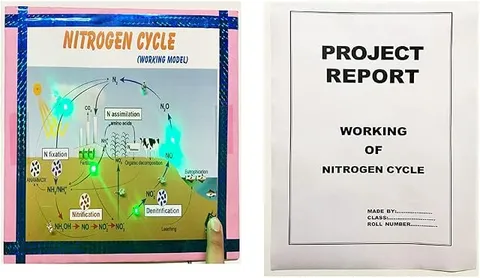
This readymade model explains the nitrogen cycle, the natural process by which nitrogen moves between the air, soil, plants, animals and microorganisms. The listing says it uses multicolour running lights to trace the cycle and includes a printed report.
How it works
The science behind it
The idea the model demonstrates, in words you can use in your report and when you explain it.
Nitrogen makes up about 78% of the air, and living things need it to make proteins and nucleic acids such as DNA, yet plants and animals cannot use nitrogen gas directly. It must first be fixed into compounds. In nitrogen fixation, Rhizobium bacteria in the root nodules of leguminous plants, and free-living bacteria such as Azotobacter, convert nitrogen gas into ammonia; lightning also fixes some nitrogen, which rain carries into the soil. In nitrification, Nitrosomonas bacteria change ammonia into nitrites and Nitrobacter changes nitrites into nitrates, which plants absorb through their roots. Animals get nitrogen by eating plants. When plants and animals die or excrete waste, decomposers turn the nitrogen back into ammonia, a step called ammonification. Denitrifying bacteria such as Pseudomonas then convert nitrates back into nitrogen gas, completing the cycle. This is why Indian farmers grow pulses such as moong, urad or chana in rotation with cereals: these legumes enrich the soil with nitrogen.
Make it yourself
Make a nitrogen cycle model with coloured lights yourself
Build your own version from scratch, or use the steps to understand how the ready-made model is put together before you present it.
What you need 9
Step by step 8 steps
Divide the board into the atmosphere at the top and the soil at the bottom, with a clear line for the ground surface.
- Place the parts
The cloud and lightning in the sky, the legume plant with nodules, the animal, the factory, and dead leaves on the soil. Mark a waterlogged patch of soil where denitrifying bacteria live.
Draw arrows for the five stages: fixation (air to soil and nodules), nitrification (ammonia to nitrites to nitrates), assimilation (nitrates into the plant and then the animal), ammonification (dead matter and waste back to ammonia), and denitrification (nitrates back to nitrogen gas).
Push three LEDs of one colour through the board along each arrow, a different colour for each stage, and label the bacteria beside them: Rhizobium and Azotobacter, Nitrosomonas and Nitrobacter, decomposers, and denitrifying bacteria such as Pseudomonas.
On the back, give every LED its own 470 Ω resistor, connect the LEDs of each stage to the positive line through that stage's push button, and join all the short legs to negative.
Fix the buttons along the front edge in cycle order with labels, so a visitor can press them one after another and follow the nitrogen round the cycle.
Add a legend card matching each colour to its stage, and a card stating that nitrogen makes up about 78% of the air.
Test every button, then cover the back wiring with a sheet of card.
Read this first
Safety first
Go through these points before you build or switch anything on. Younger students should do this with an adult.
- Use the hot glue gun only with an adult; the nozzle and fresh glue can burn.
- Keep a 470 Ω resistor with every LED; never connect an LED straight to the battery.
- Make the LED holes with a pointed tool only with an adult, pressing away from your hand.
- Cover the back wiring so no bare joints can touch, and switch off when you are not demonstrating.
Troubleshooting
If something does not work
The usual problems with this model and how to fix them. Open a problem to see the fix.
One LED in a stage does not light
It may be the wrong way round or have a broken joint. Check that its long leg goes to the button side, and reconnect the joint.
Pressing one button lights another stage too
Wires from two stages are touching at the back. Separate them and wrap every joint in insulating tape.
The blue LEDs are much dimmer than the red ones
Blue and white LEDs need about 3 V while red ones need about 2 V, so the same resistor gives them less current. Use 330 Ω resistors for the blue and white LEDs.
Visitors mix up nitrogen fixation and nitrification
Explain that fixation takes nitrogen gas out of the air, while nitrification changes ammonia already in the soil into nitrites and then nitrates. Pressing the two buttons one after the other makes the difference clear.
Exhibition day
How to present it
A running order for the exhibition table or the practical, step by step.
Run the lights and follow each stage of the cycle, naming the bacteria involved.
Explain why plants cannot use nitrogen from the air directly.
Use crop rotation with pulses to link the model with farming.
Point out lightning as a natural, non-living fixer of nitrogen.
Practice
Viva questions
Practice questions on this model, with short answers. Try each one aloud before you open the answer.
What is nitrogen fixation?
The conversion of atmospheric nitrogen gas into usable compounds such as ammonia, mainly by bacteria and also by lightning.
Which bacterium lives in the root nodules of legumes?
Rhizobium.
What is denitrification?
The conversion of nitrates in the soil back into nitrogen gas by denitrifying bacteria such as Pseudomonas.
Why do farmers grow pulses in rotation with wheat?
Pulses are legumes whose root nodules hold nitrogen-fixing bacteria, so they add nitrogen to the soil naturally.
Project file
Project file outline
The headings of the project file, in order. Give each heading its own section and write it in your own words.
The listing includes a printed project report: use this outline to check that your own file covers every part.
Free ebook: Writing a Science Project FileContents
- Aim: to show how nitrogen moves between the air, the soil and living things
- Introduction: why living things need nitrogen to make proteins and DNA
- Nitrogen fixation by bacteria, by lightning and by industry
- Nitrification by Nitrosomonas and Nitrobacter
- Assimilation by plants and animals
- Ammonification by decomposers, and denitrification back to the air
- How the coloured lights on the model trace each stage
- Importance of legumes in crop rotation, and the effects of overusing fertilisers
- Conclusion and bibliography
Buying checklist
Before you buy
What to check before you order the model, and what to do when it arrives.
1Before you order
- Check that the nitrogen cycle is in your class syllabus and whether your teacher wants a working or a static model.
- Read the listing to see what powers the lights, and keep spare batteries for the exhibition.
- Keep the box and padding, as raised parts such as the plant can break in transport.
- Check the delivery date for your PIN code on the marketplace, and order well before the exhibition or practical.
- Practise explaining it. Judges ask what the model shows and why; knowing the science matters as much as the model. The viva questions above are a good place to start.
2When it arrives
- The listing says a printed report is included; check it when the parcel arrives and add your own diagram and notes.
- Switch the lights on as soon as it arrives and again a few days before the exhibition.
Next steps
Take it further
Ways to turn this model into a bigger investigation or a stronger exhibition entry.
Grow gram or pea plants, carefully uproot one, and show its real root nodules beside the model.
Add the carbon cycle alongside and compare the part bacteria play in each.
Explain how extra fertiliser washing into ponds causes algal bloom (eutrophication).
Audience
Who it suits
Class 6 to 10 students preparing a biology or environmental science exhibition model.
- ClassClass 1 to 9
- SubjectBiology
- TypeReady-made model
- Project reportPrinted report included
Free to read
Free ebooks for this topic
Free PDF ebooks from Gurukul Technicals Institute on the science, the making and the presenting of projects like this one.
- Free PDF ebook
Biology Models Guide
Make the heart, lungs, kidney, eye, cell and more, and explain them well
- Free PDF ebook
Your Science Exhibition Guide
Choose a project, build it, present it and answer the judges with confidence
- Free PDF ebook
Writing a Science Project File
How to write the report, from the cover page to the bibliography
- Free PDF ebook
Viva Questions for Science Projects
How to answer examiner questions, with sample questions for popular projects