- Physics
- Ready-made model
- Class 1 to 9
- Printed report included
Neuron Structure Science Working Model and Project with Report Educational Electronic Hobby Kit
Code B0DTY55X49
- Paid for and delivered by Amazon. The current price and the delivery date for your PIN code are shown there.
- Sold by Gurukul Technicals Institute, Delhi.
- Need a different topic, a custom version or a school order? Ask on WhatsApp.
In this project guide
Ready-made model
About this model
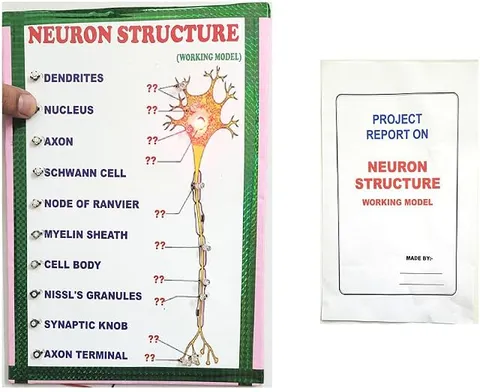
This biology model shows a neuron, or nerve cell, with its dendrites, cell body, axon and nerve endings. The listing says a report is included, and the model helps students explain how a nerve impulse travels along a neuron and passes to the next one.
How it works
The science behind it
The idea the model demonstrates, in words you can use in your report and when you explain it.
A neuron is the basic unit of the nervous system, specialised to carry messages as electrical impulses. Its dendrites are short branches that receive signals from other cells. The cell body, or cyton, contains the nucleus and keeps the cell alive. The axon is a long fibre that carries the impulse away from the cell body; many axons are wrapped in a fatty myelin sheath, which insulates them, with small gaps called nodes of Ranvier. The impulse jumps from node to node, so myelinated fibres conduct much faster. At the end of the axon, the nerve endings release chemicals called neurotransmitters into a tiny gap, the synapse, and these start a new impulse in the next neuron. So the signal is electrical inside a neuron and chemical across a synapse, and it travels in one direction only. When the school bell rings, neurons carry the message from your ears to your brain in a fraction of a second.
Make it yourself
Make a neuron structure model yourself
Build your own version from scratch, or use the steps to understand how the ready-made model is put together before you present it.
What you need 9
Step by step 8 steps
Draw the neuron large on the board: dendrites on the left, then the cell body, the long axon, and the nerve endings on the right.
Shape the cell body from clay with a nucleus in a contrasting colour, and push in pipe cleaners to form branching dendrites.
Glue the cord along the drawn axon and thread the myelin pieces onto it, leaving small gaps for the nodes of Ranvier.
Bend pipe cleaners into nerve endings, and place the dendrites of a second, smaller neuron just beyond them with a small gap to show the synapse.
Push one LED through the board at each node, in order from the cell body to the nerve endings.
Wire a 555 and 4017 chaser so the LEDs light one after another, with the first output (Q0, pin 3) at the cell body end. Connect pin 16 to positive and pins 8 and 13 to negative, and join the first output you do not use to pin 15 (reset), so the light starts again from the cell body.
Wire the push button to power the 555, so pressing it at the dendrites acts as a stimulus and sends the light along the axon.
Label every part and add arrows showing the direction of the impulse.
Read this first
Safety first
Go through these points before you build or switch anything on. Younger students should do this with an adult.
- Ask an adult to use the glue gun and any cutter.
- Keep beads and small pieces away from young children.
- Bend over the sharp ends of pipe cleaners and trimmed LED legs.
- Use the 9 V battery only and disconnect it after the demonstration.
Troubleshooting
If something does not work
The usual problems with this model and how to fix them. Open a problem to see the fix.
The lights travel in the wrong direction
The LEDs are wired in reverse order. Connect output Q0 to the LED nearest the cell body and the following outputs along the axon.
The lights move too fast to follow
Use a larger timing capacitor or resistor on the 555.
The clay cracks as it dries
Use thinner pieces of air-dry clay and fix them with glue, or switch to non-drying modelling clay.
Visitors cannot tell the dendrites from the nerve endings
Colour them differently and add a colour key on the board.
Exhibition day
How to present it
A running order for the exhibition table or the practical, step by step.
Trace the path of an impulse in the right order: dendrite, cell body, axon and nerve ending.
Explain why the myelin sheath makes impulses faster, using the idea of jumping between nodes.
Show the synapse clearly and explain why the message crosses it as a chemical.
Compare the neuron with an electric wire and point out where the comparison breaks down.
Practice
Viva questions
Practice questions on this model, with short answers. Try each one aloud before you open the answer.
In which direction does a nerve impulse travel in a neuron?
From the dendrites to the cell body, then along the axon to the nerve endings.
What is the function of the myelin sheath?
It insulates the axon and speeds up the impulse by letting it jump from one node of Ranvier to the next.
What is a synapse?
The small gap between the nerve ending of one neuron and the next cell, across which the signal is carried by chemicals.
Which is the longest cell in the human body?
The neuron; some axons, such as those running from the spinal cord to the foot, can be about a metre long.
Project file
Project file outline
The headings of the project file, in order. Give each heading its own section and write it in your own words.
The listing includes a printed project report: use this outline to check that your own file covers every part.
Free ebook: Writing a Science Project FileContents
- Aim: to show the structure of a neuron and how a nerve impulse travels along it
- Materials
- Parts of a neuron and their functions
- How an impulse travels along a myelinated axon
- The synapse and how the message passes to the next neuron
- Construction of the model and its light sequence
- Types of neurons: sensory, motor and relay
- Conclusion
Buying checklist
Before you buy
What to check before you order the model.
1Check these first
- The neuron comes in the Class 10 chapter on control and coordination and again in Class 11 biology; check how much detail your teacher wants.
- Check in the listing whether the model has lights and what batteries they need.
- If a report is included, add your own labelled diagram, because exams often ask you to draw a neuron.
- Look over the model a few days before submission to check that all parts and labels are in place.
- Keep the box so the dendrites and axon are not crushed.
- Check the delivery date for your PIN code on the marketplace, and order well before the exhibition or practical.
- Practise explaining it. Judges ask what the model shows and why; knowing the science matters as much as the model. The viva questions above are a good place to start.
Next steps
Take it further
Ways to turn this model into a bigger investigation or a stronger exhibition entry.
Add sensory, relay and motor neurons to show a complete reflex arc.
Run two light strips at different speeds to compare myelinated and non-myelinated fibres.
Add a flap at the synapse showing how neurotransmitters cross the gap.
Audience
Who it suits
Suits Class 9 and 10 biology exhibitions and lessons on nervous tissue and control and coordination, and Class 11 revision.
- ClassClass 1 to 9
- SubjectPhysics
- TypeReady-made model
- Project reportPrinted report included
Free to read
Free ebooks for this topic
Free PDF ebooks from Gurukul Technicals Institute on the science, the making and the presenting of projects like this one.
- Free PDF ebook
Physics Working Models Explained
Twenty classic models, how each works and how to make it
- Free PDF ebook
Your Science Exhibition Guide
Choose a project, build it, present it and answer the judges with confidence
- Free PDF ebook
Writing a Science Project File
How to write the report, from the cover page to the bibliography
- Free PDF ebook
Viva Questions for Science Projects
How to answer examiner questions, with sample questions for popular projects