- Biology
- Ready-made model
- Class 1 to 9
- Printed report included
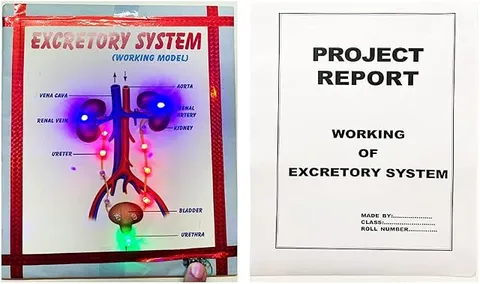
Excretory System Readymade Science Working Project & Model in Biology with Multicolor Running Lights(with Printed Report)
Code B099R18RVL
- Paid for and delivered by Amazon. The current price and the delivery date for your PIN code are shown there.
- Sold by Gurukul Technicals Institute, Delhi.
- Need a different topic, a custom version or a school order? Ask on WhatsApp.
In this project guide
Ready-made model
About this model
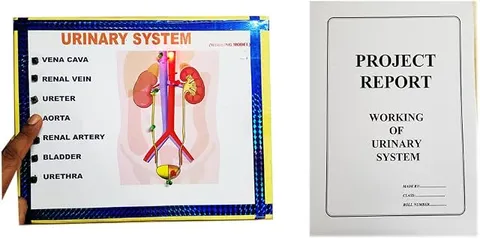
A readymade biology working model of the human excretory system, the organs that filter waste from the blood and remove it as urine. The listing says it has multicolour running lights and a printed report, and the lights can be used to show the direction in which urine moves through the system.
How it works
The science behind it
The idea the model demonstrates, in words you can use in your report and when you explain it.
The human excretory system removes nitrogenous waste, mainly urea, from the body. It consists of a pair of bean-shaped kidneys, two ureters, the urinary bladder and the urethra. Blood enters each kidney through the renal artery. The working unit of the kidney is the nephron, and each kidney has about a million of them. In each nephron, blood is filtered under pressure in a cluster of capillaries called the glomerulus, and the filtrate collects in Bowman's capsule. As the filtrate passes along the tubule, useful substances such as glucose, amino acids, salts and most of the water are reabsorbed into the blood. What remains is urine, which flows through the ureters to the bladder and leaves through the urethra. Of about 180 litres of filtrate formed each day, only about 1.5 litres leaves as urine. In hot Indian summers, drinking enough water helps the kidneys and lowers the risk of kidney stones.
Make it yourself
Make an excretory system model with running lights yourself
Build your own version from scratch, or use the steps to understand how the ready-made model is put together before you present it.
What you need 9
Step by step 9 steps
Draw the spine down the middle of the board. Mark the kidneys on either side of it just below the lowest ribs, with the right kidney a little lower than the left because the liver sits above it.
Make and fix the two kidneys. On one, draw or cut a section showing the cortex, medulla and renal pelvis.
Run the aorta (red) and the vena cava (blue) down beside the spine, with a renal artery and a renal vein joining each kidney.
Run a ureter from each kidney down to the bladder near the bottom of the board, and the urethra below the bladder.
Push the LEDs through in pairs, one on each ureter at the same height, from top to bottom, then two in the bladder and one or two on the urethra.
- Build the chaser
555 pins 8 and 4 to positive, pin 1 to negative, 1 kΩ from positive to pin 7, 47 kΩ from pin 7 to pins 6 and 2 joined, the 10 µF capacitor from pin 2 to negative (long leg to pin 2), and pin 3 to the CD4017's clock, pin 14; the counter's pin 16 goes to positive and pins 8, 13 and 15 to negative.
Connect the outputs Q0 to Q9 (pins 3, 2, 4, 7, 10, 1, 5, 6, 9 and 11) in order from kidney to urethra, so the light flows downwards. For each pair of ureter LEDs, join the two in series with one 330 Ω resistor so a single output lights both, and give each single LED in the bladder and urethra its own 330 Ω resistor to negative.
Switch on and set a slow speed with the timing capacitor, so visitors can follow the flow.
Add an enlarged nephron card beside the model showing the glomerulus, Bowman's capsule, the tubule and the collecting duct.
Read this first
Safety first
Go through these points before you build or switch anything on. Younger students should do this with an adult.
- Solder only with an adult present, and keep the hot iron in its stand.
- Use the cutter and hot glue only with an adult nearby.
- Fit the ICs the right way round; if one gets hot, switch off at once.
- Unclip the battery when the model is not on show.
Troubleshooting
If something does not work
The usual problems with this model and how to fix them. Open a problem to see the fix.
The lights flow upwards instead of downwards
The counter's outputs are connected in reverse order. Rewire so Q0 is at the kidneys and the last output is at the urethra.
A pair of ureter LEDs never lights
When two LEDs are in series, one reversed or broken LED stops both. Check that the long leg of each points towards the counter output.
The lights jump about instead of running in order
The counter's reset or clock-enable pin is floating, or the clock wire is loose. Connect pins 13 and 15 firmly to negative.
The clay kidneys cracked
They dried too fast. Fill the cracks with fresh clay or white glue mixed with paper pulp, and dry them slowly in the shade.
Exhibition day
How to present it
A running order for the exhibition table or the practical, step by step.
Trace the path of urine from kidney to ureter to bladder to urethra while the lights run.
Draw a labelled nephron on a separate chart, since most viva questions are about how filtration works.
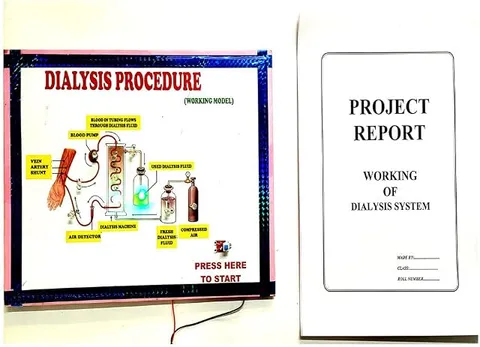
Explain dialysis briefly: an artificial kidney machine that filters the blood when the kidneys fail.
Prepare from the printed report the listing mentions, but explain filtration and reabsorption in your own words.
Practice
Viva questions
Practice questions on this model, with short answers. Try each one aloud before you open the answer.
What is the functional unit of the kidney?
The nephron, and each kidney contains about a million of them.
What are the main steps in urine formation?
Blood is filtered in the glomerulus, and useful substances are then selectively reabsorbed from the tubule back into the blood.
What is the main nitrogenous waste in human urine?
Urea, which is made in the liver and removed from the blood by the kidneys.
What is dialysis?
Dialysis is the use of an artificial kidney machine to filter waste from the blood of a person whose kidneys have failed.
Project file
Project file outline
The headings of the project file, in order. Give each heading its own section and write it in your own words.
The listing includes a printed project report: use this outline to check that your own file covers every part.
Free ebook: Writing a Science Project FileContents
- Aim: to show how the human excretory system removes urea from the blood as urine
- Introduction: what excretion is and why nitrogenous waste must be removed
- Organs of the system: kidneys, ureters, urinary bladder and urethra
- Structure of the nephron and the steps of urine formation: filtration, reabsorption and secretion
- The path of urine, shown by the running lights
- Dialysis: how an artificial kidney helps when the kidneys fail
- Keeping the kidneys healthy
- Construction of the model and the running-light circuit
- Conclusion and bibliography
Buying checklist
Before you buy
What to check before you order the model, and what to do when it arrives.
1Before you order
- Check that the excretory system is in your class syllabus and that a working model is what your teacher wants.
- The listing mentions a printed report; read it and check that its terms match the chapter in your textbook.
- Check that the organs are labelled correctly, including which kidney sits lower.
- Keep the box and packing to carry it safely.
- Check the delivery date for your PIN code on the marketplace, and order well before the exhibition or practical.
- The project report is a learning aid. Read it, understand how the model works, and write your own observations; schools expect your own work.
- Practise explaining it. Judges ask what the model shows and why; knowing the science matters as much as the model. The viva questions above are a good place to start.
2When it arrives
- Test the running lights as soon as it arrives and again a few days before the exhibition.
Next steps
Take it further
Ways to turn this model into a bigger investigation or a stronger exhibition entry.
Add a dialysis demonstration using dialysis tubing or cellophane, showing that small particles pass through the membrane while large ones stay behind.
Compare excretion in humans with excretion in plants.
Make an enlarged nephron with its own lights showing filtration and reabsorption.
Audience
Who it suits
Suits Class 7 to 11 biology exhibitions and revision of life processes.
- ClassClass 1 to 9
- SubjectBiology
- TypeReady-made model
- Project reportPrinted report included
Free to read
Free ebooks for this topic
Free PDF ebooks from Gurukul Technicals Institute on the science, the making and the presenting of projects like this one.
- Free PDF ebook
Biology Models Guide
Make the heart, lungs, kidney, eye, cell and more, and explain them well
- Free PDF ebook
Your Science Exhibition Guide
Choose a project, build it, present it and answer the judges with confidence
- Free PDF ebook
Writing a Science Project File
How to write the report, from the cover page to the bibliography
- Free PDF ebook
Viva Questions for Science Projects
How to answer examiner questions, with sample questions for popular projects