- Biology
- Ready-made model
- Class 1 to 9
- Printed report included
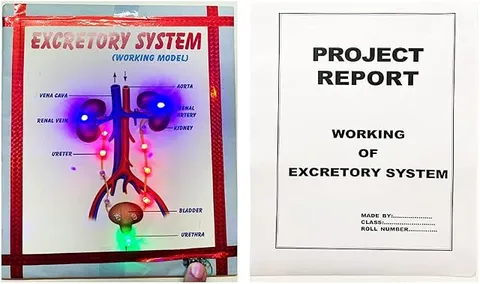
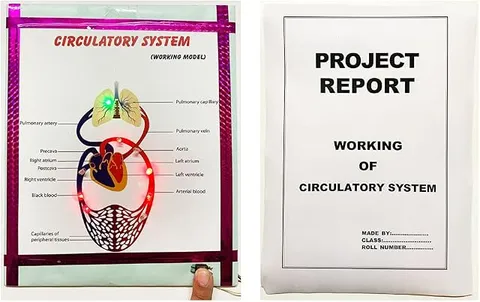
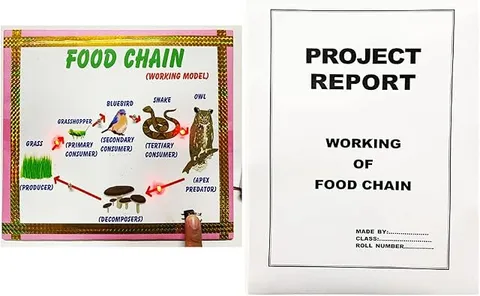
Food Chain Readymade Science Working Project & Model in Biology with Running Lights(with Printed Report)
Code B099QXJJ4R
- Paid for and delivered by Amazon. The current price and the delivery date for your PIN code are shown there.
- Sold by Gurukul Technicals Institute, Delhi.
- Need a different topic, a custom version or a school order? Ask on WhatsApp.
In this project guide
Ready-made model
About this model
A readymade biology working model of a food chain, the path along which food and energy pass from green plants to plant-eaters and then to flesh-eaters. The listing says it has running lights and a printed report, and the lights give students a lively way to point out the one-way flow of energy from one trophic level to the next.
How it works
The science behind it
The idea the model demonstrates, in words you can use in your report and when you explain it.
Every food chain begins with a producer, a green plant that makes its own food by photosynthesis using sunlight. Herbivores that eat plants are primary consumers, animals that eat herbivores are secondary consumers, and so on; each step is called a trophic level. Energy flows in one direction only, from the Sun to producers to consumers, and never back. At each step most of the energy is used up in life processes or lost as heat, so only about 10 percent passes on to the next level. This 10 percent law explains why food chains rarely have more than four or five links and why there are far fewer tigers than deer in a forest. Decomposers such as bacteria and fungi break down dead remains and return nutrients to the soil. A familiar Indian example is grass, grasshopper, frog, snake and eagle around a paddy field.
Make it yourself
Make a food chain model with running lights yourself
Build your own version from scratch, or use the steps to understand how the ready-made model is put together before you present it.
What you need 9
Step by step 8 steps
Lay out the chain from left to right: Sun, grass, grasshopper, frog, snake and eagle, leaving room for an arrow between each pair.
Make each arrow from two LEDs in series pointing in the direction of energy flow, from the one that is eaten to the one that eats it, with a 470 Ω resistor in series with each pair.
- Build the 555 clock
Pins 8 and 4 to positive, pin 1 to negative, 1 kΩ from positive to pin 7, 100 kΩ from pin 7 to pins 6 and 2 joined together, and the 10 µF capacitor from pin 2 to negative. Pin 3 then gives a pulse about every second and a half.
- Build the counter
CD4017 pin 16 to positive, pins 8 and 13 to negative, and pin 14 to the 555's pin 3.
Connect the five arrows in order to outputs Q0 (pin 3), Q1 (pin 2), Q2 (pin 4), Q3 (pin 7) and Q4 (pin 10), with the other end of each LED pair going to negative.
Join Q5 (pin 1) to the reset pin (pin 15), so that after the fifth arrow the count jumps back and the energy flow starts again from the Sun.
Switch on and check that the arrows light one after another from the Sun to the eagle, then label the levels: producer, primary consumer, secondary consumer, tertiary consumer and top consumer.
Place the energy pyramid card beside the chain, showing that only about 10 per cent of the energy passes from one level to the next, and add a corner for decomposers such as bacteria and fungi.
Read this first
Safety first
Go through these points before you build or switch anything on. Younger students should do this with an adult.
- Use the soldering iron and glue gun only with an adult, and push the ICs into their sockets after soldering so heat cannot damage them.
- Keep a resistor in series with every pair of LEDs.
- Switch the battery off when the model is not on display, and never power it from an opened charger or anything wired to the mains.
Troubleshooting
If something does not work
The usual problems with this model and how to fix them. Open a problem to see the fix.
All five arrows glow together, dimly
Pin 13 or the reset pin of the 4017 is not properly connected, or the 555 is not pulsing. Check pins 13 and 15, and test the 555's pin 3 with a single LED and resistor.
There is a long dark gap after the eagle before the Sun arrow lights again
Q5 (pin 1) is not joined to the reset pin (pin 15), so the counter runs through all ten steps. Connect them so it restarts after the fifth arrow.
One arrow stays dark
One LED in that pair is reversed or burnt out, and because the two are in series the other cannot light either. Check both against the long-leg rule.
The lights move too fast to explain
Change the 100 kΩ resistor to 220 kΩ, or use a larger capacitor, to slow the clock.
Exhibition day
How to present it
A running order for the exhibition table or the practical, step by step.
Trace the chain aloud from the producer to the top consumer while the lights run, naming each trophic level.
Prepare a what-if: explain what happens to the whole chain if one organism, such as the frog, disappears.
Draw an energy pyramid on a chart beside the model using simple figures like 10,000 J, 1,000 J, 100 J and 10 J to show the 10 percent law.
Use the printed report the listing mentions as a starting point, but explain everything in your own words.
Practice
Viva questions
Practice questions on this model, with short answers. Try each one aloud before you open the answer.
What is a trophic level?
A trophic level is a step in a food chain at which an organism gets its food, such as producer, primary consumer or secondary consumer.
Why is the flow of energy in a food chain called unidirectional?
Energy passes from the Sun to producers and then to consumers but never flows back to an earlier level, because part of it is lost as heat at every step.
What is the 10 percent law?
Only about 10 percent of the energy at one trophic level is passed on to the next; the rest is used in life processes or lost as heat.
What role do decomposers play in a food chain?
Decomposers such as bacteria and fungi break down dead plants and animals and return nutrients to the soil, where producers can use them again.
Project file
Project file outline
The headings of the project file, in order. Give each heading its own section and write it in your own words.
The listing includes a printed project report: use this outline to check that your own file covers every part.
Free ebook: Writing a Science Project FileContents
- Aim: to show the flow of energy along a food chain using running lights
- Introduction: producers, consumers and decomposers
- Trophic levels in a grassland food chain
- One-way flow of energy and the 10 per cent law
- Food chains, food webs, and why chains are short
- Circuit of the running lights (555 timer and 4017 counter)
- Construction of the model
- Biological magnification: how harmful chemicals build up along a chain
- Conclusion and bibliography
Buying checklist
Before you buy
What to check before you order the model, and what to do when it arrives.
1Before you order
- Check that food chains are in your class syllabus (Class 7 or Class 10 science) and whether your teacher also wants a food web.
- Practise explaining why the arrows point from the eaten to the eater.
- Keep the box and carry the model flat so the cut-outs are not bent.
- Check the delivery date for your PIN code on the marketplace, and order well before the exhibition or practical.
2When it arrives
- The listing mentions a printed report; read it when the model arrives and add your own example of a food chain from your area.
- Test the running lights on arrival and keep a spare battery for the exhibition day.
Next steps
Take it further
Ways to turn this model into a bigger investigation or a stronger exhibition entry.
Add a pond chain, such as algae, small insects, small fish, big fish and kingfisher, and link both chains into a food web.
Show biological magnification by explaining how a pesticide can become more concentrated at each level, and why top consumers suffer most.
Work out how much energy reaches the eagle if the grass stores 10,000 joules, using the 10 per cent law at each step.
Audience
Who it suits
Suits Class 6 to 10 biology and environmental science exhibitions, and quick revision of ecosystems for older students.
- ClassClass 1 to 9
- SubjectBiology
- TypeReady-made model
- Project reportPrinted report included
Free to read
Free ebooks for this topic
Free PDF ebooks from Gurukul Technicals Institute on the science, the making and the presenting of projects like this one.
- Free PDF ebook
Biology Models Guide
Make the heart, lungs, kidney, eye, cell and more, and explain them well
- Free PDF ebook
Your Science Exhibition Guide
Choose a project, build it, present it and answer the judges with confidence
- Free PDF ebook
Writing a Science Project File
How to write the report, from the cover page to the bibliography
- Free PDF ebook
Viva Questions for Science Projects
How to answer examiner questions, with sample questions for popular projects