- Biology
- Class 1 to 9
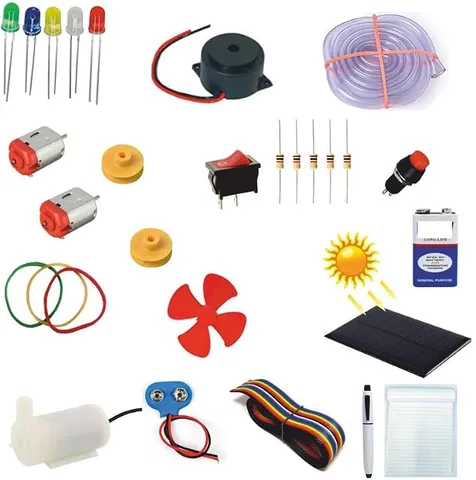
Dynamo Motor with Pulley for Electricity Generation with Pump Motor & Solar Cell
Code B0FGV3K3X9
- Paid for and delivered by Amazon. The current price and the delivery date for your PIN code are shown there.
- Sold by Gurukul Technicals Institute, Delhi.
- Need a different topic, a custom version or a school order? Ask on WhatsApp.
Biology
About this part
This is a set of parts for energy projects: the listing names a dynamo motor with pulley, a pump motor and a solar cell. Together they let a student build models that turn motion or sunlight into electricity and then use it to do work, such as a hand-cranked generator, a model windmill or a solar water pump.
How it works
The science behind it
The idea the part demonstrates, in words you can use in your report and when you explain it.
A dynamo works on electromagnetic induction, discovered by Michael Faraday. When a coil turns inside a magnetic field, the magnetic flux through it keeps changing, and this induces a voltage across the coil. Turning it faster changes the flux more quickly, so the voltage rises. A small DC motor turned by hand or by a pulley works the same way and becomes a generator. A solar cell uses the photovoltaic effect: light falling on a silicon p-n junction frees electrons and pushes them around the circuit. One silicon cell gives only about half a volt, so panels join many cells in series. The pump motor does the reverse job, turning electrical energy back into motion to lift water. The set shows energy changing form, just like the solar pumps now used by farmers in Rajasthan and Gujarat.
Using it in your projects
Using a dynamo motor, pump motor and solar cell in your projects
What this part is good for, what else you need with it and how to connect it.
Projects you can build with it 7
- A hand-cranked generator that lights an LED
- A model windmill whose paper blades turn the dynamo
- A solar water pump that waters a small potted plant
- A model hydroelectric plant with a water wheel turning the dynamo
- A solar fountain in a small tub
- An experiment comparing solar cell voltage in sunlight, cloud and shade
- A cycle-lamp model showing how a dynamo lights a bicycle lamp
What else you need 9
How to connect it 8 steps
Find the two terminals on each part, and read the listing or any label for the voltage the pump motor is meant to run on.
- Test the dynamo
Set the multimeter to DC volts, clip it across the dynamo's terminals and spin the pulley by hand. The reading should rise as you spin faster.
- Make a hand generator
Fix the big wheel on the base with its handle, loop the rubber band round the wheel and the dynamo pulley, and turn the handle. One turn of the big wheel spins the small pulley many times.
Connect a red LED, with the 100 Ω resistor in series, across the dynamo and turn the handle. If it does not glow, swap the LED's legs or turn the other way, because an LED lights only when current flows in one direction.
- Test the pump
Put it fully under water in the tub, fit the tube on its outlet and connect it to the battery holder for a few seconds to see water flow.
Measure the solar cell's voltage in direct sunlight and again in shade, and write down both readings.
Connect the solar cell to the pump in bright sunlight. If the pump does not run, compare the cell's voltage with the pump's rated voltage; it may need a bigger panel or battery power.
Keep every wire joint above the water line and wrap it in insulation tape.
Read this first
Safety first
Go through these points before you build or switch anything on. Younger students should do this with an adult.
- Put the pump fully under water before switching it on; running it dry can damage it.
- Keep all joints above the water and use only cells or the solar cell, never a mains adapter, near water.
- Do not look at the sun while placing the solar cell; angle it by watching its shadow instead.
- Keep fingers and hair away from the turning wheel and belt, and let an adult handle the hot glue gun.
Troubleshooting
If something does not work
The usual problems with this part and how to fix them. Open a problem to see the fix.
The dynamo gives almost no voltage
It is turning too slowly. Use a bigger driving wheel, tighten the rubber band so it does not slip, and check that the multimeter is set to DC volts.
The LED does not light on the hand generator
Turn the handle the other way or swap the LED's legs, since the direction of turning sets the polarity. White and blue LEDs need more voltage than red, so start with red.
The pump hums but no water comes out
Air may be trapped inside; tilt and shake it gently under water. Also check that the inlet is not blocked and the tube is not kinked or lifted too high.
The solar cell ran the pump at home but not in the classroom
Indoor light is far weaker than sunlight. Take the model to a sunny window or outdoors and tilt the cell towards the sun, or run it on cells and explain the solar part.
Exhibition day
How to present it
A running order for the exhibition table or the practical, step by step.
Draw an energy-flow chart: sunlight or motion, then electrical energy, then water being lifted.
Spin the dynamo slowly and then quickly with a load such as an LED connected, and show the output rising with speed.
Shade the solar cell with your hand to show the output falling when light is blocked.
Explain why a farm pump needs a panel of many cells and not just one.
Practice
Viva questions
Practice questions on this part, with short answers. Try each one aloud before you open the answer.
On which principle does a dynamo work?
On electromagnetic induction: a changing magnetic flux through a coil induces an EMF in it.
Can a DC motor be used as a generator?
Yes. If its shaft is turned by an outside force, the rotating coil in the magnetic field produces a voltage at its terminals.
What is the photovoltaic effect?
It is the production of a voltage and current when light falls on a junction of two types of semiconductor, as in a solar cell.
What energy changes take place in a solar water pump?
Light energy becomes electrical energy in the solar cell, and the pump motor turns that into mechanical energy that lifts the water.
Buying checklist
Before you buy
What to check before you order the part, and what to do when it arrives.
1Before you order
- Check in the listing exactly which parts are named and whether wires or batteries come with them.
- Match it to your topic Sources of energy, electricity or electromagnetic induction.
- Note the pump's rated voltage before connecting anything to it.
- Keep the parts in a labelled box so the pulley and solar cell leads do not get lost.
- Check the delivery date for your PIN code on the marketplace, and order well before the exhibition or practical.
- Practise explaining it. Judges ask what the part shows and why; knowing the science matters as much as the part. The viva questions above are a good place to start.
2When it arrives
- Test each part as soon as it arrives, using a multimeter and a battery as described above.
Next steps
Take it further
Ways to turn this part into a bigger investigation or a stronger exhibition entry.
Plot the dynamo's voltage against turning speed, counting handle turns in 10 seconds for each reading.
Compare how much water the pump lifts in one minute on battery power and on solar power.
Draw the energy chain for each project (light to electrical to kinetic, or kinetic to electrical to light) on a chart.
Audience
Who it suits
Suits Class 6 to 10 projects on renewable energy and energy conversion, and hobby builders making their own generator or pump models.
- ClassClass 1 to 9
- SubjectBiology
Free to read
Free ebooks for this topic
Free PDF ebooks from Gurukul Technicals Institute on the science, the making and the presenting of projects like this one.
- Free PDF ebook
Electronic Components Handbook
Resistors, capacitors, LEDs, diodes, transistors and more, with how to use each
- Free PDF ebook
Electricity and Magnetism Experiments
Hands-on experiments with cells, wires, bulbs and magnets