- Biology
- Ready-made model
- Class 1 to 9
Solar Room Heating Process Physics Biology Working Model Educational Science Project
Code B0BN2DPHDQ
- Paid for and delivered by Amazon. The current price and the delivery date for your PIN code are shown there.
- Sold by Gurukul Technicals Institute, Delhi.
- Need a different topic, a custom version or a school order? Ask on WhatsApp.
In this project guide
Ready-made model
About this model
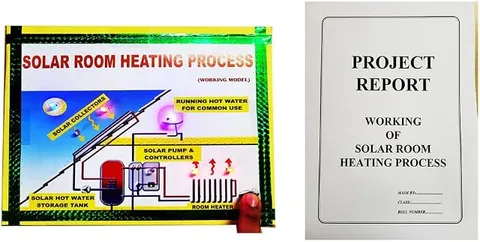
This working model shows how a room can be warmed using sunlight alone, without burning fuel or running an electric heater. It explains passive solar heating, the same idea behind greenhouses and sun-facing houses in cold regions.
How it works
The science behind it
The idea the model demonstrates, in words you can use in your report and when you explain it.
Passive solar heating depends on the greenhouse effect. Sunlight is mostly visible light, which passes easily through glass. Inside the room it is absorbed by floors, walls and furniture, especially dark ones, which warm up and then give off heat as infrared radiation of longer wavelength. Ordinary glass lets much less of this infrared escape, and the closed room stops the warm air from blowing away, so heat builds up and the temperature rises. Thick walls of brick, stone or mud act as thermal mass: they soak up heat during the day and release it slowly at night. Heat moves by conduction, convection and radiation, and a well-planned room uses all three, for example by letting warm air rise and circulate. In cold places such as Ladakh, sun-facing glazed walls help keep homes warm in winter. A car parked in the sun with its windows shut heats up for the same reason.
Make it yourself
Make a solar room heating model yourself
Build your own version from scratch, or use the steps to understand how the ready-made model is put together before you present it.
What you need 9
Step by step 8 steps
With an adult, cut a window in one long side of the first box and cover it with the clear sheet, taping every edge so no air leaks.
Line the floor and the wall opposite the window with black paper, and line the other walls and the roof with thermocol to stop heat escaping.
Put the brick or water bottle on the floor where the sunlight will fall on it.
Leave the second box plain, with no window, lining or insulation, as the control room.
Place a thermometer in each box with its probe shaded by a small card, so it measures the air and not direct sunlight.
Put both boxes in the sun with the window facing the Sun (in India, south-facing windows get the most winter sunshine) and record both temperatures every five minutes for about an hour.
Move both boxes into the shade and keep recording, to see which room holds its heat longer.
Fix the card sunshade above the window and explain how it blocks the high summer Sun but lets in the low winter Sun.
Read this first
Safety first
Go through these points before you build or switch anything on. Younger students should do this with an adult.
- Never look directly at the Sun while setting up the boxes.
- Use the cutter only with an adult, and tape over any sharp edges of the plastic sheet.
- Use digital or spirit thermometers rather than mercury ones, and handle any glass thermometer carefully.
- The inside of the box can get hot in strong sun, so put nothing inside that can melt, and never use a magnifying lens.
Troubleshooting
If something does not work
The usual problems with this model and how to fix them. Open a problem to see the fix.
The temperature hardly rises
The window may not face the Sun, the day may be hazy, or warm air is leaking out. Turn the box to face the Sun, tape every gap and check the black lining.
Both boxes show the same temperature
The thermometers may be in direct sunlight or touching the walls. Shade each probe with a small card and keep it in the middle of the box.
The plastic window fogs up
Moisture inside the box is condensing on the cooler sheet. Dry the inside and let the box air out before the test.
The model room cools quickly in the shade
It needs more insulation or thermal mass. Add thermocol and a larger brick or water bottle, which store heat and release it slowly.
Exhibition day
How to present it
A running order for the exhibition table or the practical, step by step.
Shine sunlight or a lamp on the model and trace the path of light in and heat trapped inside.
If you can, place a thermometer inside and outside the model and compare the readings.
Explain why dark surfaces and thick walls help to collect and store heat.
Link the idea to greenhouses and to saving fuel and electricity in winter.
Practice
Viva questions
Practice questions on this model, with short answers. Try each one aloud before you open the answer.
What is passive solar heating?
Heating a building directly with sunlight through its design, such as windows, walls and materials, without pumps, fans or fuel.
Why do dark surfaces get hotter in sunlight?
Dark surfaces absorb most of the light falling on them, while light-coloured surfaces reflect more of it.
How does glass help to trap heat?
Glass lets visible sunlight in but blocks much of the longer-wavelength infrared given off by warm surfaces, so heat builds up inside.
What is thermal mass?
Material such as brick or stone that absorbs heat during the day and releases it slowly, keeping a room warm at night.
Project file
Project file outline
The headings of the project file, in order. Give each heading its own section and write it in your own words.
Free ebook: Writing a Science Project FileContents
- Aim: to show how a room can be warmed by sunlight without fuel or electricity
- Why heating matters in cold regions, and the idea of passive solar design
- The greenhouse effect: visible light in, infrared trapped
- Conduction, convection and radiation in the model
- Thermal mass and insulation
- Construction of the model room and the control box
- Observation table and graph of temperature against time in sun and shade
- Advantages and limitations of passive solar heating
- Conclusion and sources used
Buying checklist
Before you buy
What to check before you order the model, and what to do when it arrives.
1Before you order
- Check that the model suits your class and the chapter on heat or sources of energy.
- Read the listing to see whether any lamp or batteries are mentioned; do not assume they are included.
- Exhibitions are usually indoors, so bring photographs and a graph of your outdoor test for visitors.
- Keep the box so the window sheet is not scratched or cracked in transport.
- Check the delivery date for your PIN code on the marketplace, and order well before the exhibition or practical.
- Practise explaining it. Judges ask what the model shows and why; knowing the science matters as much as the model. The viva questions above are a good place to start.
2When it arrives
- When it arrives, test it in real sunlight with a thermometer so you have readings to show.
Next steps
Take it further
Ways to turn this model into a bigger investigation or a stronger exhibition entry.
Build a Trombe wall, a dark wall behind the window with vents at the top and bottom, inside the box and compare the warming.
Compare boxes lined with black paper, white paper and aluminium foil, and explain the results using absorption and reflection.
Research traditional houses in cold parts of India that use thick walls and sun-facing windows, using reliable sources, and add a panel.
Audience
Who it suits
Class 6 to 9 students preparing an exhibition model on heat, renewable energy or eco-friendly buildings.
- ClassClass 1 to 9
- SubjectBiology
- TypeReady-made model
Free to read
Free ebooks for this topic
Free PDF ebooks from Gurukul Technicals Institute on the science, the making and the presenting of projects like this one.
- Free PDF ebook
Biology Models Guide
Make the heart, lungs, kidney, eye, cell and more, and explain them well
- Free PDF ebook
Physics Working Models Explained
Twenty classic models, how each works and how to make it
- Free PDF ebook
Your Science Exhibition Guide
Choose a project, build it, present it and answer the judges with confidence