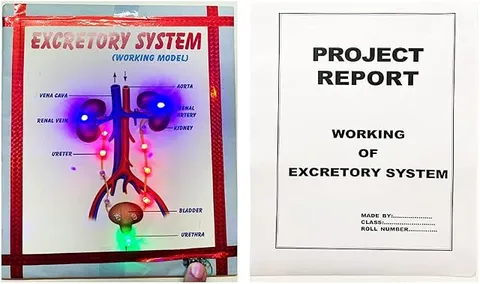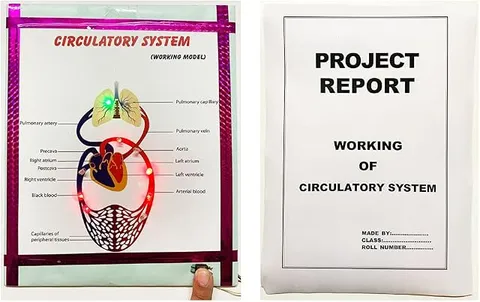
- Biology
- Ready-made model
- Class 1 to 9
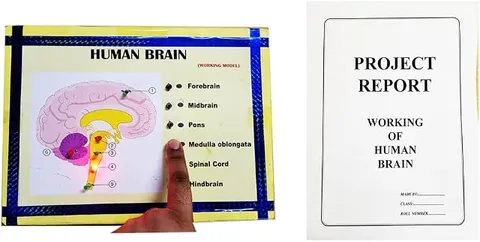
Human Brain Biology Working Model Educational Science Project
Code B0BN2G3R5T
- Paid for and delivered by Amazon. The current price and the delivery date for your PIN code are shown there.
- Sold by Gurukul Technicals Institute, Delhi.
- Need a different topic, a custom version or a school order? Ask on WhatsApp.
In this project guide
Ready-made model
About this model
This biology working model shows the human brain and its main parts, and explains how each part controls different activities of the body. It is useful for explaining the nervous system, from thinking and memory to balance and heartbeat.
How it works
The science behind it
The idea the model demonstrates, in words you can use in your report and when you explain it.
The brain is the main control centre of the nervous system. It is protected by the skull, by three membranes called meninges, and by cerebrospinal fluid, which acts as a shock absorber. It has three main regions. The forebrain includes the cerebrum, the largest part, which handles thinking, memory, learning, speech, the senses and voluntary actions; it is split into left and right hemispheres, and the left hemisphere controls the right side of the body. The hypothalamus, also in the forebrain, controls body temperature, hunger and thirst. The midbrain connects the forebrain and the hindbrain. The hindbrain includes the cerebellum, which keeps balance and coordinates movement, and the medulla oblongata, which controls involuntary actions such as heartbeat, breathing and blood pressure. Neurons carry messages as electrical impulses. Balancing on a bicycle uses your cerebellum, and wearing a helmet on a two-wheeler protects the whole brain.
Make it yourself
Make a human brain model with light-up regions yourself
Build your own version from scratch, or use the steps to understand how the ready-made model is put together before you present it.
What you need 10
Step by step 8 steps
Cover the hemisphere with a thin layer of pink or grey clay and press in winding grooves with a toothpick to show the folds that give the cerebrum its large surface area.
Mark the four lobes with thin lines of clay or paint: frontal at the front, parietal at the top, temporal at the side above the ear, and occipital at the back.
Shape the cerebellum as a smaller ridged lump under the back of the cerebrum, and the brainstem (midbrain, pons and medulla) as a short stalk below the middle, joined to the spinal cord tube.
Press a small bead of a different colour under the centre of the cerebrum for the hypothalamus, with the pea-sized pituitary gland hanging just below it.
Make a hole for an LED in six regions: frontal lobe, occipital lobe, temporal lobe, cerebellum, medulla and hypothalamus, and push the LEDs in from behind so only their domes show.
Wire each LED as its own circuit: battery positive through the on/off switch to one side of every push button; the other side of each button through a 1 kΩ resistor to that LED's long leg; all the short legs back to battery negative.
Fix the six buttons in a row in front of the model under the function chart, so pressing 'balance' lights the cerebellum and pressing 'heartbeat and breathing' lights the medulla.
Label every part, add a card showing the skull, meninges and cerebrospinal fluid that protect the brain, and test each button before covering the wiring.
Read this first
Safety first
Go through these points before you build or switch anything on. Younger students should do this with an adult.
- Use the glue gun and any knife for the thermocol only with an adult, and keep hot glue off your fingers.
- If you shape the thermocol with a hot-wire cutter, do it with an adult in a well-ventilated place, as melting foam gives off fumes.
- Keep a resistor in series with every LED; without it the 9 V battery burns the LED out.
- Disconnect the battery after the exhibition so a stuck button cannot drain it.
Troubleshooting
If something does not work
The usual problems with this model and how to fix them. Open a problem to see the fix.
One LED does not light when its button is pressed
The LED may be in backwards (its long leg must face the resistor and button), or a wire has come loose at the button. Hold a spare LED and resistor across the same wires to find which part is at fault.
Two regions light together
Wires from two buttons are touching, or two LEDs share a bare joint. Separate the wires and tape each joint.
The clay cracks as it dries
Air-dry clay shrinks as it dries. Apply it in thin layers, smooth cracks with a wet finger, and let it dry slowly away from direct sun or a fan.
Visitors ask why the left side of the brain controls the right hand
Most nerve pathways cross over in the brainstem, so each hemisphere controls the opposite side of the body. A small card with a diagram of the crossing answers this well.
Exhibition day
How to present it
A running order for the exhibition table or the practical, step by step.
Point to each part of the brain and give one activity it controls, using simple examples like riding a cycle or feeling hungry.
Explain how the brain is protected and why helmets matter on two-wheelers.
Show the link between the brain, spinal cord and nerves with a simple flow chart.
Ask a visitor to touch their nose with their eyes closed to show the cerebellum at work.
Practice
Viva questions
Practice questions on this model, with short answers. Try each one aloud before you open the answer.
Which part of the brain maintains balance?
The cerebellum, in the hindbrain, maintains balance and posture and coordinates movements.
Which part of the brain controls heartbeat and breathing?
The medulla oblongata controls involuntary actions such as heartbeat, breathing and blood pressure.
How is the brain protected?
By the bony skull, three membranes called meninges, and cerebrospinal fluid that absorbs shocks.
Which is the largest part of the human brain?
The cerebrum, which controls thinking, memory and voluntary actions.
Project file
Project file outline
The headings of the project file, in order. Give each heading its own section and write it in your own words.
Free ebook: Writing a Science Project FileContents
- Aim: to show the main parts of the human brain and the activities each part controls
- Introduction: the brain as the control centre of the nervous system
- Protection of the brain: skull, meninges and cerebrospinal fluid
- Forebrain, midbrain and hindbrain: their parts and functions
- Construction of the clay model and the light-up function panel
- Circuit diagram of the push-button LED panel
- Observations: table of buttons, regions lit and functions
- Voluntary and involuntary actions, with examples
- Conclusion, caring for the brain (helmets, sleep) and bibliography
Buying checklist
Before you buy
What to check before you order the model, and what to do when it arrives.
1Before you order
- Check which parts of the brain your syllabus names (control and coordination in Class 10, or the nervous system in lower classes) so the model's detail matches.
- Compare the labelled parts in the listing photos with your textbook diagram, so you can add any missing labels yourself.
- Practise naming each part and its function aloud, since examiners usually point to a region and ask what it controls.
- Keep the box and some padding to carry the model without breaking small parts like the brainstem.
- Check the delivery date for your PIN code on the marketplace, and order well before the exhibition or practical.
2When it arrives
- When it arrives, check that labels are firmly fixed and any working part functions, and check again a few days before the exhibition.
Next steps
Take it further
Ways to turn this model into a bigger investigation or a stronger exhibition entry.
Add the functions of each lobe of the cerebrum in more detail, including the speech area in the frontal lobe.
Show a reflex arc beside the brain and explain why a reflex action does not wait for the brain to decide.
Survey classmates on hours of sleep and screen time and link your results to memory and concentration in the report.
Audience
Who it suits
Suits Class 8 to 10 biology exhibitions and lessons on control and coordination.
- ClassClass 1 to 9
- SubjectBiology
- TypeReady-made model
Free to read
Free ebooks for this topic
Free PDF ebooks from Gurukul Technicals Institute on the science, the making and the presenting of projects like this one.
- Free PDF ebook
Biology Models Guide
Make the heart, lungs, kidney, eye, cell and more, and explain them well
- Free PDF ebook
Your Science Exhibition Guide
Choose a project, build it, present it and answer the judges with confidence
- Free PDF ebook
Writing a Science Project File
How to write the report, from the cover page to the bibliography
- Free PDF ebook
Viva Questions for Science Projects
How to answer examiner questions, with sample questions for popular projects