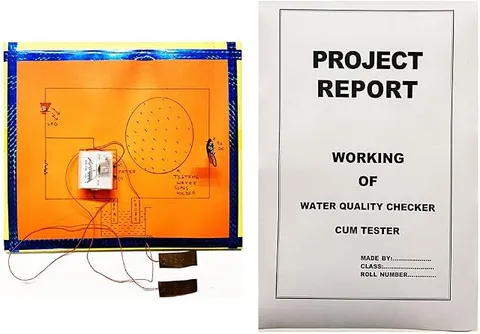
- Chemistry
- Ready-made model
- Class 1 to 9
- Printed report included
Water Quality Checker to Check Salt Impurities in Water Readymade Science Working Project & Model in Chemistry (with Printed Report)
Code B099QYQ7FY
- Paid for and delivered by Amazon. The current price and the delivery date for your PIN code are shown there.
- Sold by Gurukul Technicals Institute, Delhi.
- Need a different topic, a custom version or a school order? Ask on WhatsApp.
In this project guide
Ready-made model
About this model
This chemistry working model checks water for dissolved salt impurities by testing how well the water conducts electricity. The listing says it comes with a printed report, and the model lets students compare samples such as tap water, salty water and purified water.
How it works
The science behind it
The idea the model demonstrates, in words you can use in your report and when you explain it.
Pure water is a very poor conductor of electricity because it contains very few ions. When salts such as sodium chloride dissolve, they split into positive and negative ions (Na⁺ and Cl⁻), and these ions carry current between two electrodes dipped in the water. So the more salt is dissolved, the higher the conductivity, and a simple circuit with an indicator responds more strongly. Total dissolved solids (TDS) is the usual measure of dissolved salts, given in milligrams per litre. India's drinking water standard, IS 10500, sets an acceptable TDS limit of 500 mg/L, and many homes in Delhi use RO purifiers because local groundwater can be well above this. A conductivity test has limits: it does not detect bacteria, viruses or most pesticides, which add few or no ions, so clear water that gives a low reading is not automatically safe to drink.
Make it yourself
Make a water quality checker for dissolved salts yourself
Build your own version from scratch, or use the steps to understand how the ready-made model is put together before you present it.
What you need 10
Step by step 8 steps
Push the two screws through the plastic strip about 1 cm apart, so their spacing stays the same for every test.
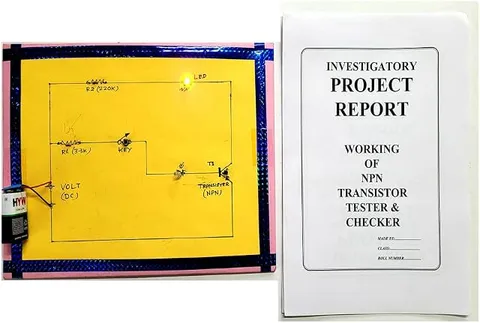
Connect the battery, the switch, the 1 kΩ resistor, the LED and the two screws in one series loop, with the LED's long leg towards the battery positive.
Add the multimeter into the loop on its mA range if you want numbers as well as a glow.
Fill the cups with equal amounts of RO or distilled water, tap water, and water with one, two and four spoons of salt stirred in, and label each cup.
Dip the screws to the same depth in the first cup, press the switch for about five seconds, and note the LED's brightness and the current.
Rinse the screws in RO or distilled water and dry them before moving to the next sample.
Record every result in a table and arrange the cups from the least to the most conducting.
Plot a graph of current against the number of spoons of salt.
Read this first
Safety first
Go through these points before you build or switch anything on. Younger students should do this with an adult.
- Do not drink or taste any of the samples, and wash your hands after the experiment.
- Use the 9 V battery only; never use a mains adapter or socket near water.
- Keep each test short: current through salty water slowly corrodes the screws and gives off a little gas, so work in an airy room and do not leave the circuit on.
- Wipe up spills at once and keep the battery and switch dry.
Troubleshooting
If something does not work
The usual problems with this model and how to fix them. Open a problem to see the fix.
The LED glows even in RO water
The screws may be touching, or a film of salty water on the holder is joining them. Clean and dry the holder and check the gap.
Tap water does not make the LED glow
Tap water conducts only weakly, so the glow may be too faint to see. Use the multimeter reading, or add a transistor to amplify the current.
The current keeps changing while I watch
Bubbles and corrosion on the screws change the reading. Take every reading after the same time, for example five seconds, and clean the screws with sandpaper between sessions.
All the salty samples look equally bright
The LED is close to full brightness. Compare the multimeter readings instead, or move the screws farther apart.
Exhibition day
How to present it
A running order for the exhibition table or the practical, step by step.
Test three samples, such as distilled water, tap water and salty water, and arrange them by their readings.
Rinse and wipe the electrodes between samples so one test does not affect the next.
Explain honestly what the device cannot detect, such as germs.
Show the IS 10500 TDS limit on a chart beside your results.
Practice
Viva questions
Practice questions on this model, with short answers. Try each one aloud before you open the answer.
Why does salty water conduct electricity while distilled water hardly does?
Dissolved salt splits into ions that carry current, while distilled water has almost no ions.
What is TDS?
Total dissolved solids, the amount of salts and minerals dissolved in water, measured in milligrams per litre.
Does a low reading mean the water is safe to drink?
No. The test only senses dissolved ions; germs and many other contaminants can still be present.
What happens at the electrodes if current flows through salt water for a long time?
Electrolysis takes place, releasing gases and slowly corroding the electrodes, so readings should be taken briefly.
Project file
Project file outline
The headings of the project file, in order. Give each heading its own section and write it in your own words.
The listing includes a printed project report: use this outline to check that your own file covers every part.
Free ebook: Writing a Science Project FileContents
- Aim: to compare the amount of dissolved salts in water samples by testing how well they conduct electricity
- Materials
- Theory: why dissolved salts let water conduct
- Circuit diagram
- Procedure
- Observation table: sample, LED brightness and current
- Graph of current against the amount of salt added
- Conclusion
- Limitations: this test does not detect germs or impurities that do not form ions
Buying checklist
Before you buy
What to check before you order the model.
1Check these first
- Check that the model fits your class topic, such as water or acids, bases and salts, and how your teacher wants results shown.
- Check in the listing what power source the model needs and whether a battery is included.
- If a printed report comes with it, add results from your own samples, such as water from home and from school, so the file is your own work.
- Test the model a few days before the exhibition, and bring labelled bottles of your samples on the day.
- Keep the box, and dry the electrodes before packing so they do not rust.
- Check the delivery date for your PIN code on the marketplace, and order well before the exhibition or practical.
- Practise explaining it. Judges ask what the model shows and why; knowing the science matters as much as the model. The viva questions above are a good place to start.
Next steps
Take it further
Ways to turn this model into a bigger investigation or a stronger exhibition entry.
Make solutions with known amounts of salt per litre to calibrate your checker, then estimate the salt in an unknown sample.
Compare your ranking of samples with readings from a TDS meter.
Test a sugar solution too: sugar does not form ions, so it hardly conducts, which shows that only ionic impurities are detected.
Audience
Who it suits
Suits Class 8 to 12 chemistry and environmental science exhibitions and investigatory projects on water quality.
- ClassClass 1 to 9
- SubjectChemistry
- TypeReady-made model
- Project reportPrinted report included
Free to read
Free ebooks for this topic
Free PDF ebooks from Gurukul Technicals Institute on the science, the making and the presenting of projects like this one.
- Free PDF ebook
Safe Chemistry Projects for School
Experiments and models with kitchen materials and proper safety
- Free PDF ebook
Your Science Exhibition Guide
Choose a project, build it, present it and answer the judges with confidence
- Free PDF ebook
Writing a Science Project File
How to write the report, from the cover page to the bibliography
- Free PDF ebook
Viva Questions for Science Projects
How to answer examiner questions, with sample questions for popular projects