- Physics
- Ready-made model
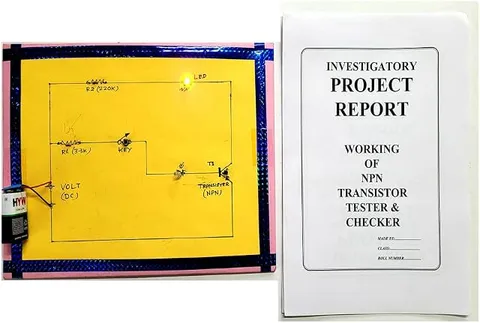
NPN Transistor Checker and Tester Physics Working Model Educational Science Project
Code B0C3H5RL7V
- Paid for and delivered by Amazon. The current price and the delivery date for your PIN code are shown there.
- Sold by Gurukul Technicals Institute, Delhi.
- Need a different topic, a custom version or a school order? Ask on WhatsApp.
In this project guide
Ready-made model
About this model
This NPN transistor checker is a working model that tests whether an NPN transistor is working properly. It is a practical way to learn how an NPN transistor conducts and to spot common faults such as a shorted or open junction.
How it works
The science behind it
The idea the model demonstrates, in words you can use in your report and when you explain it.
An NPN transistor has a thin, lightly doped p-type base between an n-type emitter and an n-type collector, and electrons are its main charge carriers. Electrically it behaves like two diodes sharing the base. It conducts when the base is made about 0.7 V more positive than the emitter (for silicon), which forward biases the emitter-base junction while the collector-base junction stays reverse biased. Electrons then flow from emitter to collector, so conventional current enters at the collector and leaves at the emitter. The current gain β = IC / IB is often 100 or more, so a tiny base current controls a large collector current. A checker applies a base current and looks for collector current, usually through an LED. A good transistor lights it only when the base is driven, a shorted one lights it all the time, and an open one never does. In the symbol, the emitter arrow points outwards.
Make it yourself
Make an NPN transistor tester yourself
Build your own version from scratch, or use the steps to understand how the ready-made model is put together before you present it.
What you need 8
Step by step 8 steps
Connect the E clip to the negative rail, because an NPN's emitter must be the most negative terminal.
Connect the C clip through the LED and the 330 Ω resistor to the positive rail, with the LED's longer leg towards positive.
Connect the B clip through the 10 kΩ resistor and the push button to the positive rail, so pressing the button lifts the base about 0.7 V above the emitter.
Check the transistor's pin order in its datasheet, clip it in and switch on; before you press anything, the LED should stay dark.
- Press the button
A good NPN conducts and the LED lights; release it and the LED goes out.
- Read the results
An LED that lights before pressing means a shorted collector-emitter path, and one that never lights means an open junction or a wrong pin order.
Check with the multimeter's diode range: with the red probe on the base, the emitter and collector each read about 0.6 to 0.7 V; reversed, and between collector and emitter either way, there should be no reading.
To estimate the current gain, replace the 10 kΩ base resistor with the 1 MΩ one, measure the collector current with the meter in series, work out the base current as (supply voltage − 0.7 V) ÷ 1 MΩ, and divide the first by the second.
Read this first
Safety first
Go through these points before you build or switch anything on. Younger students should do this with an adult.
- Use only the small cell pack; never test transistors on an adapter or the mains.
- Keep the base and LED resistors in place, so even a shorted transistor draws only a small current.
- Switch off before inserting or removing a transistor, and do not bend its legs back and forth.
- When measuring current, put the multimeter in series on its mA range, never straight across the cells.
- Solder only with an adult and rest the hot iron in its stand.
Troubleshooting
If something does not work
The usual problems with this model and how to fix them. Open a problem to see the fix.
The LED never lights, even with a new transistor
Check that its legs are in the right E, B and C positions, since pin orders differ between types, and that the LED is the right way round.
The LED lights before the button is pressed
That transistor is probably shorted between collector and emitter. Confirm it with the multimeter, and recheck the tester with a known good one.
A PNP transistor does nothing in this tester
That is expected, because a PNP needs the opposite polarity. Use a PNP tester, or reverse both the supply and the LED.
The gain I worked out seems far too high or too low
Check the base resistor's value and the meter's range. Gain varies a lot between transistors, even of the same type, so a wide spread is normal.
Exhibition day
How to present it
A running order for the exhibition table or the practical, step by step.
Show the NPN symbol and explain why the emitter arrow points outwards.
Test a good transistor and a faulty one side by side to show the difference.
Explain current gain with a simple number example, such as 0.1 mA of base current controlling 10 mA.
Keep the E, B and C pin diagram of the transistor you test on display.
Practice
Viva questions
Practice questions on this model, with short answers. Try each one aloud before you open the answer.
What are the majority charge carriers in an NPN transistor?
Electrons.
What is current gain β?
The ratio of collector current to base current, β = IC / IB.
Why is the base made thin and lightly doped?
So that most electrons from the emitter cross into the collector instead of recombining in the base, which gives a large current gain.
How can a multimeter check an NPN transistor?
In diode mode, with the red probe on the base, both the base-emitter and base-collector junctions should conduct, and both should block when the probes are reversed.
Project file
Project file outline
The headings of the project file, in order. Give each heading its own section and write it in your own words.
Free ebook: Writing a Science Project FileContents
- Aim: to make a tester that checks whether an NPN transistor is good, and to estimate its current gain
- Structure of an NPN transistor and how it behaves like two diodes
- Biasing an NPN transistor: base made positive, emitter to negative
- Circuit diagram of the tester and how it works
- Construction
- Observation table: transistors tested and the verdict for each
- Multimeter diode-test readings and the current-gain measurement
- Shorted and open junctions, and what causes them
- Conclusion and precautions
Buying checklist
Before you buy
What to check before you order the model, and what to do when it arrives.
1Before you order
- Check that a transistor tester suits your class and the chapter on semiconductor devices.
- Read the listing for the battery needed and whether any transistors are mentioned; do not assume test transistors are included.
- Buy a few common NPN transistors so you can show both good and faulty results.
- Keep the box so the socket or clips are not damaged.
- Check the delivery date for your PIN code on the marketplace, and order well before the exhibition or practical.
2When it arrives
- When it arrives, test a known good transistor first, then practise explaining the faults it can find.
Next steps
Take it further
Ways to turn this model into a bigger investigation or a stronger exhibition entry.
Measure the current gain of several transistors of the same type and show how much it varies.
Plot collector current against base current for one transistor using several base resistors, and find β from the slope.
Build a combined tester with a switch for NPN and PNP, and add a chart of common transistor pin orders beside it.
Audience
Who it suits
Class 11 and 12 physics students, ITI and diploma electronics learners, and hobbyists who test transistors before using them.
- SubjectPhysics
- TypeReady-made model
Free to read
Free ebooks for this topic
Free PDF ebooks from Gurukul Technicals Institute on the science, the making and the presenting of projects like this one.
- Free PDF ebook
Physics Working Models Explained
Twenty classic models, how each works and how to make it
- Free PDF ebook
Your Science Exhibition Guide
Choose a project, build it, present it and answer the judges with confidence
- Free PDF ebook
Writing a Science Project File
How to write the report, from the cover page to the bibliography
- Free PDF ebook
Viva Questions for Science Projects
How to answer examiner questions, with sample questions for popular projects