- Chemistry
- Ready-made model
- Class 1 to 9
- Printed report included
Atomic Structure Readymade Working Chemistry Project & Model with Multicolor Running Lights(with Printed Report)
Code B099R1KMT8
- Paid for and delivered by Amazon. The current price and the delivery date for your PIN code are shown there.
- Sold by Gurukul Technicals Institute, Delhi.
- Need a different topic, a custom version or a school order? Ask on WhatsApp.
In this project guide
Ready-made model
About this model
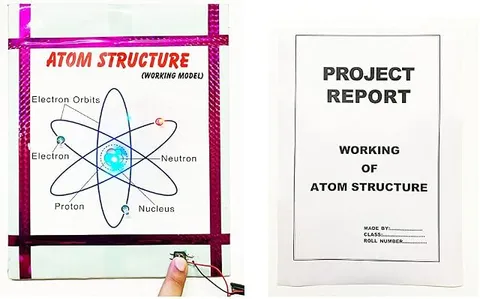
A readymade chemistry working model of atomic structure, with the nucleus at the centre and electrons arranged in shells around it. The listing says it has multicolour running lights and a printed report, and running lights are a lively way to suggest electrons moving in their shells.
How it works
The science behind it
The idea the model demonstrates, in words you can use in your report and when you explain it.
An atom has a tiny, dense nucleus containing positively charged protons and neutral neutrons, surrounded by negatively charged electrons. In a neutral atom the number of electrons equals the number of protons, which is the atomic number, Z. The mass number, A, is the total of protons and neutrons. In the Bohr model, electrons move in fixed orbits or shells named K, L, M and N, each with a definite energy. The maximum number of electrons a shell can hold is 2n², so K holds 2, L holds 8 and M holds 18, although the outermost shell holds no more than 8. Sodium (Z = 11), for example, has the arrangement 2, 8, 1, and its single outer electron makes it very reactive. When electrons drop from a higher shell to a lower one, they give out light of a definite colour, which is why the old sodium vapour street lamps on Indian roads glowed yellow.
Make it yourself
Make an atomic structure model with running lights yourself
Build your own version from scratch, or use the steps to understand how the ready-made model is put together before you present it.
What you need 11
Step by step 9 steps
- Choose neon as your element
Atomic number 10 and mass number 20, so it has 10 protons, 10 neutrons and 10 electrons arranged 2, 8. Its 10 electrons match the counter's 10 outputs.
Draw the nucleus position at the centre of the board and two circles around it for the K and L shells.
Make the nucleus by gluing the 10 red beads (protons) and 10 blue beads (neutrons) onto the thermocol ball, and fix it at the centre.
Fix the shell rings, then push 2 LEDs through the K shell and 8 through the L shell, evenly spaced, and mark each long leg on the back.
- Build the timer
555 pins 4 and 8 to positive, pin 1 to negative, 1 kΩ from pin 8 to pin 7, 47 kΩ from pin 7 to pin 6, pins 2 and 6 joined, and the 10 µF capacitor from pin 6 to negative. Its output, pin 3, goes to the counter's clock input, pin 14.
- Connect the counter
Pin 16 to positive, pins 8, 13 and 15 to negative. Test the whole circuit on a breadboard before soldering it.
Wire the counter outputs Q0 to Q9 to the LED long legs in order, round the K shell first and then round the L shell. Join all the short legs and take them to negative through the single 470 Ω resistor.
- Switch on
The light should travel round the K shell and then round the L shell. A bigger capacitor makes it slower, a smaller one faster.
- Add labels
Element name, Z = 10, A = 20, electron configuration 2, 8, the shell names, and a key for protons, neutrons and electrons.
Read this first
Safety first
Go through these points before you build or switch anything on. Younger students should do this with an adult.
- Solder only with an adult present, and keep the hot iron in its stand between joints.
- Fit each IC with its notch matching the socket; if a chip gets hot, switch off at once and check it is the right way round.
- Cut foam board with a cutter only with an adult nearby, on a cutting mat.
- Switch off and unclip the battery when the model is not being shown.
Troubleshooting
If something does not work
The usual problems with this model and how to fix them. Open a problem to see the fix.
No LED lights at all
Check the battery, then the timer: if pin 3 is not switching, look at the capacitor and the two timing resistors. Also make sure the counter's pins 13 and 15 are connected to negative, or it will not count.
Several LEDs glow faintly or light at random
The counter's reset (pin 15) or clock-enable (pin 13) pin is floating, or the clock wire is loose. Connect both pins firmly to negative.
One electron never lights
That LED is probably reversed or has a broken joint. Also check it is wired to the right output pin, because the counter's outputs are not in pin-number order.
The lights move too fast for visitors to follow
Use a bigger timing capacitor, for example 22 µF, or a larger resistor between pins 7 and 6.
Exhibition day
How to present it
A running order for the exhibition table or the practical, step by step.
Identify which element your model represents by counting its electrons, and write its electronic configuration on a card.
Explain the 2n² rule with a quick table for the first three shells.
Mention the limits of the Bohr model: it explains hydrogen well but was later improved by the quantum model.
Prepare from the printed report the listing mentions, and add your own diagram of Rutherford's gold foil experiment.
Practice
Viva questions
Practice questions on this model, with short answers. Try each one aloud before you open the answer.
What is the atomic number of an element?
It is the number of protons in the nucleus of its atom, which also equals the number of electrons in a neutral atom.
What is the maximum number of electrons in the L shell?
Eight, from the formula 2n² with n = 2.
What is the electronic configuration of sodium?
Sodium has 11 electrons, arranged as 2, 8, 1.
What did Rutherford's gold foil experiment show?
Most alpha particles passed straight through, showing the atom is mostly empty space, while a few bounced back, showing a tiny, dense, positive nucleus.
Project file
Project file outline
The headings of the project file, in order. Give each heading its own section and write it in your own words.
The listing includes a printed project report: use this outline to check that your own file covers every part.
Free ebook: Writing a Science Project FileContents
- Aim: to show the structure of an atom, its nucleus and electron shells, using neon as the example
- Introduction: discovery of the electron, proton and neutron by Thomson, Rutherford and Chadwick
- Bohr's model and the K, L, M and N shells
- Atomic number, mass number and the 2n² rule for filling shells
- Electron configurations of the first 20 elements (table)
- Construction of the model and the running-light circuit with a 555 timer and a decade counter
- Limitations of the Bohr model
- Conclusion and bibliography
Buying checklist
Before you buy
What to check before you order the model, and what to do when it arrives.
1Before you order
- Check that the structure of the atom is in your class syllabus and that a working model is what your teacher wants.
- The listing mentions a printed report; read it through and add your own observations so the file is in your words.
- Find out which element the model shows, so you can explain its atomic number, mass number and configuration.
- Keep the box and some packing material to carry the model safely.
- Check the delivery date for your PIN code on the marketplace, and order well before the exhibition or practical.
2When it arrives
- Test the running lights and battery as soon as it arrives and again a few days before the exhibition.
Next steps
Take it further
Ways to turn this model into a bigger investigation or a stronger exhibition entry.
Add cards on isotopes, such as hydrogen, deuterium and tritium, or carbon-12 and carbon-14.
Show how valence electrons decide valency, for example sodium losing one electron and chlorine gaining one to form sodium chloride.
Make the electron shells removable so the model can show different elements in a quiz.
Audience
Who it suits
Suits Class 8 to 10 chemistry exhibitions and revision of atomic structure for Class 11.
- ClassClass 1 to 9
- SubjectChemistry
- TypeReady-made model
- Project reportPrinted report included
Free to read
Free ebooks for this topic
Free PDF ebooks from Gurukul Technicals Institute on the science, the making and the presenting of projects like this one.
- Free PDF ebook
Safe Chemistry Projects for School
Experiments and models with kitchen materials and proper safety
- Free PDF ebook
Your Science Exhibition Guide
Choose a project, build it, present it and answer the judges with confidence
- Free PDF ebook
Writing a Science Project File
How to write the report, from the cover page to the bibliography
- Free PDF ebook
Viva Questions for Science Projects
How to answer examiner questions, with sample questions for popular projects