- Maths
- Ready-made model
- Class 1 to 9
- Printed report included
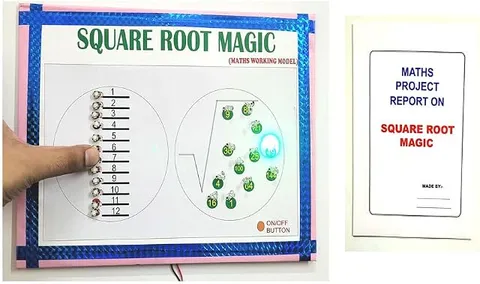
Square Root Magic Mathematics Educational Maths Working Project Model for Class 8 9 with Report
Code B0DK22C7P7
- Paid for and delivered by Amazon. The current price and the delivery date for your PIN code are shown there.
- Sold by Gurukul Technicals Institute, Delhi.
- Need a different topic, a custom version or a school order? Ask on WhatsApp.
In this project guide
Ready-made model
About this model
This maths model is about square roots. A good trick to present with it is subtracting odd numbers one by one, which finds the square root of any perfect square and feels like magic to visitors. The listing says it is meant for Class 8 and 9 and includes a report.
What the listing says
- Sqaure Root Magic Mathematics Educational Maths Working Project Model for Class 8 9 with Report
How it works
The science behind it
The idea the model demonstrates, in words you can use in your report and when you explain it.
The square root of a number is the value that, multiplied by itself, gives that number: √49 = 7 because 7 × 7 = 49. One neat piece of "magic" comes from a pattern: the sum of the first n odd numbers is n². So 1 = 1², 1 + 3 = 2², 1 + 3 + 5 = 3², and so on. To find √36, keep subtracting 1, 3, 5, 7, 9 and 11 from 36; you reach zero after six steps, so √36 = 6. Larger squares need prime factorisation, pairing equal factors (196 = 2 × 2 × 7 × 7, so √196 = 2 × 7 = 14), or the long-division method. A perfect square never ends in 2, 3, 7 or 8. Some square roots, such as √2 ≈ 1.414, are irrational: their decimal never ends or repeats. A square plot of land of 900 square feet has sides of √900 = 30 feet.
Make it yourself
Make a square root magic model yourself
Build your own version from scratch, or use the steps to understand how the ready-made model is put together before you present it.
What you need 7
Step by step 8 steps
Build a coloured square from the paper squares, adding one L-shaped layer at a time in a new colour: 1 square, then 3 more, then 5 more and so on up to a 7 × 7 square. Each finished square shows that 1 + 3 + 5 + … = n².
Write each layer's odd number on it and the running total (1, 4, 9, 16, 25, 36, 49) along the side.
Make the subtraction trick strip for 81: write 81, then flaps that each subtract the next odd number (1, 3, 5, … 17). After nine flaps you reach zero, so √81 = 9.
- Make the answer wheel
On the larger disc, write the perfect squares from 1 to 400 in a ring about 6 cm from the centre, with each root just inside its square in a ring about 4 cm from the centre, spacing the 20 entries evenly with the protractor. Cut two windows in the smaller disc, one above the other over the two rings, and pin it on top so turning it shows a square and its root together.
- Make a prime factor panel
324 = 2 × 2 × 3 × 3 × 3 × 3; pair the equal factors and take one from each pair, so √324 = 2 × 3 × 3 = 18.
Make a long-division panel showing √529 step by step: pair the digits as 5 | 29, take 2, carry the remainder down, and find 43 × 3 = 129, giving 23.
Add a 'last digit clue' card: if a perfect square ends in 6, its square root ends in 4 or 6; if it ends in 1, the root ends in 1 or 9.
Arrange all the panels on the board with a heading, and practise the subtraction trick on a number a visitor chooses.
Read this first
Safety first
Go through these points before you build or switch anything on. Younger students should do this with an adult.
- Handle the compass point and scissors carefully, and use a cutter only with an adult.
- Cover the back of the paper fastener on the answer wheel with tape.
- Keep loose paper squares in an envelope so they are not lost or swallowed by small children.
Troubleshooting
If something does not work
The usual problems with this model and how to fix them. Open a problem to see the fix.
The coloured layers do not make a neat square
The paper squares are not all the same size. Cut them from graph paper along the printed lines so every one matches.
The answer wheel shows a square next to the wrong root
The entries are not spaced evenly. Divide 360° by the number of entries and mark each position with the protractor before writing.
The subtraction trick does not reach zero
The number is not a perfect square. Use it as a teaching moment: the leftover shows the root lies between two whole numbers.
A visitor asks for the square root of 2
√2 is irrational, about 1.414, and its decimals never end or repeat. Show the first few digits by long division.
Exhibition day
How to present it
A running order for the exhibition table or the practical, step by step.
Ask a visitor to pick a perfect square and find its root together by subtracting odd numbers.
Arrange dots or small squares in L-shaped layers to show why adding odd numbers builds bigger squares.
Use the unit-digit rule to show at once that a number such as 2,738 cannot be a perfect square.
Keep one long-division example ready for numbers too big for the subtraction trick.
Practice
Viva questions
Practice questions on this model, with short answers. Try each one aloud before you open the answer.
Why is the sum of the first n odd numbers equal to n²?
Each new odd number adds an L-shaped layer that turns an n × n square into an (n + 1) × (n + 1) square.
Can a perfect square end in 7?
No. Squares of whole numbers end only in 0, 1, 4, 5, 6 or 9.
What is √2 and why is it special?
√2 is about 1.414; it is irrational because it cannot be written as a fraction p/q and its decimal never ends or repeats.
How many digits does the square root of a 6-digit perfect square have?
Three, because a perfect square with an even number of digits n has a square root with n/2 digits.
Project file
Project file outline
The headings of the project file, in order. Give each heading its own section and write it in your own words.
The listing includes a printed project report: use this outline to check that your own file covers every part.
Free ebook: Writing a Science Project FileContents
- Aim: to find square roots of perfect squares by repeated subtraction of odd numbers and by other methods
- Introduction: squares, perfect squares and square roots
- The pattern: the sum of the first n odd numbers is n², shown with coloured layers
- Method 1: repeated subtraction of odd numbers
- Method 2: prime factorisation
- Method 3: long division
- Properties of perfect squares and their last digits
- Construction of the model
- Conclusion and references
Buying checklist
Before you buy
What to check before you order the model, and what to do when it arrives.
1Before you order
- Check that square roots are in your class syllabus; the listing says it is meant for Classes 8 and 9.
- Read the listing to see what is mentioned with the model, such as the report, and plan your own observation pages anyway.
- Practise the subtraction trick on several numbers until you can do it quickly in front of visitors.
- Keep the box to carry the model safely.
- Check the delivery date for your PIN code on the marketplace, and order well before the exhibition or practical.
2When it arrives
- Check the model for loose parts as soon as it arrives.
Next steps
Take it further
Ways to turn this model into a bigger investigation or a stronger exhibition entry.
Find square roots of non-perfect squares and decimals to two decimal places by long division.
Draw the square root spiral to locate √2, √3, √4 and so on, on a number line.
Add Pythagorean triplets such as 3, 4, 5 and 5, 12, 13, and show how they link squares to right-angled triangles.
Audience
Who it suits
Suits Class 8 and 9 maths exhibitions and lessons on squares, square roots and irrational numbers.
- ClassClass 1 to 9
- SubjectMaths
- TypeReady-made model
- Project reportPrinted report included
Free to read
Free ebooks for this topic
Free PDF ebooks from Gurukul Technicals Institute on the science, the making and the presenting of projects like this one.
- Free PDF ebook
Maths Working Models and Activities
Make maths visible: models for number, geometry, algebra and data
- Free PDF ebook
Your Science Exhibition Guide
Choose a project, build it, present it and answer the judges with confidence
- Free PDF ebook
Writing a Science Project File
How to write the report, from the cover page to the bibliography
- Free PDF ebook
Viva Questions for Science Projects
How to answer examiner questions, with sample questions for popular projects